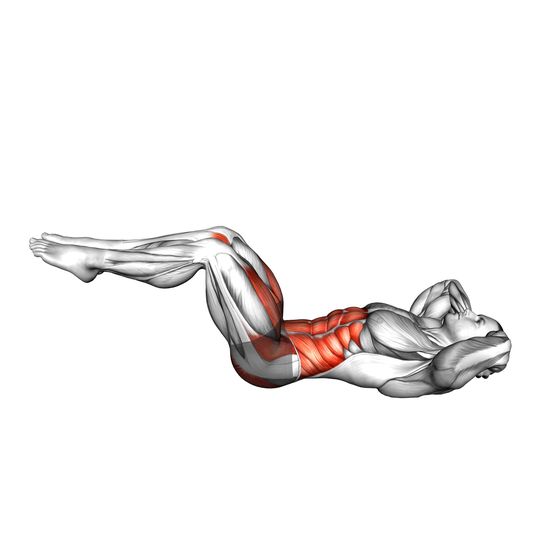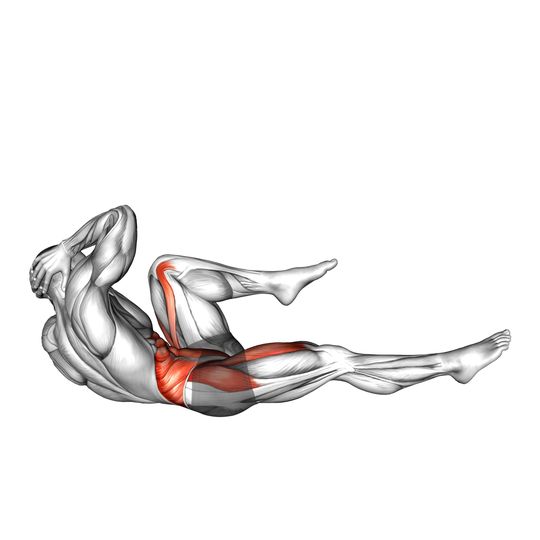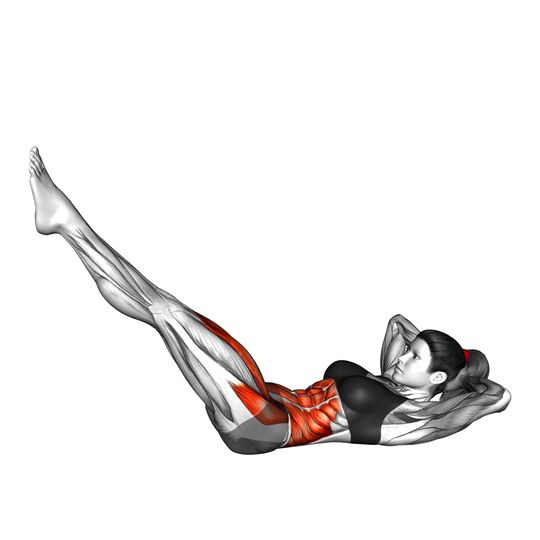


A crunch is a short supine spinal-flexion movement that raises the shoulders off the floor to contract the abdominals (rectus abdominis). It uses a small range of motion to focus on the midline core muscles.
How to do the Crunch#
- Lie on your back with knees bent about 90° and feet flat on the floor.
- Place your hands lightly at your temples or cross them over your chest while keeping your neck neutral.
- Exhale and curl your ribcage toward your pelvis, lifting only your shoulder blades a few inches off the mat.
- Hold the top position briefly while keeping tension in your abdominal wall.
- Inhale and lower slowly until your shoulders return to the floor, then repeat for reps.
Muscles worked#
The crunch trains the rectus abdominis, the long muscle down the front of the stomach that people mean when they say abs. Its job is to flex the spine by pulling the ribcage toward the pelvis, and the crunch is that motion in its purest form: the lower back stays on the floor, the shoulder blades lift a few centimetres, and the abs shorten under load. The upper portion of the muscle does most of the work because it is the ribs that are moving.
The obliques along the sides of the waist assist and stop the torso twisting, and the deeper transversus abdominis braces as you exhale. Unlike a sit-up, the hip flexors barely contribute because the hips never move, which is the whole point. Done properly it feels like a short, hard contraction right under the ribs, not a strain in the neck or a pull at the front of the hips.
Common mistakes#
- Pulling the head forward with your hands.
- Using momentum or throwing the torso up instead of a controlled curl.
- Lifting the lower back off the mat.
- Holding your breath during the movement.
Crunch vs other exercises#
Head-to-head breakdowns of muscles worked, loading, joint stress, and which one to pick for your goal.
Why it works#
It isolates the abs better than almost any other bodyweight movement. Planks train the abs to resist movement, leg raises bring in the hip flexors, and sit-ups turn into a hip exercise halfway up. The crunch keeps the range short and the hips still, so the rectus abdominis does the work directly, and it is easy to feel and easy to progress with a slower tempo or a weight held on the chest.
It is also low-risk and needs nothing but a floor. The lumbar spine moves through a small range with the lower back supported, the load is light, and it can be done daily without impact on the rest of your training. For anyone who wants visible abs, direct flexion work like the crunch is what builds the muscle; whether you see it is a body-fat question the crunch cannot answer.
Sets, reps and setup#
Three sets of 15-25 slow reps with 45-60 seconds of rest, two or three times a week. If you can do 25 without a burn, the reps are too fast: use a two-second lift, a one-second squeeze and a two-second lower. Once tempo alone is not enough, hold a plate or dumbbell on the chest and drop to 10-15.
- Setup
- Lie on your back with knees bent and feet flat, hands crossed on the chest or fingertips at the temples. Tuck the chin slightly and keep a fist's space between chin and chest throughout. Exhale hard and curl the ribs toward the pelvis until the shoulder blades clear the floor, squeeze, then lower slowly without letting the head touch down between reps.
- Progression
- Slow the tempo first, then add a pause at the top. When three sets of 20 slow reps are easy, hold a weight on the chest, raise the feet onto a bench to remove any hip flexor help, or move to a decline bench or cable crunch where the load can keep going up. Adding more reps beyond 25 gives diminishing returns.
Variations#
- Cable Crunch Kneeling at a cable stack, which lets you load spinal flexion progressively and heavily.
- Decline Crunch On a decline bench, adding range at the bottom and making the same reps harder.
- Bicycle Crunch Alternating knee-to-elbow twists that bring the obliques in alongside the abs.
- Reverse Crunch Curling the hips toward the ribs instead, which emphasises the lower part of the abs.
- Stability Ball Crunch Lying over a ball lets the spine extend at the start, so the abs work through a longer range.
Crunch vs sit-up#
The crunch keeps the lower back on the floor and lifts only the shoulder blades, so the abs do the work and the hips stay out of it. The range is short, the load on the spine is small, and the exercise is easy to feel in the right place. For training the rectus abdominis specifically, the crunch is the more targeted movement.
The sit-up continues past the crunch position until the torso is upright, and everything after the first few centimetres is hip flexion driven by the hip flexors rather than the abs. It burns more energy and trains the hip flexors as well, which some people want, but it also loads the lower back more and is a common cause of hip and back complaints when done in high volume. Crunch for the abs; sit up only if you specifically want the hip flexor work.
Common questions#
What muscles do crunches work?
The rectus abdominis, the front sheet of the abs, is the main mover. The obliques assist and keep the torso from twisting, and the deep transversus abdominis braces on the exhale. The hip flexors are barely involved because the hips do not move.
Do crunches burn belly fat?
No. Crunches build the abdominal muscle underneath, but they burn very few calories and cannot target the fat over the area. Visible abs come from a calorie deficit and overall body-fat loss; crunches decide how developed the muscle is once it shows.
How many crunches should I do a day?
You do not need them daily. Three sets of 15-25 slow reps, two or three times a week, is plenty. Doing hundreds of fast crunches trains endurance rather than muscle and usually ends up straining the neck.
Are crunches bad for your back?
Not for healthy backs when done with a short range and a controlled tempo. The lumbar spine stays on the floor and moves only a little. People with existing disc problems are often advised to prefer planks and dead bugs, which train the abs without repeated spinal flexion.
Why does my neck hurt when I do crunches?
You are pulling your head forward with your hands or leading the movement with your chin. Keep the hands on the chest or lightly at the temples, tuck the chin slightly, keep a fist's space between chin and chest, and start each rep by lifting the ribs rather than the head.
Should I lift my whole back off the floor?
No. Only the shoulder blades should leave the floor; the lower back stays pressed down. Lifting further turns the crunch into a sit-up and hands the work to the hip flexors.