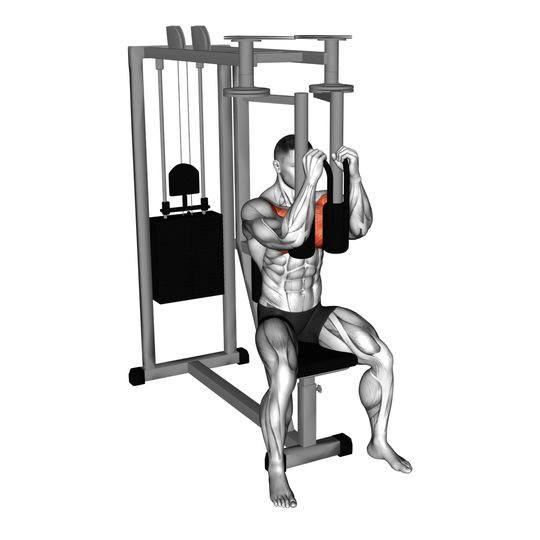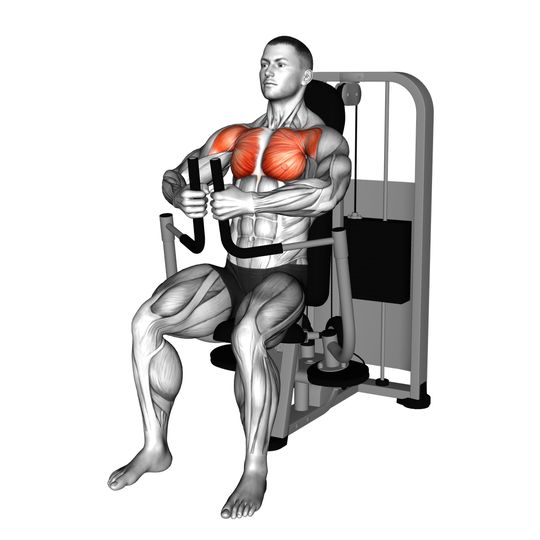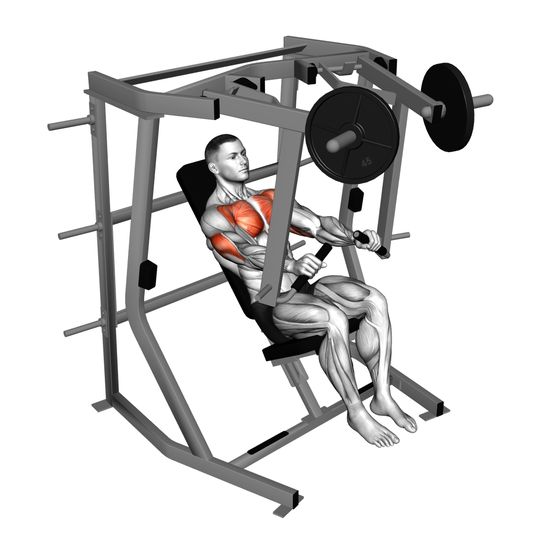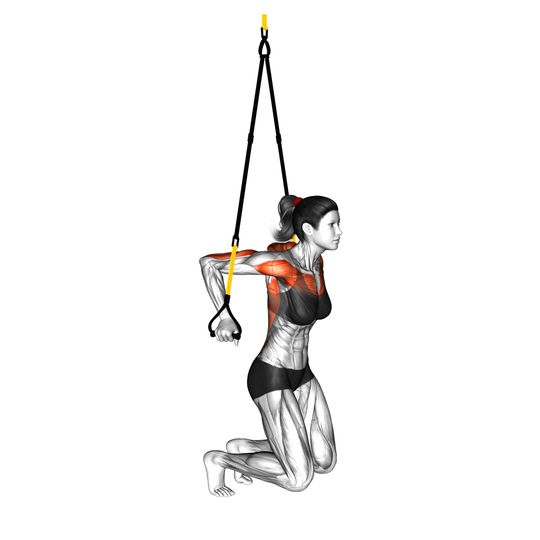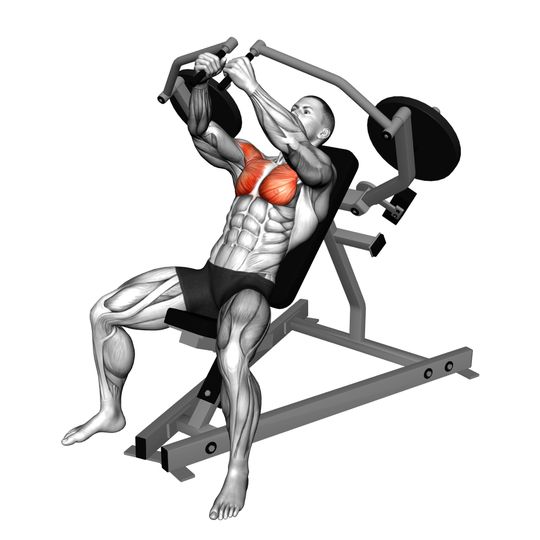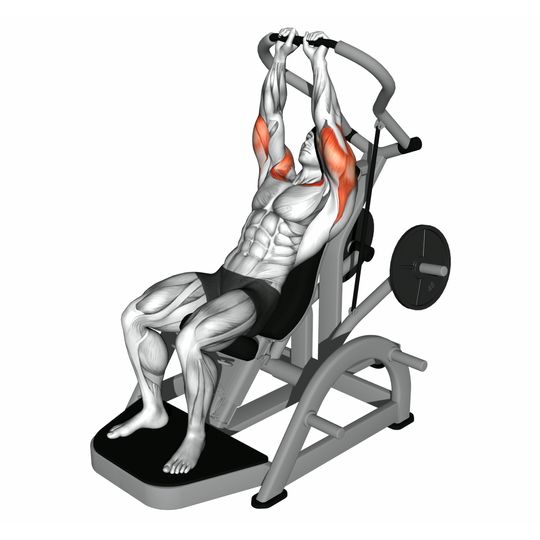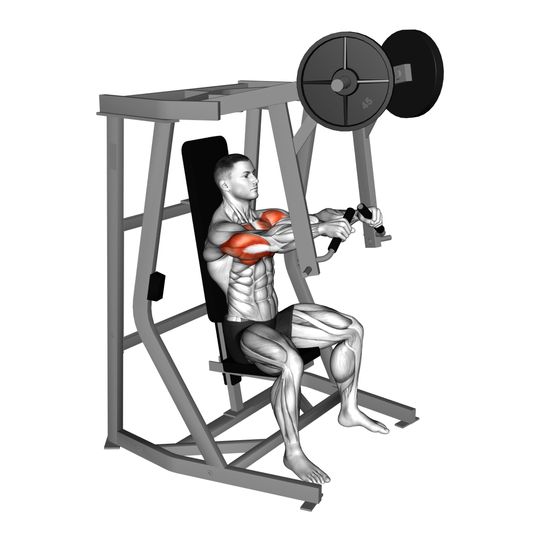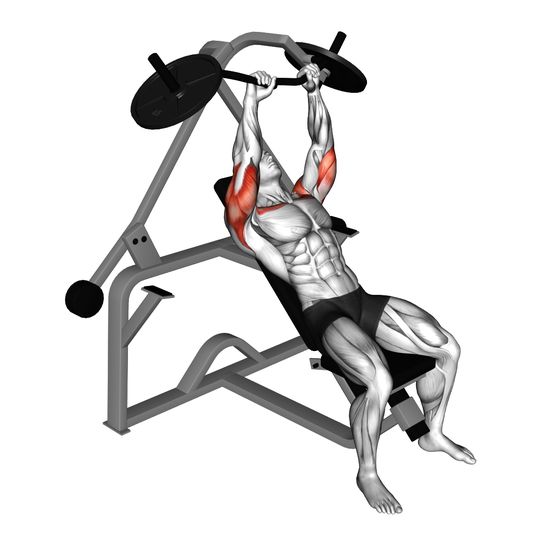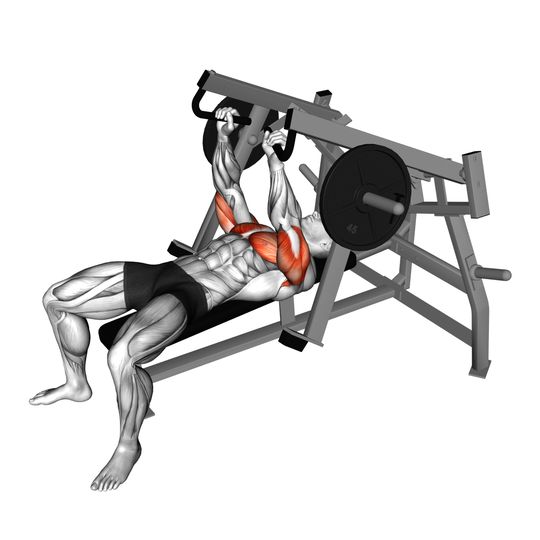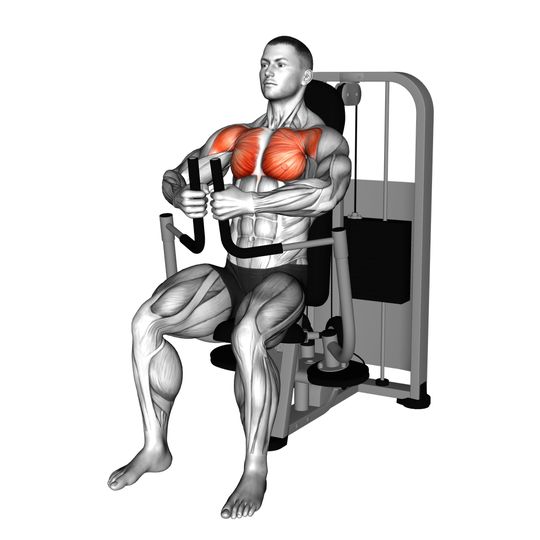


A horizontal pushing motion performed on a leverage machine that works the chest (pectorals) by extending the arms against the resistance.
How to do the Machine Chest Press#
- Adjust the seat so the handles sit level with your mid-to-lower chest and set any handle position accordingly.
- Sit with your back against the pad and grasp the handles at about shoulder width.
- Draw your shoulder blades back and position your elbows roughly 45–90 degrees from your torso.
- Exhale and press the handles forward by contracting the chest until your arms are extended.
- Inhale and lower the handles back to the mid-chest under control, then repeat.
Muscles worked#
The machine chest press is a horizontal press, so the chest does the bulk of the work: the pectoralis major pulls the upper arms forward and across the body as the handles travel out. With the handles set at mid-chest, the sternal portion of the chest takes the largest share, and converging handles that come together at the end of the rep bring in a squeeze you cannot get from a straight bar. The load is easy to feel across the whole chest, especially at the stretched start.
The front delts assist at the start of the press and the triceps finish the lockout, in roughly the same proportion as in a dumbbell bench press. What is missing is the stabiliser work: the back pad and the fixed handle path mean the rotator cuff, upper back, and core do far less than under a barbell, which is why the chest tends to be the muscle that fails first and why the exercise is so easy to recover from.
- Primary: Chest (Pectoralis Major)
- Secondary: Front delts (Anterior Deltoid), Triceps (Triceps Brachii)
Common mistakes#
- Seat too high or low so the handles do not line up with the mid-chest.
- Allowing the shoulders to round forward instead of retracting the shoulder blades.
- Flaring the elbows excessively or tucking them in outside the intended 45–90° range.
- Using a grip width that is noticeably wider or narrower than shoulder width.
Machine Chest Press vs other exercises#
Head-to-head breakdowns of muscles worked, loading, joint stress, and which one to pick for your goal.
Why it works#
The machine chest press lets you press heavy and press to failure without a spotter and without the balance demands of free weights. That makes it the safest way to get the chest close to its limit, and it explains why the last exercise on many chest days is a machine press pushed for every rep. The seat and handle adjustments also let you find a path that avoids a sore shoulder in a way a barbell cannot.
It is also the best pressing option for beginners and for anyone coming back from a layoff. The path is fixed, so you learn to feel the chest working before you have to manage a bar, and the load can start very light. For experienced lifters it is a volume tool: drop sets, rest-pause sets, and slow eccentrics are all straightforward here and reckless under a heavy barbell.
Sets, reps and setup#
Three to four sets of 8-12 reps with 90 seconds to two minutes of rest, once or twice a week. Use it either as the main press for beginners or after a barbell or dumbbell press for volume. Take at least one set per session to within a rep of failure; the machine is built for it.
- Setup
- Adjust the seat so the handles sit level with the middle of the chest, roughly nipple height, and set the handle start so the hands begin slightly behind the line of the shoulders with a stretch across the chest. Keep the shoulder blades pulled back and down against the pad, feet planted, and press until the arms are almost straight, then lower over two to three seconds without letting the shoulders roll forward.
- Progression
- Add reps to twelve, then add one plate and drop to eight. Once weight jumps become too large, add a one-second pause at the stretched position, slow the eccentric to four seconds, or finish the last set with a drop set of half the weight for as many reps as possible.
Variations#
- Machine Incline Chest Press Angles the press upward to shift emphasis to the upper chest and front delts.
- Iso-Lateral Chest Press Independent arms on a plate-loaded machine, which prevents the strong side from taking over and allows a converging path.
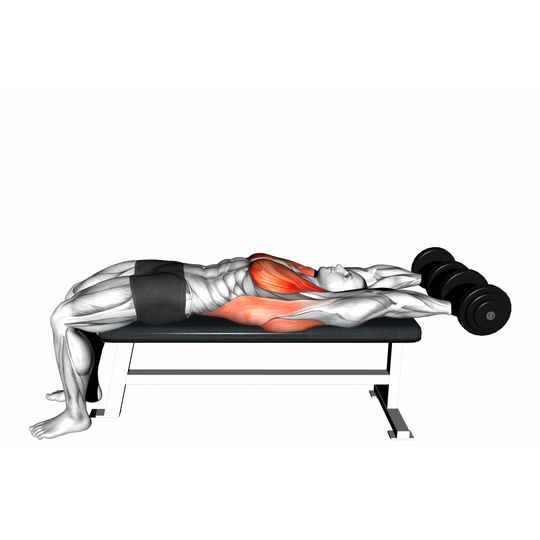
- Dumbbell Bench Press The free-weight version with a similar arm path and far more stability demand on the shoulders.
- Barbell Bench Press The heaviest horizontal press, which trains the whole body to stabilise a load and remains the strength standard.
- Pec Deck Removes the triceps entirely to isolate the chest, the natural pairing after a machine press.
Machine chest press vs bench press#
The barbell bench press lets you lift the most weight and makes the whole body work to keep the bar stable, so it builds strength, the front delts and triceps, and the stabilisers of the shoulder alongside the chest. It also demands a spotter for true failure sets and punishes small technique errors.
The machine press fixes the path and supports the back, so the chest becomes the limiting factor and you can safely take every set close to failure. Per set it is at least as effective for chest growth and far easier to recover from. If your goal is a bigger chest, run both: the bench for heavy strength work and the machine for hard, safe volume.
Common questions#
What muscles does the machine chest press work?
The chest does most of the work, with the front delts helping at the start of the press and the triceps finishing the lockout. Because the back is supported and the path is fixed, the stabilising muscles of the shoulder and core contribute much less than in a free-weight press.
Is the machine chest press as good as the bench press?
For chest growth, yes, and it is easier to take to failure safely. For total strength and the carryover to other lifts, the barbell bench press is better because it demands stability and lets you load heavier. Most lifters get the most from doing both.
How should the seat be set on a chest press machine?
So the handles line up with the middle of your chest when you sit back against the pad. If the handles sit at shoulder height the front delts take over; if they sit too low the press becomes a decline and the shoulders can roll forward at the start.
Should I lock my elbows out on the chest press?
Press until the arms are almost straight, then stop just short of a hard lockout. The last few degrees add nothing for the chest and simply shift the load onto the triceps and elbow joints; keeping a slight bend also keeps tension on the chest for the whole set.
How much should I be able to chest press on a machine?
Numbers vary between machines because leverage differs, so compare only with yourself. A useful benchmark is being able to press roughly your bodyweight on the stack or plates for eight to ten reps, but progression on the same machine matters more than any figure.