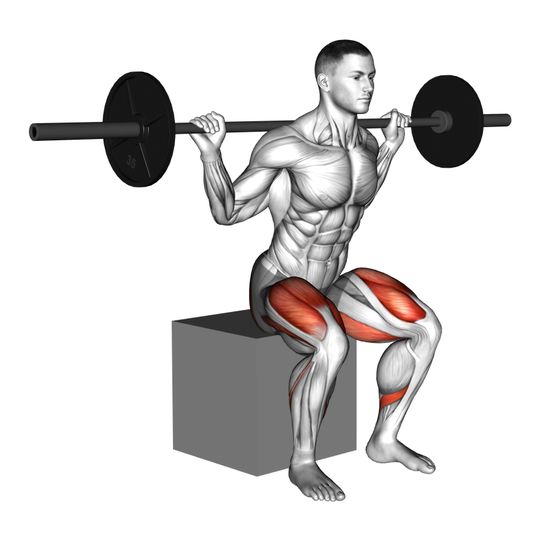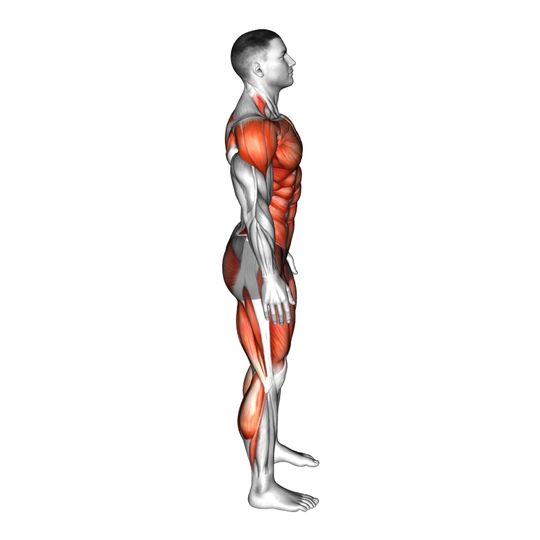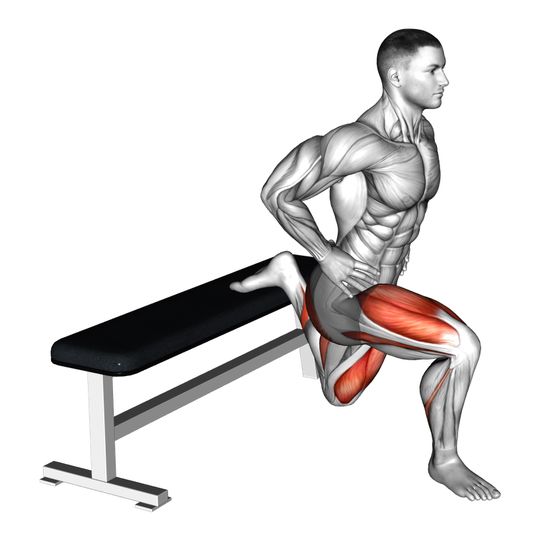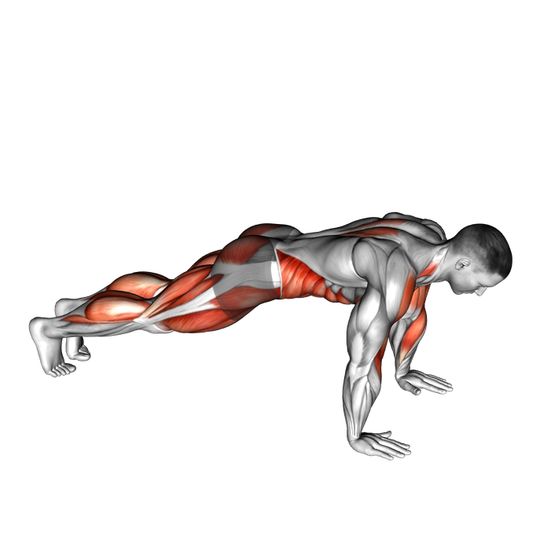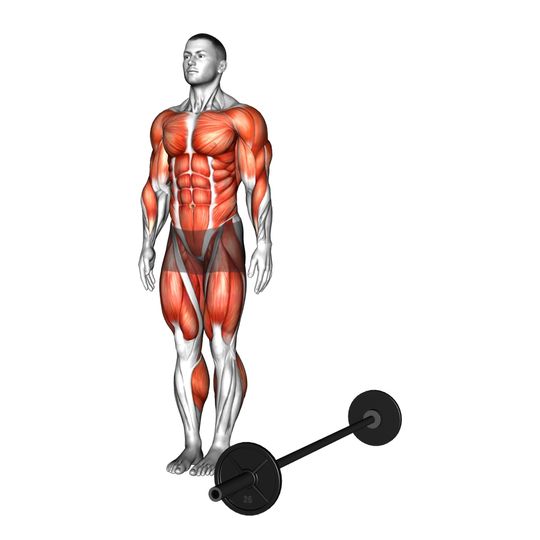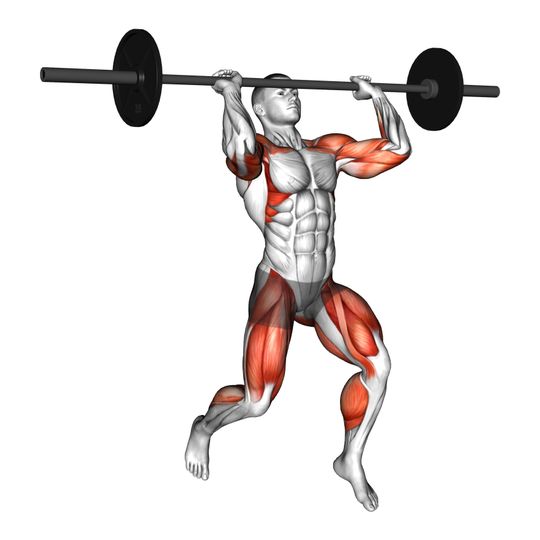


Perform a backward stepping lunge that lowers the rear knee toward the floor, primarily loading the quadriceps while the hamstrings and glutes assist.
How to do the Reverse Lunge#
- Stand tall with feet about hip-width apart, brace your core, and place your hands on your hips or at your sides.
- Step one foot straight back and bend both knees to lower until your front thigh is near parallel to the floor and the rear knee is just above the ground.
- Keep an upright torso and ensure the front knee tracks over the ankle without collapsing inward.
- Drive through the front heel to extend the front leg and bring the rear foot forward to return to the start.
- Repeat for the desired reps, then switch legs or alternate legs each rep.
Muscles worked#
The reverse lunge loads the front leg, which does not move. Stepping back and lowering the rear knee puts the front shin close to vertical and the hips behind the knee, so the glutes of the front leg carry a large share of the work alongside the quads, which control the knee on the way down and drive it straight on the way up. Compared with a forward lunge, the balance is easier and the load sits more in the hip than in the knee.
The hamstrings assist the glutes in extending the hip, and the adductors help stabilise the pelvis and the front knee. The rear leg is not idle: its hip flexors and quads get a long stretch at the bottom, and its calf and foot help with balance on the push back. The abs and obliques stop the torso from twisting or tipping forward as you step. Most people feel it in the glute of the front leg first.
- Primary: Quads (Quadriceps Femoris), Glutes (Gluteus Maximus)
- Secondary: Hamstrings (Biceps Femoris, Semitendinosus & Semimembranosus), Adductors (Adductor Magnus, Longus & Brevis (Hip Adductors)), Calves (Gastrocnemius & Soleus)
Common mistakes#
- Letting the front knee push well past the toes.
- Leaning the torso forward instead of keeping it upright.
- Pushing up through the toes rather than driving through the front heel.
- Taking a step that is too short or too long, reducing stability or range of motion.
- Allowing the front knee to collapse inward.
Why it works#
The reverse lunge is the lunge most coaches teach first, because stepping backward keeps the front knee stable and the shin vertical, which takes stress off the knee and places it on the hips. Lifters who find forward lunges uncomfortable on the knees almost always tolerate the reverse version well, and it produces the same single-leg strength benefit.
It trains each leg independently, which exposes and fixes the side-to-side strength differences that two-legged squats hide, and it improves balance and hip stability without any equipment. Add dumbbells, a barbell, or a front rack hold and it scales into a serious glute and quad builder that carries over directly to running, stairs, and stepping off anything.
Sets, reps and setup#
Three sets of 8-12 reps per leg with 60-90 seconds of rest, once or twice a week. Do all reps on one leg before switching for a strength focus, or alternate legs for a conditioning or warm-up set. Bodyweight sets of twelve per side work as a warm-up; beyond that, add load rather than reps.
- Setup
- Stand tall with the feet hip width. Step one foot straight back about one long stride and lower under control until the rear knee is just above the floor and the front thigh is near parallel, keeping the front shin vertical and the torso upright. Push through the whole front foot to stand and bring the rear foot back to the start, without leaning forward or letting the front knee cave.
- Progression
- Start with bodyweight and a hand on a rail if balance is shaky. Add dumbbells at the sides, then a single dumbbell in the goblet position for a more upright torso, then a barbell on the back or front rack. Slowing the lowering to three seconds or stepping back from a low platform for a deficit both increase the difficulty without heavier weights.
Variations#
- Dumbbell Reverse Lunge The same step back with a dumbbell in each hand, the most common way to load it.
- Barbell Reverse Lunge Bar on the back for heavier loading and more demand on the trunk to stay upright.
- Bodyweight Lunge The forward stepping version, which puts more load on the front knee and quad and asks more of your balance.
- Split Squat Holds the lunge stance and squats up and down in place, removing the step so you can focus purely on the front leg.
- Dumbbell Bulgarian Split Squat Rear foot elevated on a bench for a deeper range and a heavier load on the front leg.
Reverse lunge vs forward lunge#
The forward lunge involves stepping out and decelerating your bodyweight on the front leg, which loads the quad and the knee more and demands more balance. That deceleration is valuable for athletes, but it is also why forward lunges bother people with sore knees.
The reverse lunge keeps the front foot planted and moves the rear leg, so the front shin stays vertical and the hips sit back, shifting the emphasis toward the glutes and making it much easier on the knee. It is the better default for building single-leg strength and the right version to load heavy; use forward lunges for the deceleration component once the reverse lunge is solid.
Common questions#
What muscles do reverse lunges work?
The glutes and quads of the front leg do most of the work, with the hamstrings and adductors assisting hip extension and knee stability. The hip flexors of the rear leg stretch at the bottom, and the abs and obliques keep the torso upright.
Are reverse lunges better than forward lunges?
For most people, yes. They are easier on the knees, simpler to balance, and put more of the load on the glutes, which makes them the better version to load heavily. Forward lunges add a deceleration demand that is useful for athletes but harder on the joints.
Are reverse lunges good for glutes?
Yes. The step back puts the hips behind the front knee with the shin vertical, so the glute of the front leg has to extend the hip through a long range to stand you back up. Holding a weight and leaning slightly forward at the hip increases the glute demand further.
Should the back knee touch the floor in a reverse lunge?
Lower until it is just above the floor, about two to five centimetres. Touching lightly is fine on a pad, but resting the knee on the floor unloads the front leg and encourages bouncing out of the bottom.
Why do I lose balance on reverse lunges?
Usually the step is too short or too long, or the rear foot lands on its side. Take a step about one full stride long, land on the ball of the rear foot with the toes pointing forward, and keep your eyes on a point ahead rather than looking down.