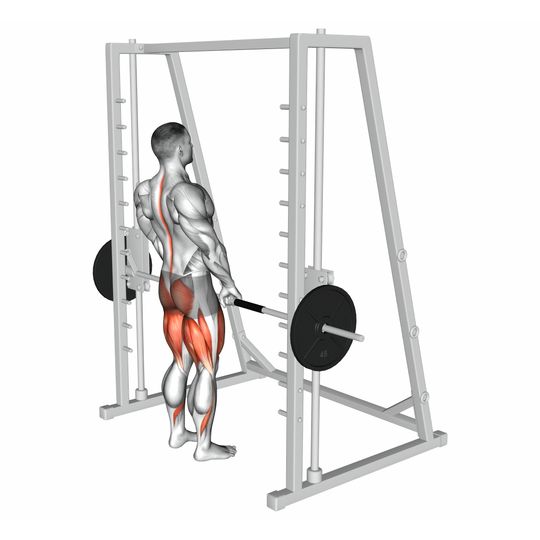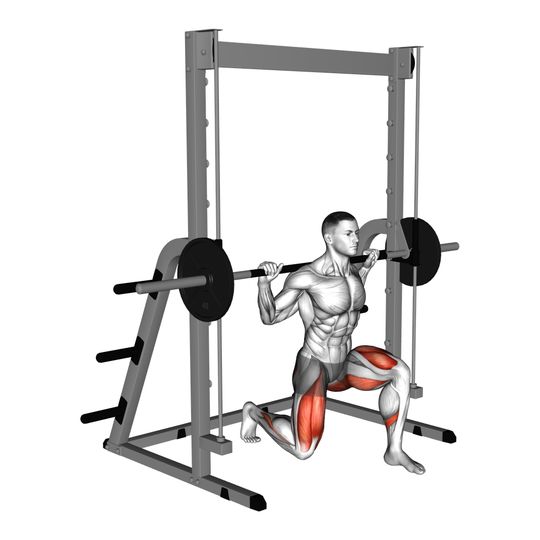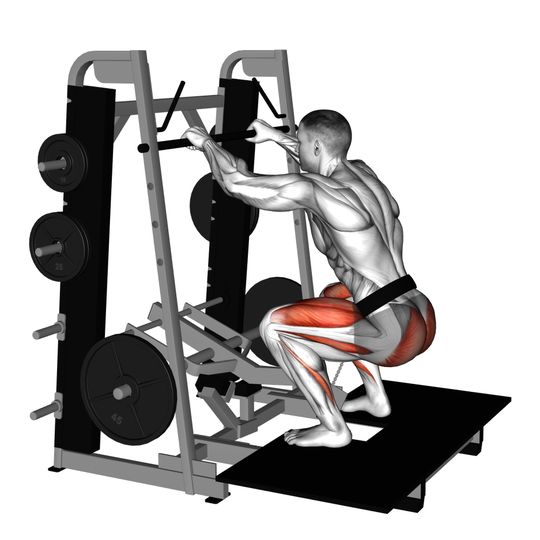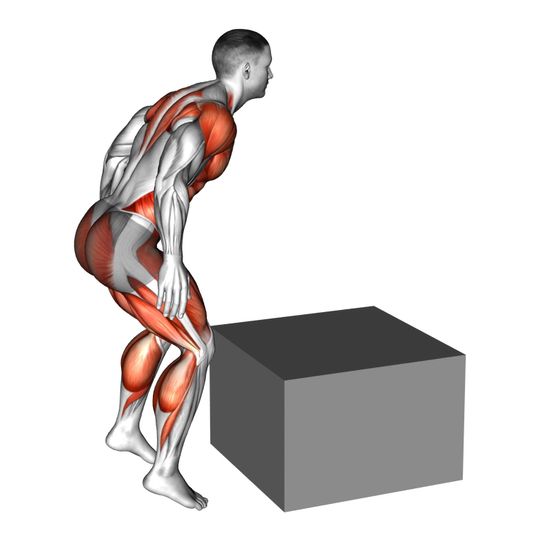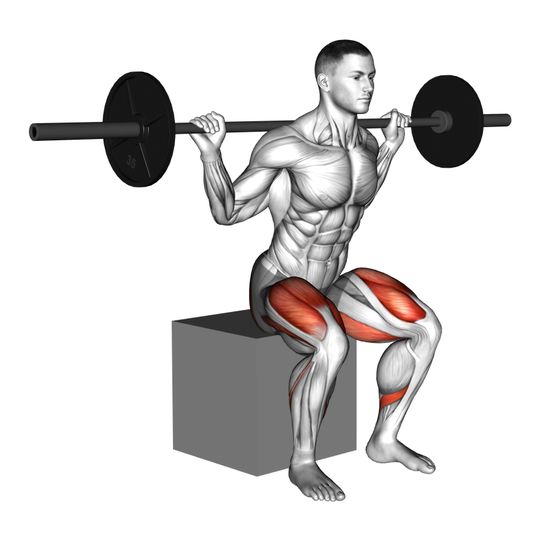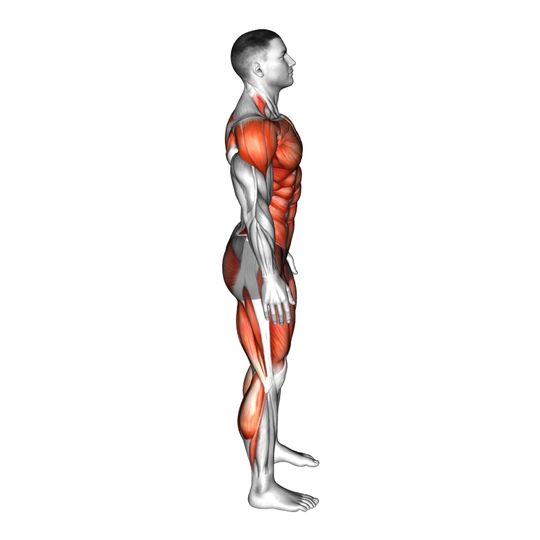


A controlled squat performed on a Smith machine that mainly develops the quadriceps while also engaging the glutes and hamstrings. You descend by bending at the hips and knees, then drive back up through the heels to return upright.
How to do the Smith Machine Squat#
- Position the bar a little below shoulder height and place it across your upper back; stand with feet about shoulder-width apart.
- Take the bar onto your upper back, brace your core, keep your spine neutral and your head aligned with your torso.
- Begin the descent by pushing your hips back and bending your knees, lowering until your thighs reach about parallel to the floor or slightly below.
- Keep weight through your heels and mid-foot and push the knees out over the toes as you drive the bar upward.
- Exhale as you rise, extend hips and knees to return to the starting position, and repeat for the desired number of reps.
Muscles worked#
The Smith machine squat is a quad exercise first. Because the bar runs on fixed rails, you can place your feet in front of it and keep the torso vertical while you sit straight down, and that position makes the quads control the knee more than in a free-weight squat where the hips have to move back to keep the bar over the mid-foot. The glutes still extend the hips out of the bottom and take a bigger share when the feet are set closer to the bar.
The hamstrings and adductors assist at the hip and the calves stabilise the ankle, but the stabilising work that a barbell squat demands from the lower back and abs is far smaller, since the rails stop the bar from tipping. That is why you can usually load it heavier than a free squat and why it fatigues the legs specifically rather than the whole body. Expect a deep quad burn and much less lower back strain.
- Primary: Quads (Quadriceps Femoris), Glutes (Gluteus Maximus)
- Secondary: Hamstrings (Biceps Femoris, Semitendinosus & Semimembranosus), Adductors (Adductor Magnus, Longus & Brevis (Hip Adductors)), Calves (Gastrocnemius & Soleus)
Common mistakes#
- Allowing the knees to collapse inward.
- Shifting weight onto the toes and lifting the heels.
- Rounding the lower back instead of keeping a neutral spine.
- Leading the movement with the knees instead of sitting the hips back.
How much should you squat?#
What the average squat actually is, and what counts as beginner, intermediate, advanced, or elite at your bodyweight — for men and women, in kg and lbs.
See squat strength standards →
Why it works#
The fixed bar path is a feature, not a flaw, when the goal is leg growth. You can set the feet forward and lean back into the bar to load the quads through a range that would tip you over with a free barbell, and the safety catches let you take sets close to failure without a spotter. For a hypertrophy block the Smith squat is one of the most productive quad exercises available.
It is also a practical bridge for lifters who cannot barbell squat comfortably. Anyone with a cranky lower back, limited ankle mobility, or a shoulder that will not tolerate a low bar position can still squat heavy here, and the machine removes most of the balance and bracing demands that make free squats hard to learn. It is not a replacement for the barbell squat as a strength lift, but it is an excellent complement.
Sets, reps and setup#
Three to four sets of 8-12 reps with two minutes of rest, once or twice a week. The stability lets you push closer to failure than a barbell squat, so aim for one rep in reserve on most sets and take the last set to technical failure with the safeties set. Heavy sets of five are possible but the machine's strength is in controlled volume.
- Setup
- Set the bar just below shoulder height and the safety catches just below your lowest position. Place the bar across the upper traps, step the feet forward so they sit ahead of the bar by 15 to 30 centimetres, and stand slightly wider than hip width with toes turned out a little. Unhook, sit straight down until the thighs pass parallel, and drive up through the whole foot without letting the hips shoot back.
- Progression
- Add reps to twelve, then add 2.5 to 5 kilograms per side and drop back to eight. When progress stalls, slow the lowering to three seconds, add a two-second pause at the bottom, or move the feet further forward to increase the quad demand at the same weight.
Variations#
- Barbell Squat The free-weight version, which adds balance and bracing demands and remains the main strength lift.
- Hack Squat A sled on angled rails with a back pad, which gives a similar quad-focused path with even more support.
- Leg Press Seated pressing with the back fully supported, for heavy quad volume with no spinal loading at all.
- Smith Machine Split Squat One leg forward under the fixed bar, which turns the machine into a stable single-leg exercise.
- Barbell Front Squat A free-weight squat with the bar on the front of the shoulders and a similarly upright, quad-focused position.
Smith machine squat vs barbell squat#
The barbell squat makes you balance the load and keep the bar over the mid-foot, so the hips move back, the torso leans, and the whole body braces. That builds full-body strength and carries over to sport and to other lifts, and it is why the free squat remains the standard strength exercise. It also demands more skill, mobility, and recovery.
The Smith machine fixes the bar path, removes the balance component, and lets you set the feet forward to bias the quads. Per set it is arguably the better quad builder, and it is safer to take to failure alone. Use the barbell squat for strength and the Smith squat for quad volume, or make the Smith squat your main squat if a barbell does not agree with your back or shoulders.
Common questions#
What muscles does the Smith machine squat work?
Mainly the quads, which control the knee through a vertical bar path, and the glutes, which extend the hips out of the bottom. The hamstrings, adductors, and calves assist, while the lower back and abs do far less stabilising than in a free squat.
Is the Smith machine squat as good as a barbell squat?
For quad growth it is at least as good and easier to push hard, because the stability lets you focus on the legs. For total strength, athletic carryover, and core development the barbell squat is better. Most lifters do well with the barbell as the main lift and the Smith as a volume tool.
Where should my feet be on a Smith machine squat?
Ahead of the bar by 15 to 30 centimetres, slightly wider than hip width with the toes turned out a little. Feet directly under the bar force you into a forward lean; feet very far forward turn it into a hack squat with more quad and less glute.
Why does the Smith machine squat feel awkward?
Because the bar cannot move forward or back as you would naturally shift it. Standing with the feet under the bar, as you would with a barbell, forces a forward lean against the rails. Step the feet forward, lean back into the bar, and sit straight down and the movement will feel right.
Can you squat more on a Smith machine?
Usually, because the rails take over the balance work and the machine's counterbalance often makes the bar lighter than a standard 20 kilograms. Do not compare Smith numbers with barbell numbers; treat them as separate lifts.