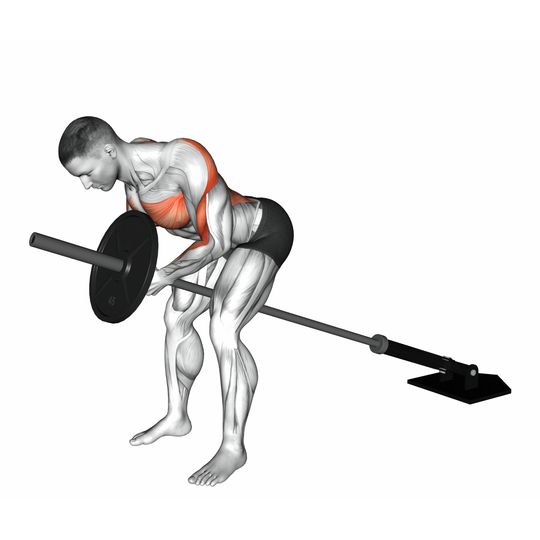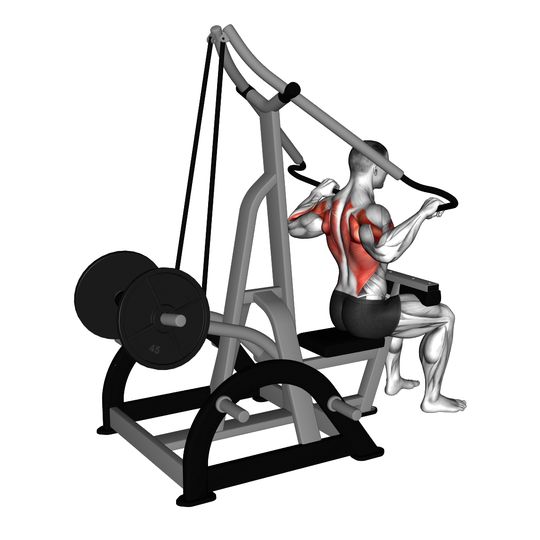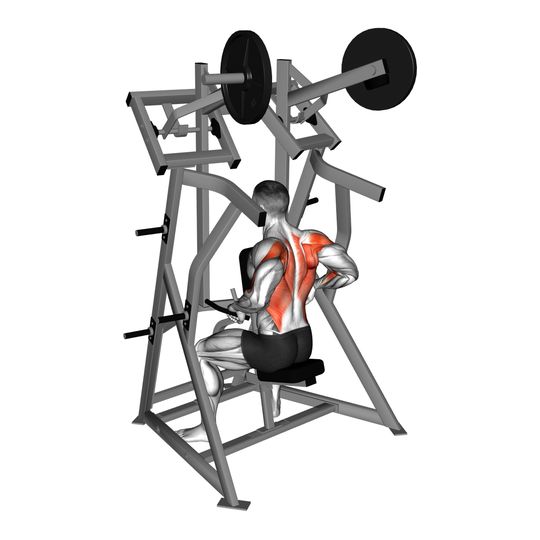


A bent-over rowing movement performed with one end of a barbell fixed in a leverage machine, emphasizing the upper back through a horizontal pull.
How to do the T Bar Row#
- Secure one end of the barbell in the leverage machine and load the free end; stand with feet about shoulder-width apart.
- Hinge at the hips with a slight bend in the knees until your torso is roughly parallel to the floor, keeping a neutral spine.
- Reach down and grip the bar with both hands beneath the loaded end, maintaining a firm, stable hold.
- Pull the bar toward your chest by driving your elbows back and squeezing your shoulder blades together; pause briefly at the top.
- Lower the bar under control to the starting position while holding the hip hinge and flat back.
Muscles worked#
The T bar row trains the whole back with the mid and upper back leading. The neutral or close grip keeps the elbows tucked and pulling toward the hips, which loads the lats through a long range, while the top of the rep, with the plates against your chest, drives the rhomboids, mid traps, and rear delts into a hard shoulder blade squeeze. Because the bar is fixed at one end, the load path stays consistent and you can pull heavier than with a free barbell.
The spinal erectors and lower back hold the bent-over position for the whole set, a serious isometric demand at heavy weights and often the reason a set ends. The hamstrings and glutes hold the hip hinge. The biceps and forearms bend the elbows and hang on to the handle, and grip usually gives out before the back once the plates stack up.
- Primary: Upper back (Rhomboids & Middle Trapezius), Lats (Latissimus Dorsi)
- Secondary: Biceps (Biceps Brachii), Rear delts (Posterior Deltoid), Traps (Trapezius)
Common mistakes#
- Rounding the lower back during the hip hinge.
- Using a torso jerk or momentum to initiate the pull.
- Pulling primarily with the arms instead of engaging the shoulder blades.
- Letting the elbows flare excessively away from the body.
Cannot do this one today?#
Machine taken, gym closed, or the movement just not agreeing with you? Here is what to run instead, and what each substitute changes.
8 best T-bar row alternatives →
Why it works#
The T bar row is the heaviest row most lifters can do with good form. The bar pivots on the floor, so the load moves in a fixed arc and you can focus on pulling instead of balancing, and the neutral handles are the strongest position for the arms and shoulders. That lets you load the upper back progressively the way you would a squat or a bench press.
It also builds the thickness that pulldowns and pull-ups do not. Vertical pulling builds width through the lats; heavy horizontal rows build the rhomboids, mid traps, and rear delts that make a back look dense from behind. A T bar row loaded for sets of six to ten does this better than nearly any machine.
Sets, reps and setup#
Three to four sets of 6-12 reps with two to three minutes of rest, once or twice a week as the main row on a back day. Keep reps clean: plates touch the chest every rep, the torso angle does not change during the set, and the bar is lowered rather than dropped. Sets of six build strength; ten to twelve build the back faster.
- Setup
- Stand over the bar, hinge until the torso is around 45 degrees or lower, and grab the handles with a neutral grip. Set the back flat and the knees soft, then pull the handles to the lower chest by driving the elbows back and up. Pause with the shoulder blades squeezed, and lower until the arms are straight and the lats are stretched, without the torso rising.
- Progression
- Add 2.5 to 5 kilos when every set reaches the top of the range with the plates touching the chest. If the torso comes up as the weight goes on, reset lighter and hold the angle; a T bar row that becomes a shrug at 60 degrees is not heavier, it is shorter. Straps are fine once grip is the limit.
Variations#
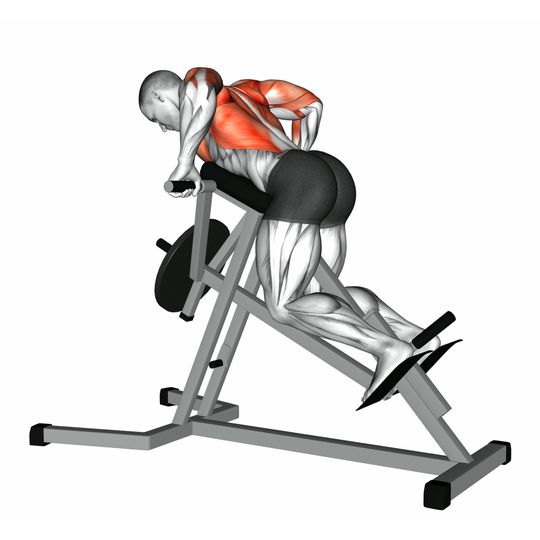
- Chest Supported T-Bar Row Torso on a pad, removing the lower back and hamstrings so the back alone fails.
- Barbell Bent Over Row Free barbell with a pronated grip and no pivot, more stability demand and more grip variety.
- Pendlay Row Dead-stop barbell row from the floor with the torso parallel, more explosive and stricter.
- Landmine Row Same pivoting bar idea with a landmine attachment, for gyms without a T bar station.
T bar row vs barbell row#
The barbell row asks you to control a free bar with a pronated grip, so the lower back, hamstrings, and every trunk stabiliser work harder and you have to be honest about the torso angle. It is a more demanding exercise and a better one for overall strength, but the weight you can row with a flat back is limited by the hinge as much as by the back.
The T bar fixes one end of the bar, gives you neutral handles, and puts the load under your chest, so you can pull more weight with a more stable torso. It is the better choice for back hypertrophy for most people and the easier one to progress.
Common questions#
What muscles does the T bar row work?
The lats, rhomboids, mid traps, and rear delts do the pulling, with the biceps and forearms assisting. The spinal erectors, glutes, and hamstrings hold the bent-over position throughout the set.
Is the T bar row better than the barbell row?
For building the back, usually yes, because the fixed pivot and neutral handles let you row heavier with a stable torso. The barbell row is better for total-body strength. Many lifters rotate between them across blocks.
Where should the T bar row hit?
Pull the handles to the lower chest with the elbows driving back and slightly out for the upper back and rear delts. Pulling toward the belly button with the elbows tucked shifts more onto the lats.
Should you use a wide or narrow grip on the T bar row?
Neutral and shoulder-width is the strongest and the best default for the lats. A wider pronated grip pulls the elbows out and puts more on the upper back and rear delts, at the cost of some weight.