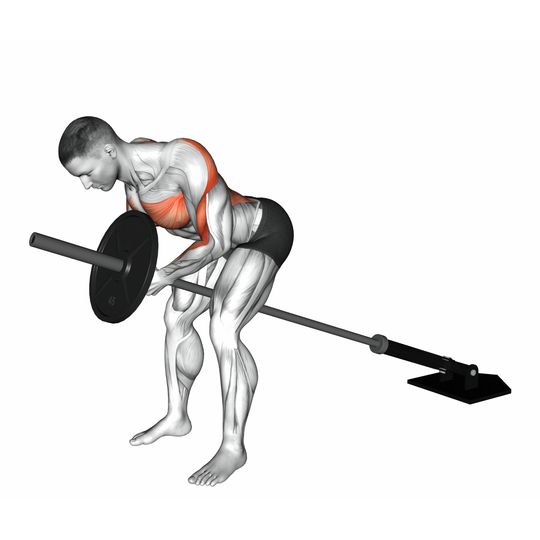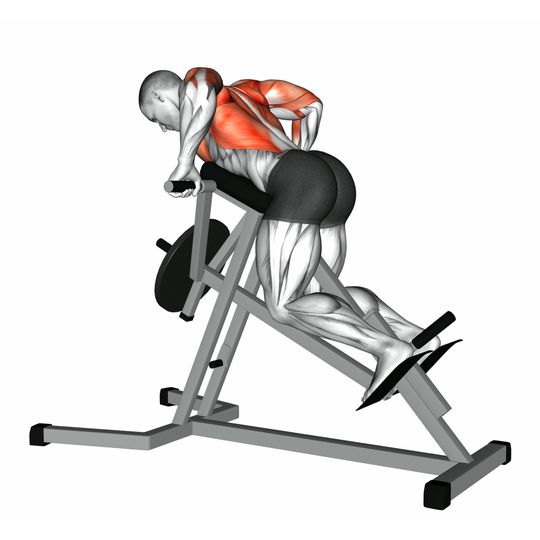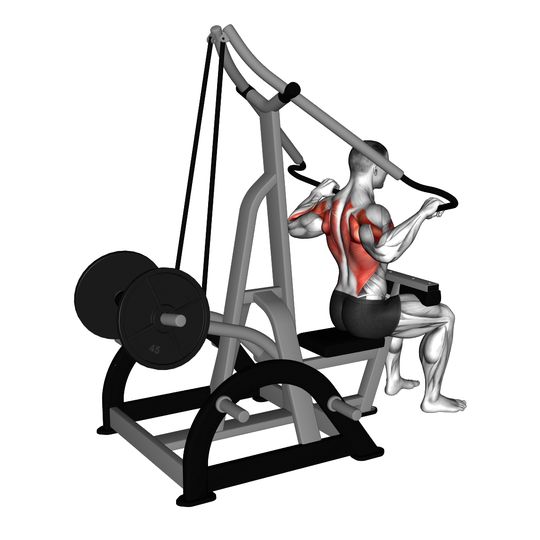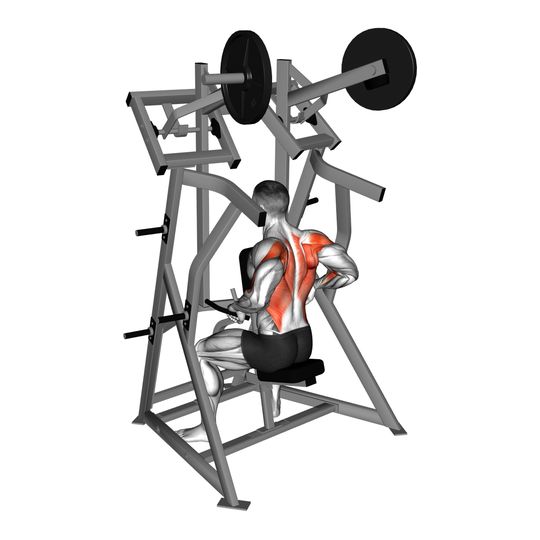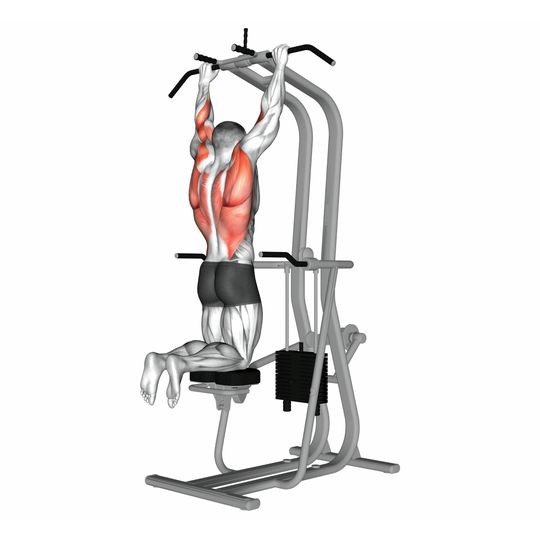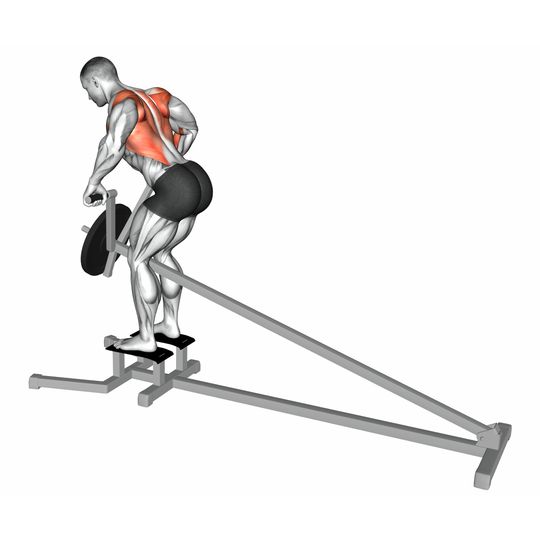


Sit at the leverage-row machine and pull the handles horizontally toward your mid-torso, emphasizing contraction of the upper back. Maintain an upright chest and a neutral spine throughout the movement.
How to do the Seated Machine Row#
- Sit and grasp the machine handles with both hands while sitting tall and keeping your back straight.
- Retract your shoulder blades to set the upper back before initiating the pull.
- Pull the handles toward your mid-torso in a controlled, horizontal rowing motion.
- Pause briefly and actively squeeze the upper back as the handles approach your torso.
- Slowly extend your arms and allow the shoulder blades to return to the start position with control.
Muscles worked#
The seated machine row trains the upper back and lats as one unit. The handles travel horizontally toward the torso, so the rhomboids and middle trapezius pull the shoulder blades together while the latissimus dorsi draws the upper arms back along the ribs. With a neutral grip and the elbows tucked the lats take a bigger share; with a wide overhand grip and the elbows out, the upper back and rear delts do more of the work.
The rear delts assist in pulling the arm back, and the biceps and forearms flex the elbow and hold the handles, so a fatigued set is felt in the arms as much as the back. The chest pad, if the machine has one, removes the lower back and hamstrings almost entirely. Without a pad the spinal erectors work isometrically to hold you upright, which is one reason to sit tall rather than lean back.
- Primary: Upper back (Rhomboids & Middle Trapezius), Lats (Latissimus Dorsi)
- Secondary: Biceps (Biceps Brachii), Rear delts (Posterior Deltoid), Forearms (Forearm Flexors & Extensors (incl. Brachioradialis))
Common mistakes#
- Using torso momentum by leaning backward or forward instead of pulling with the back.
- Letting the shoulders round forward during the pull.
- Relying on the arms to do the work instead of engaging the upper back.
- Dropping the chest or allowing the spine to flex on the return.
Why it works#
The machine row does one thing the cable row and barbell row cannot: it fixes the path and supports the torso so that the back is the only thing that can end the set. There is no cable to stabilise, no hinge to hold, and no momentum to sneak in by rocking backward. For lifters who struggle to feel their back on free-weight rows, it is the fastest way to learn what a scapular retraction with load feels like.
It is also easy to progress and easy to push. Plate-loaded versions can be loaded in small jumps, selectorised versions make drop sets a matter of moving a pin, and most machines offer two or three grips, so the same station can be a lat exercise one block and an upper back exercise the next.
Sets, reps and setup#
Three to four sets of 8-12 reps with 90 seconds of rest, once or twice a week. Hold the contraction for a full second on every rep and let the shoulder blades protract completely at the start; the stretch is half the exercise.
- Setup
- Set the seat so the handles line up with the lower chest and the chest pad, if present, lets you reach the handles with the arms almost fully extended. Sit tall, set the shoulder blades down, and pull the handles toward the torso by driving the elbows back. Squeeze, then return under control until the arms are straight and the upper back rounds slightly forward.
- Progression
- Add a plate when you can complete 12 reps with a pause on all sets. If the torso starts swinging back to help, the chest lifts off the pad, or the shoulders round forward at the finish, the load is too heavy. Alternate grips between training blocks to keep the movement productive.
Variations#
- Seated Cable Row Free cable path with no chest support, so the torso has to hold itself upright.
- Chest Supported T-Bar Row Lying prone on a pad with a lever arm, the same isolation at a slightly lower pulling angle.
- Iso-Lateral Row Independent arms that let each side work separately and reveal a weaker lat.
- Iso-Lateral Low Row Handles start low and pull upward toward the hip, biasing the lats.
- Single Arm Cable Row One arm at a time with a free path and a longer range through rotation.
Seated machine row vs seated cable row#
The cable row asks the torso to hold itself upright while the load pulls it forward, so the lower back and core work along with the upper back, and small changes in torso angle let you shift the emphasis between lats and mid back on each rep. It is the more athletic exercise and allows a longer, freer range.
The machine row supports the chest and fixes the arc, which removes the stabilising work and lets you load the back harder with less technique variance. If you already have a heavy hinge in your program or you want a row you can take to failure safely, the machine is the better choice. If you want the row to contribute to trunk strength, use the cable.
Common questions#
What muscles does the seated machine row work?
The upper back and lats, with the rhomboids and mid traps squeezing the shoulder blades together and the lats drawing the arms back. The rear delts, biceps and forearms assist. A chest pad removes most of the lower back involvement.
Is the seated machine row good for building a thick back?
It is one of the best exercises for it. The support lets you load the mid back heavily and take sets to failure without the lower back giving out, and the horizontal pull trains the thickness of the back that vertical pulls miss. Eight to twelve reps with a pause, once or twice a week, is a proven approach.
Which grip is best on a seated row machine?
A neutral grip with the elbows tucked emphasises the lats, a wide overhand grip with the elbows out emphasises the upper back and rear delts. Neither is superior; rotate them every few weeks so both regions get direct work.
Should I lean back during a seated row?
No. Leaning back turns the movement into a torso swing that takes work away from the back muscles. Sit tall with the chest against the pad, let the shoulder blades move forward at the start and back at the finish, and keep the spine still throughout.
How heavy should a seated machine row be?
Heavy enough that 8-12 reps with a one-second squeeze is hard, but light enough that the arms fully straighten at the start and the chest stays on the pad. Most intermediate lifters end up between 50 and 90 kg on a plate-loaded machine. Momentum means the weight is too high.