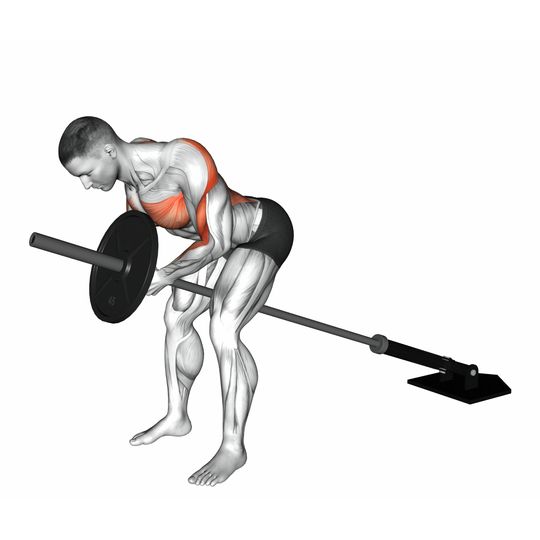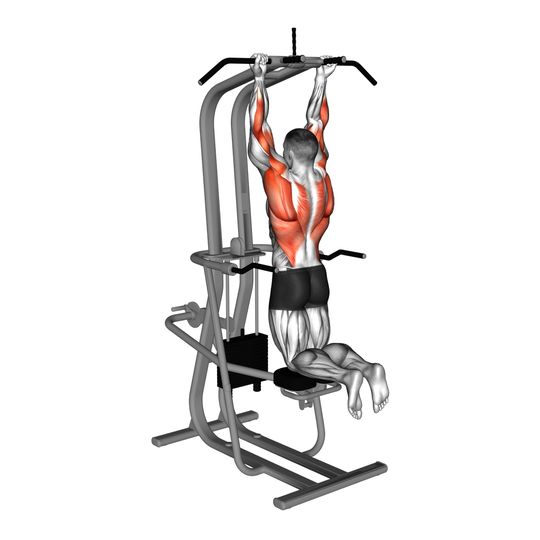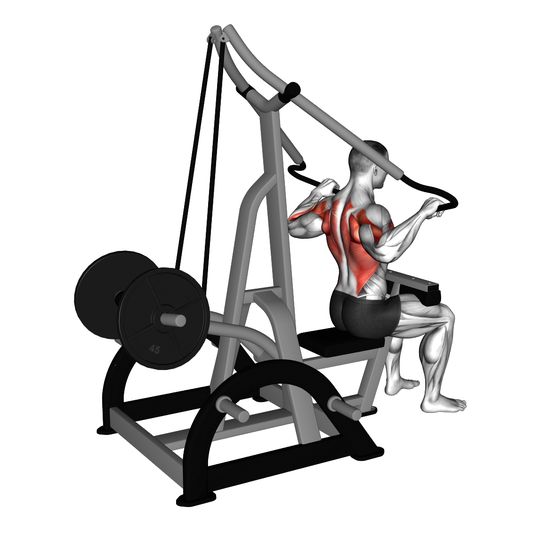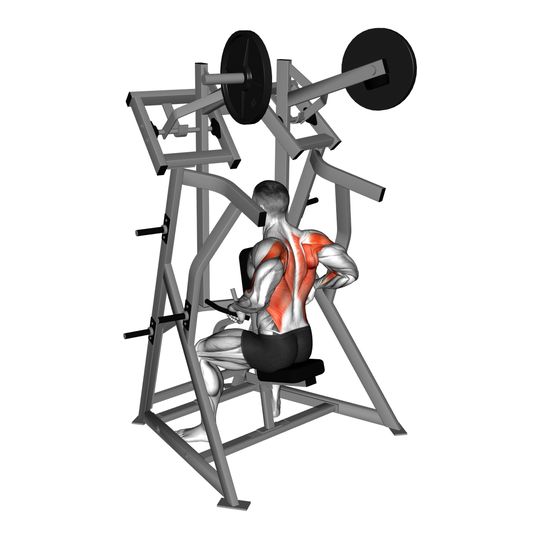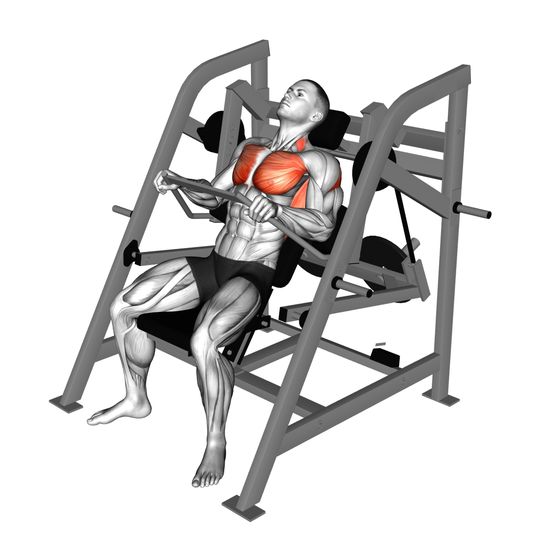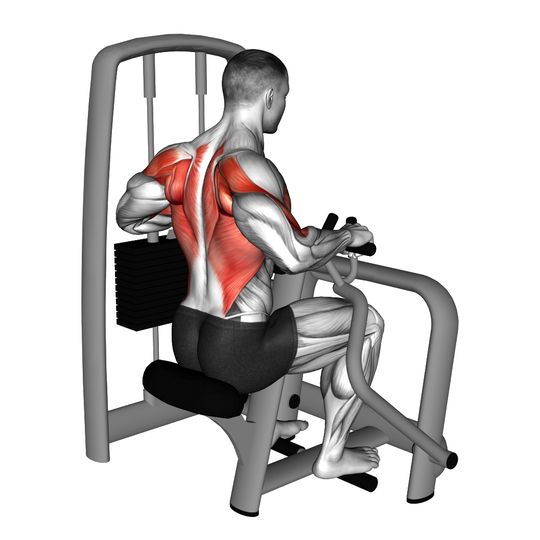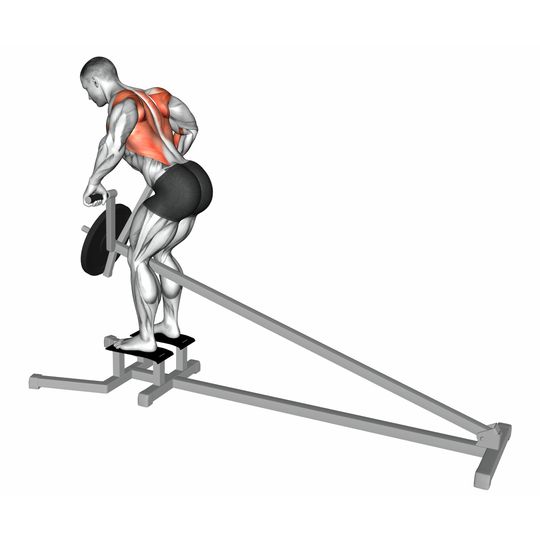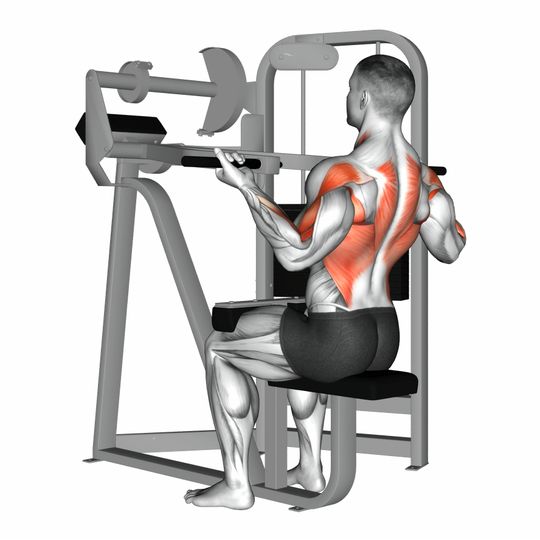


A chest-supported horizontal pulling exercise performed on a leverage machine that primarily develops the back muscles.
How to do the Chest Supported T-Bar Row#
- Set the chest pad so your torso lies flat and your feet are steady, then grasp the machine handles.
- Start with your arms extended and your shoulders down and slightly retracted.
- Pull the handles toward your sternum by drawing your shoulder blades together and bending your elbows.
- Hold briefly at the top and consciously squeeze your mid-back.
- Lower the handles under control until your arms return toward full extension while keeping your chest on the pad.
Muscles worked#
The chest supported T-bar row targets the lats and the muscles of the upper back together. The handles sit under the chest and the elbows drive back along the ribs, which lets the latissimus dorsi pull the arm toward the hip while the rhomboids and middle trapezius squeeze the shoulder blades toward the spine at the top. With the torso pinned to the pad there is nowhere for the load to go except into those muscles.
The rear delts help draw the upper arms back and the biceps and forearms flex the elbow and hold the grip, so a hard set leaves the arms tired too. The lower back and hamstrings, which have to hold a bent over row together, are switched off entirely by the chest pad. That is the whole point of the machine: you get to train the back to failure without the posterior chain deciding when the set ends.
- Primary: Lats (Latissimus Dorsi), Upper back (Rhomboids & Middle Trapezius)
- Secondary: Rear delts (Posterior Deltoid), Traps (Trapezius), Biceps (Biceps Brachii), Forearms (Forearm Flexors & Extensors (incl. Brachioradialis))
Common mistakes#
- Lifting or arching the chest off the pad.
- Using momentum or jerking the machine instead of controlled movement.
- Pulling mainly with the arms instead of initiating with scapular retraction.
- Allowing the shoulders to round forward at the end of the rep.
Why it works#
Bent over rows stop when your lower back or hamstrings get tired, not when your lats do. Putting your chest on a pad removes that ceiling. You can load the T-bar heavily, take sets close to failure and use a slow eccentric without any of it turning into a stability exercise. For pure back growth per set, few movements beat it.
The fixed pivot gives a consistent bar path, so the exercise is easy to learn and easy to progress. Most machines offer several grip positions: a wide overhand grip pushes the work into the upper back and rear delts, a close neutral grip lets the elbows stay tight and brings in more lat. Changing the grip is a free way to shift emphasis without changing the exercise.
Sets, reps and setup#
Three to four sets of 8-12 reps with 90 seconds of rest, once or twice a week. Because the support lets you push hard, keep one to two reps in reserve on the early sets and take the last set to technical failure.
- Setup
- Set the pad so your chest rests fully and your arms hang fully extended without the plates touching the floor. Take the grip that matches your goal, set the shoulder blades down, then pull the handles toward your sternum by driving the elbows back. Hold the contraction for a full second, then lower until the arms are straight and you feel the stretch across the back.
- Progression
- Add a plate when you can complete 12 clean reps on every set. If your chest lifts off the pad or you start pulling with a jerk from the bottom, the load is ahead of your strength. Slowing the lowering phase to three seconds is a better next step than more weight at that point.
Variations#
- T-Bar Row The unsupported version, which loads the lower back and hamstrings as stabilisers.
- Barbell Seal Row Chest down on a raised flat bench with a straight bar, the free-weight equivalent of the same idea.
- Iso-Lateral Row Independent handles that let each arm move separately and expose a weaker side.
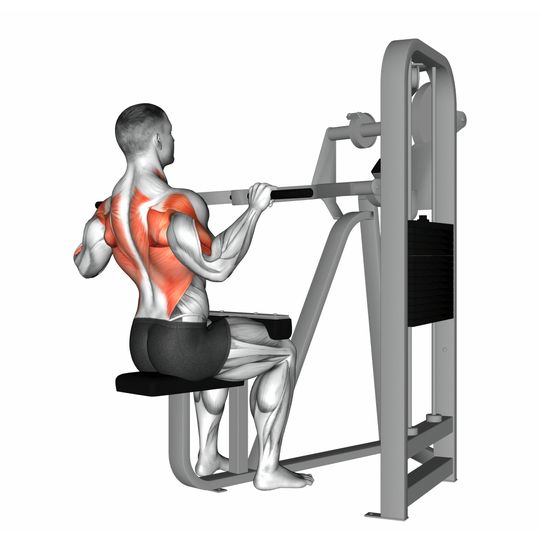
- Seated Machine Row Upright with the chest against a pad, a similar isolation with a slightly higher pulling angle.
- Incline Dumbbell Row Dumbbells on an incline bench give a longer range and a free path with the same chest support.
Chest supported T-bar row vs T-bar row#
The standard T-bar row is a compound lift. Holding the hinge position works the lower back, glutes and hamstrings hard, and that makes it a good choice for lifters who want their rows to contribute to overall strength and deadlift positioning. It also limits how heavy and how close to failure you can safely go.
The chest supported version strips the movement back to the muscles it was meant to train. You lose the posterior chain work but gain the ability to isolate and fully fatigue the lats and upper back. If your program already has heavy deadlifts or squats, the supported version is usually the smarter row.
Common questions#
What muscles does the chest supported T-bar row work?
The lats and upper back, with the rhomboids and mid traps pulling the shoulder blades together at the top of each rep. The rear delts, biceps and forearms assist, while the chest pad removes the lower back and hamstrings from the exercise.
Is the chest supported T-bar row good for building your back?
It is one of the best. The support lets you load it heavily and take sets close to failure with no lower back limitation, which is exactly what back thickness responds to. Eight to twelve reps for three or four sets, once or twice a week, is a proven dose.
Which grip should I use on a chest supported T-bar row?
A close neutral grip keeps the elbows tucked and puts more work into the lats. A wide overhand grip lets the elbows flare and shifts emphasis to the upper back and rear delts. Alternate between them across training blocks rather than picking one forever.
Should my chest come off the pad during T-bar rows?
No. Lifting the chest is a sign the weight is too heavy or the rep is being started with a jerk. Keep the sternum glued to the pad and let the elbows do all the moving; if you cannot, lower the load.
How heavy should a chest supported T-bar row be?
Heavier than you could bent over row with good form, because the back is no longer the limiter. Start with a load you can row for 12 reps with a one-second pause and build from there. Most intermediate lifters end up between 40 and 80 kg on the lever.