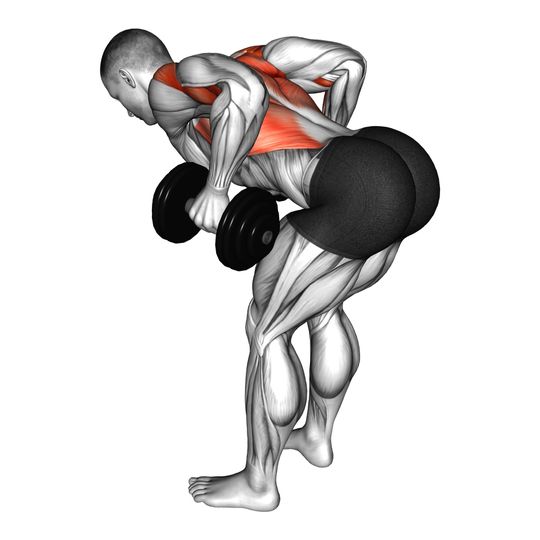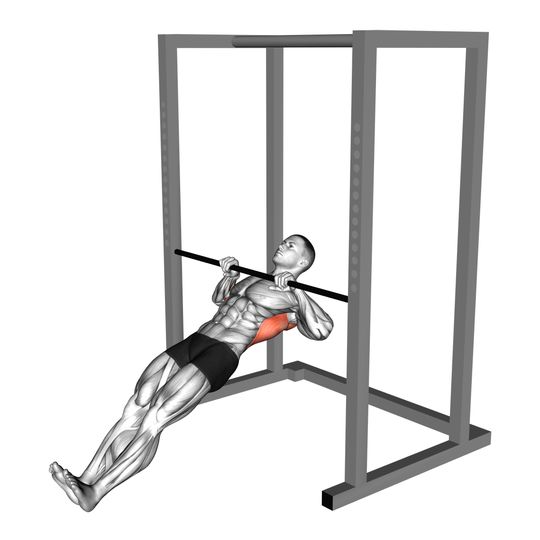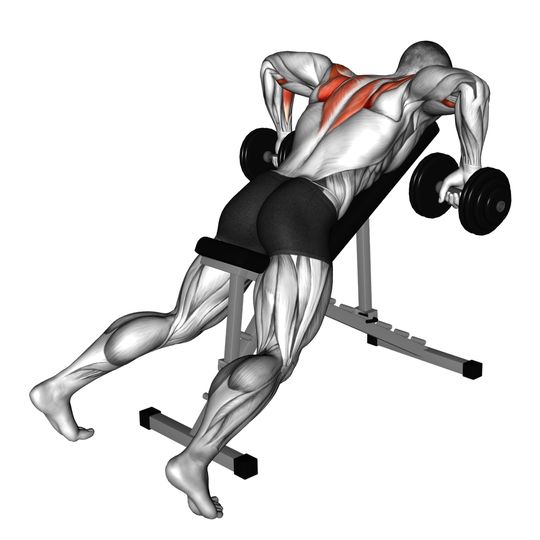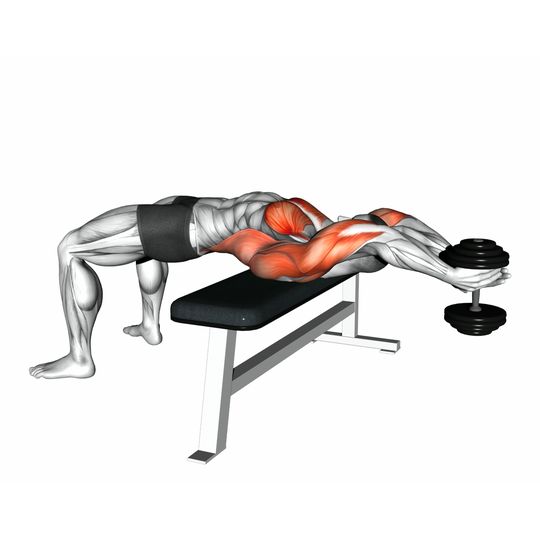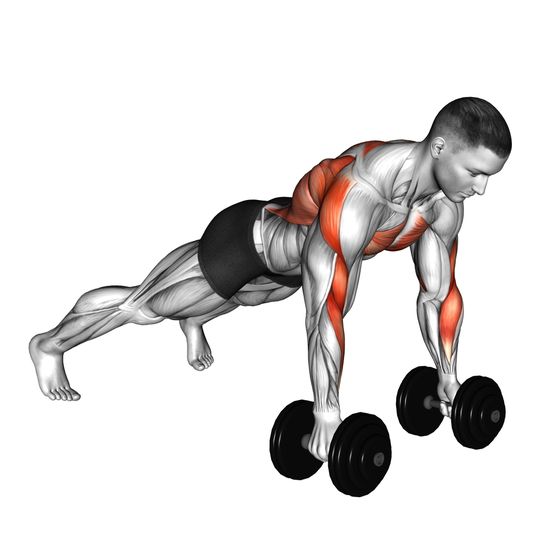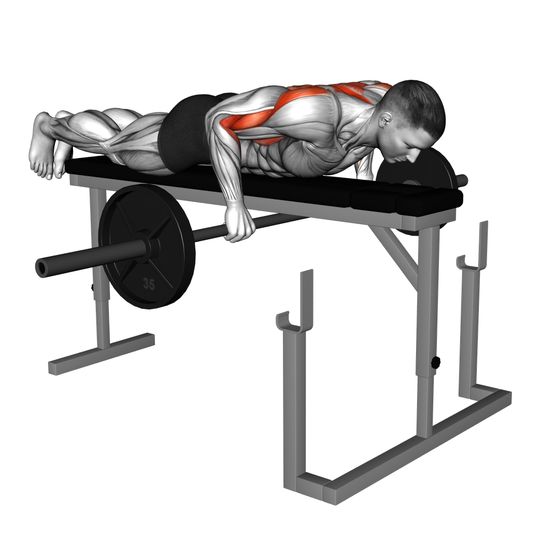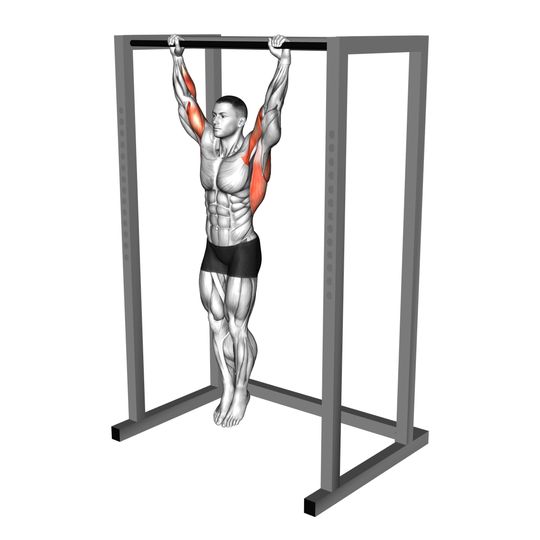


A one-arm dumbbell row performed with one knee and hand bracing on a bench, using a pulling motion to work the back muscles, primarily the latissimus dorsi and upper back. The movement lifts the weight from a hanging position to the side of the torso.
How to do the One Arm Dumbbell Row#
- Place one knee and the same-side hand on a bench so your torso is supported and the other arm hangs toward the floor holding the dumbbell.
- Engage your core and keep your spine and neck in a neutral, straight line.
- Drive your elbow upward and pull the dumbbell toward the side of your torso, leading with the elbow rather than the hand.
- Pause and squeeze your shoulder blade at the top of the movement while exhaling.
- Lower the dumbbell slowly back to the starting hang under control.
Muscles worked#
- Primary: Lats (Latissimus Dorsi), Upper back (Rhomboids & Middle Trapezius)
- Secondary: Biceps (Biceps Brachii), Rear delts (Posterior Deltoid), Forearms (Forearm Flexors & Extensors (incl. Brachioradialis)), Traps (Trapezius)
Common mistakes#
- Rounding the lower back instead of keeping a neutral spine.
- Twisting the torso to help lift the weight.
- Using momentum or jerking the dumbbell upward.
- Letting the elbow flare wide instead of keeping it close to the body.
Why it works#
The one-arm dumbbell row is the easiest heavy back movement to set up. A hand and knee on the bench take the load off your lower back, so the lats and mid-back can work hard without your spinal erectors deciding when the set ends.
Rowing one side at a time also buys range of motion a barbell cannot match, and it forces each side to pull its own weight instead of hiding behind the other.
Sets, reps and setup#
Three to four sets of 8-12 reps per arm, resting 60-90 seconds between sides. Two rowing sessions a week suit most back training.
- Setup
- Same-side hand and knee on the bench, back flat and roughly parallel to the floor, dumbbell hanging straight down. Pull the elbow back toward your hip rather than out to the side, and let the shoulder blade travel at the bottom.
- Progression
- Work up to 12 reps on both arms before moving to the next dumbbell. If your torso twists to finish a rep, the weight is too heavy.
Variations#
- Bent Over Row (Dumbbell) Both arms at once, no bench. Faster to run but harder on the lower back.
- Bent Over Row (Barbell) More total load per set, less range of motion per side.
- Chest Supported T-Bar Row Chest on a pad takes the lower back out entirely.
- Seated Row (Cable) Constant tension and a simple setup for higher-rep back volume.
One-arm dumbbell row vs barbell row#
Use the one-arm row when you want range of motion and a fresh lower back, and the barbell row when you want total load. Because the bench supports your torso, you can push close to failure without your erectors calling the set.
The barbell row trains both sides under one heavier load, but it fatigues the lower back and hides side-to-side differences.
Common questions#
How many sets and reps per arm should I do?
Three to four sets of 8-12 reps on each arm, resting about a minute. Finish every rep on one side before switching.
Should I row to my hip or to my chest?
Row toward the hip with the elbow close to the body for the lats. Pulling higher toward the ribs with the elbow flared shifts work to the rhomboids and rear delts.
How heavy should I go?
Heavy enough that 12 reps is genuinely hard, light enough that your torso stays still. Twisting to finish a rep shortens the range you actually loaded.
What can I do without a bench?
Brace your free hand on a rack upright, a dumbbell stood on end, or your own knee in a staggered stance. The support only needs to keep your torso flat.