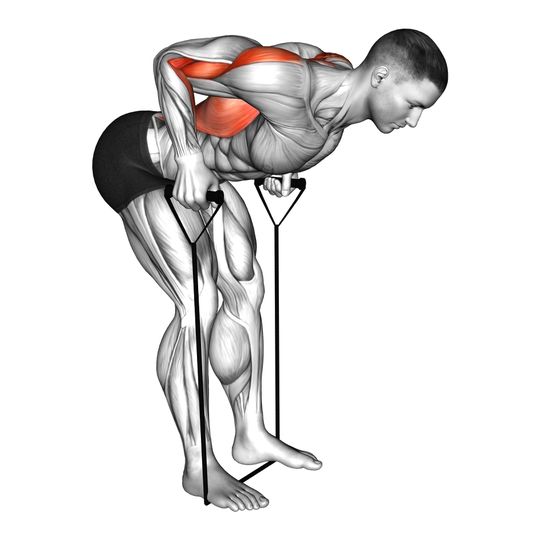


From a high-plank position, perform single-arm dumbbell rows to work the upper back while the core holds the torso stable.
How to do the Renegade Row#
- Place a dumbbell in each hand on the floor and get into a high plank with your hands gripping the dumbbells and feet set wider than hip-width for balance.
- Brace your core and keep your hips level so your body forms a straight line from head to heels.
- Pull one dumbbell toward your lower rib cage by driving your elbow back and squeezing the upper back at the top of the movement.
- Lower the dumbbell back to the floor with control and pause briefly before performing the row on the opposite side.
- Keep a neutral neck and avoid rotating your torso as you row each arm.
Muscles worked#
The renegade row is a one-arm row done from a plank, so the lats and upper back on the rowing side drive the elbow back and up while the rest of the body fights to stay level. The lats pull the dumbbell toward the hip, and the rhomboids and mid traps retract the shoulder blade at the top. The rear delts and biceps assist the pull, exactly as in a bent-over row, but with less weight than you could normally handle.
The reason to do the exercise is everything else. The obliques and abs opposite the rowing arm work hard to stop the hips rotating toward the floor, and the abs prevent the lower back sagging. The supporting arm's chest, front delt, triceps, and serratus anterior hold a one-arm plank. Grip and forearms work from balancing on a dumbbell handle. It is as much a core exercise as a back exercise.
- Primary: Lats (Latissimus Dorsi), Upper back (Rhomboids & Middle Trapezius)
- Secondary: Abs (Rectus Abdominis), Obliques (External & Internal Obliques), Biceps (Biceps Brachii), Rear delts (Posterior Deltoid), Triceps (Triceps Brachii)
Common mistakes#
- Allowing the hips to rotate toward the rowing side.
- Letting the hips drop or the lower back sag.
- Using momentum or jerking the weight instead of a controlled pull.
- Flaring the elbow too far away from the body.
- Not bracing the core, causing instability.
Why it works#
The renegade row trains anti-rotation core strength in a way that carries directly into heavy lifting and sport. Every rep, the trunk resists a rotating load while a limb moves, which is what happens in a single-arm carry, a punch, a throw, and any brace under an uneven load. Planks build the same muscles, but the moving load makes the position much harder to hold.
It is also efficient. A pair of dumbbells and two metres of floor cover the upper back, core, shoulders, and grip in one set, and it fits into circuits and warm-ups without a bench or a cable stack. It is not a mass builder for the back, but as a stability and control exercise it is hard to beat.
Sets, reps and setup#
Three sets of 6-10 reps per arm with 60-90 seconds of rest, once or twice a week, as a core exercise or a second back movement. Go slower than you want to: a one-second pause at the top of each row with the hips perfectly still is the standard. If you cannot hold that pause, the weight is too heavy.
- Setup
- Use hex dumbbells so they do not roll. Set up in a high plank with the hands on the handles under the shoulders and the feet wider than hip-width, which makes balancing far easier. Squeeze the glutes, brace the abs, and row one dumbbell to the lower ribs by driving the elbow up and back. Lower it under control, then row the other side.
- Progression
- Narrow the feet as the exercise gets easier; feet together is far harder than a wide stance. Then add weight, and only then reps. If the hips rotate or the lower back arches, widen the stance or reduce the load. Anyone who cannot yet hold a one-arm plank should build to that first with hands on a bench.
Variations#
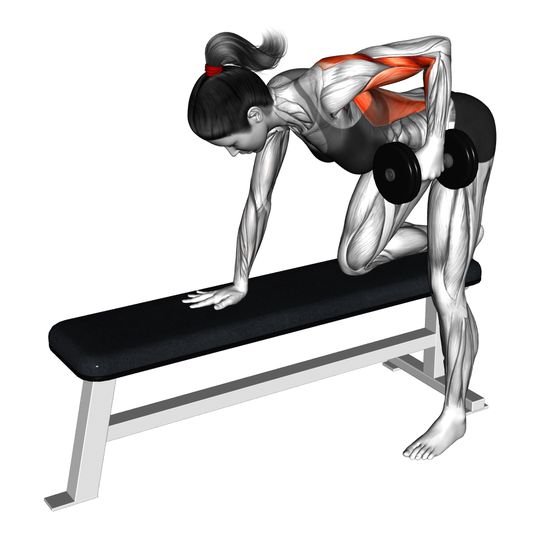
- One Arm Dumbbell Row Supported on a bench, so you can row two to three times the weight and actually build the back.
- Kettlebell Gorilla Row Bent over with kettlebells on the floor, alternating arms, heavy loads and no plank.
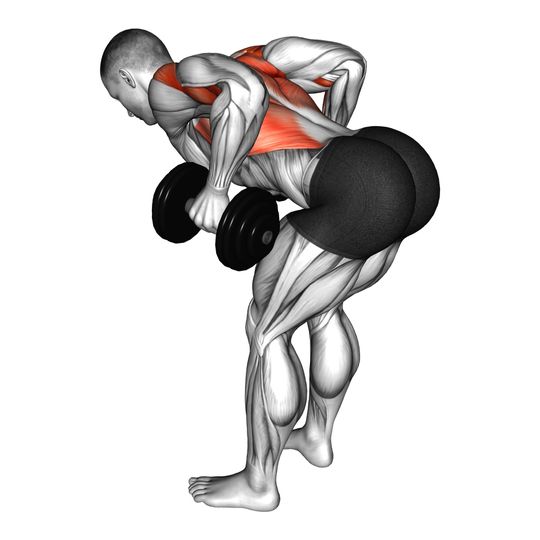
- Dumbbell Bent Over Row Both arms from a hinge, the volume-friendly way to train the upper back with dumbbells.
- High Plank The base position of the renegade row, worth mastering before adding the pull.
Renegade row vs one arm dumbbell row#
The one arm dumbbell row braces you on a bench so nothing limits the weight except your back and grip. That makes it the better back exercise by a wide margin: you can row heavy, stretch the lat fully at the bottom, and take sets close to failure without falling over. If back size is the goal, it belongs in your program and the renegade row is optional.
The renegade row trades load for stability demand. You will use perhaps a third of the weight, the back gets a moderate stimulus, and the core, shoulders, and grip get a hard one. It belongs in the core part of a session or a home program, not as your main horizontal pull.
Common questions#
What muscles does the renegade row work?
The lats, rhomboids, mid traps, and rear delts pull the dumbbell, with the biceps assisting. The obliques and abs stop the trunk rotating, while the supporting arm's chest, shoulder, triceps, and serratus hold the plank.
Are renegade rows good for abs?
Yes. The anti-rotation demand on the obliques and the anti-extension demand on the abs are the main reason to do the exercise. Keep the hips completely still and the core does more than in a standard plank.
How heavy should renegade rows be?
Light enough that the hips do not move when you row, usually 25-40 percent of your one arm dumbbell row weight, often 10-20 kilos. Heavier turns it into a wobbly half-range row and loses the point.
Should the feet be wide or narrow?
Wide when learning, because a wider base makes balancing far easier. Narrow the stance as you get stronger; feet together is the hardest version and a genuine progression without heavier dumbbells.