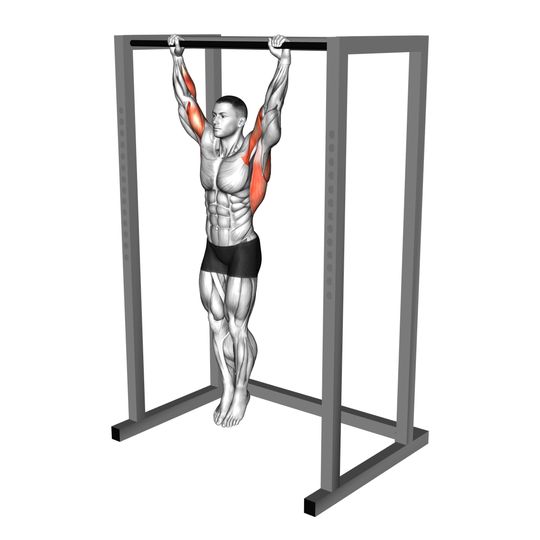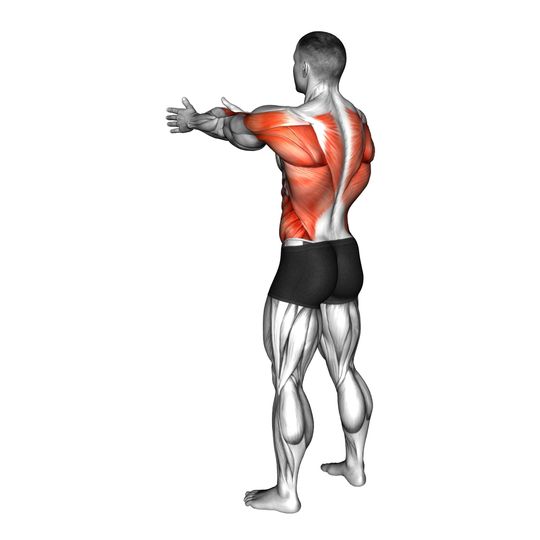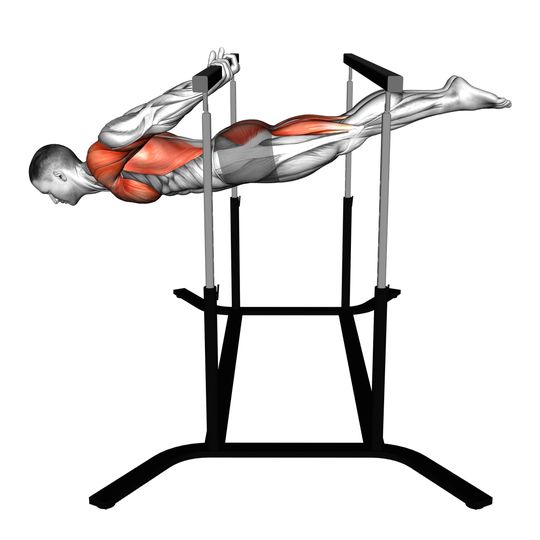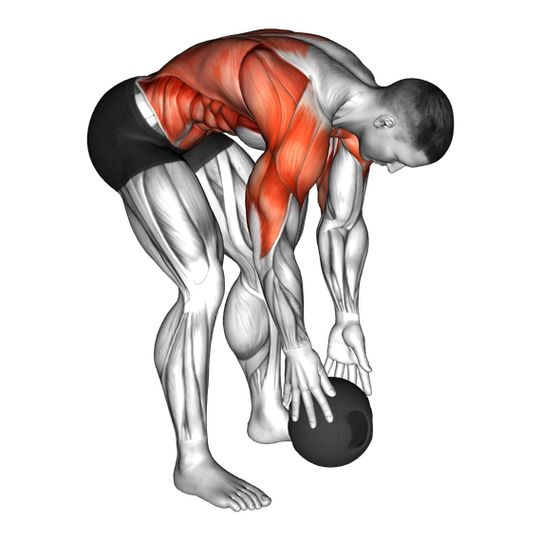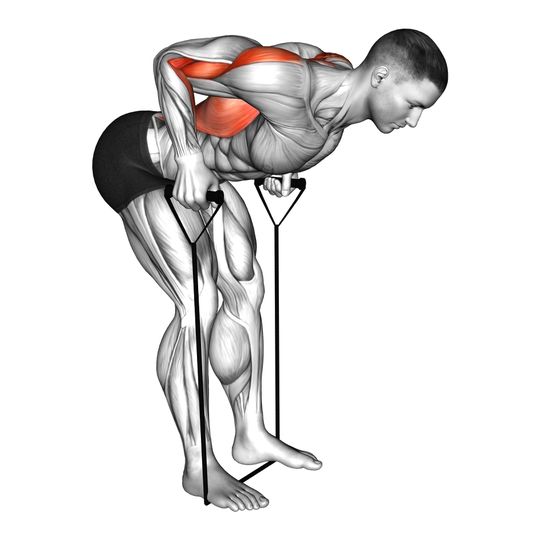


A hip-hinged pulling movement that brings dumbbells toward the hips to work the upper back. Maintain a flat spine while rowing to the top of each rep.
How to do the Dumbbell Bent Over Row#
- Hold a dumbbell in each hand with your palms facing inward at your sides.
- Hinge at the hips and bend your knees slightly, keeping your back straight and chest open.
- Tighten your core and keep your neck neutral throughout the movement.
- Pull the dumbbells toward your hips by driving your elbows back and squeezing your shoulder blades together.
- Lower the weights slowly to the starting position and repeat for the prescribed reps.
Muscles worked#
The dumbbell bent over row builds the whole back. The lats (latissimus dorsi) pull the elbows back and toward the hips, and because the dumbbells can travel to the sides of the body rather than being stopped by the torso, the lats get a longer range than a barbell row allows. The rhomboids and mid traps of the upper back squeeze the shoulder blades together at the top, and the rear delts help drive the elbows back behind the body.
Everything below the shoulders is working to hold the hinge. The spinal erectors of the lower back keep the torso at roughly 45 degrees for the whole set, the hamstrings and glutes anchor the hips, and the abs stop the trunk from rotating as each dumbbell moves. The biceps and forearms bend the elbows and hold the weights, and grip is often what gives out first on heavy sets.
- Primary: Lats (Latissimus Dorsi), Upper back (Rhomboids & Middle Trapezius)
- Secondary: Biceps (Biceps Brachii), Rear delts (Posterior Deltoid), Traps (Trapezius), Lower back (Erector Spinae), Forearms (Forearm Flexors & Extensors (incl. Brachioradialis))
Common mistakes#
- Rounding the lower back during the hinge.
- Using torso swing instead of arm/elbow drive.
- Pulling primarily with the hands instead of leading with the elbows.
- Lifting the head and breaking a neutral neck position.
- Dropping the shoulder blades instead of squeezing them together.
Why it works#
Rowing with two dumbbells is a rare combination of heavy loading and independent arms. Each side has to move its own weight, so a stronger lat cannot pull more than its share, and the hands are free to rotate from neutral to pronated through the rep, which most people find more comfortable on the shoulders than a fixed bar. The longer range at the top means a harder contraction in the upper back.
The bent over position also trains the hinge under load, so the lower back and hamstrings get isometric work that carries over to deadlifts. It needs no rack, no machine, and no bench, which makes it the default back exercise for home gyms and busy commercial ones alike.
Sets, reps and setup#
Three or four sets of 8-12 reps with 90 seconds of rest, once or twice a week. Pull both dumbbells together, pause for a second with the shoulder blades squeezed, and lower over two seconds.
- Setup
- Hold a dumbbell in each hand, push the hips back, and hinge until the torso is around 45 degrees with a soft bend in the knees and a flat back. Let the arms hang straight down. Drive the elbows up and back toward the hips, keeping them close to the body, until the dumbbells reach the sides of the ribs. Lower to a full stretch without letting the shoulders roll forward.
- Progression
- Add 2 kg per hand when 12 reps are clean on all sets. If the torso rises as the set goes on, the load is too heavy for the lower back; hold the weight and add reps or switch to a chest-supported version for a cycle.
Variations#
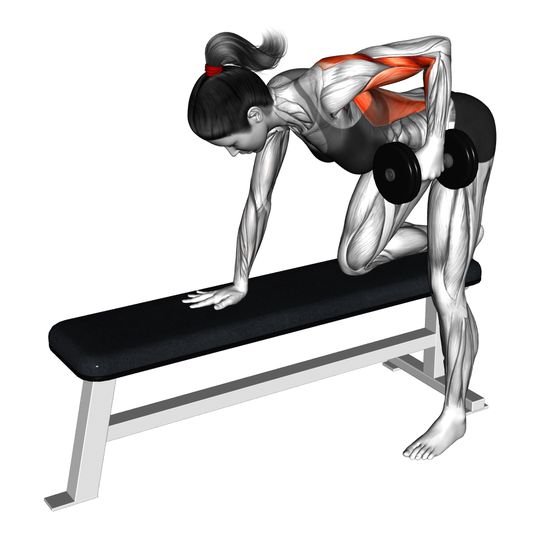
- One Arm Dumbbell Row One hand braced on a bench so the lower back is supported and each lat can be loaded heavier.
- Barbell Bent Over Row Both hands on a bar for the heaviest loads, with a shorter range at the top.
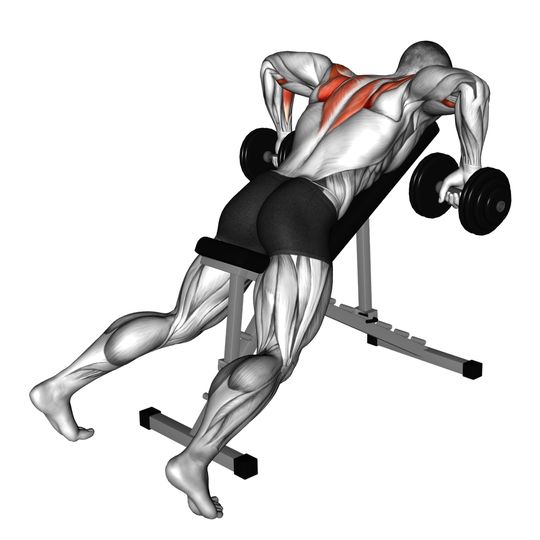
- Dumbbell Incline Row Chest on an incline bench, which removes the hinge and lets you take the upper back to failure.
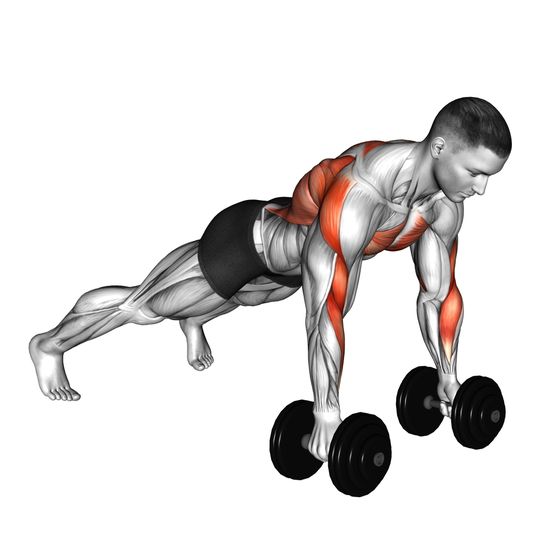
- Kettlebell Gorilla Row Alternating rows from a deep hinge with the weights starting on the floor, adding a heavy grip and core demand.
- Seated Cable Row A supported horizontal row with constant tension for volume work.
Dumbbell bent over row vs barbell bent over row#
The barbell lets you move more total weight, which makes it the better choice for building raw back strength and for lifters who want a row that scales with their deadlift. The bar stops at the torso, though, which cuts the range short at the top and locks the hands into one grip.
Dumbbells trade some load for a longer range, independent arms, and the freedom to rotate the wrists, so they are usually better for upper back and lat development and for anyone whose shoulders dislike a fixed bar. If your lower back limits the dumbbell version before your lats do, the one arm row with a hand on a bench is the fix.
Common questions#
What muscles does the dumbbell bent over row work?
The lats and upper back are the main movers, with the rear delts, biceps, and forearms assisting the pull. The lower back, glutes, hamstrings, and abs work isometrically to hold the bent over position.
How far should I bend over for a dumbbell row?
Around 45 degrees is the sweet spot. Closer to parallel with the floor increases the range and the lower back demand; more upright is easier to hold but shortens the pull. Pick an angle you can keep for the whole set rather than one that rises as you fatigue.
Should I row the dumbbells to my chest or my hips?
Toward the hips with the elbows close to the body for a lat-dominant row, or toward the lower chest with the elbows wider for more upper back and rear delt work. Both are useful; most lifters default to the hips and change the angle every few weeks.
Why does my lower back hurt during dumbbell rows?
Either the back is rounding, the load is heavier than the erectors can hold for a full set, or you are swinging the torso to move the weight. Reduce the weight, brace before each rep, and if the problem persists use the one arm row with a hand on a bench or a chest-supported row instead.
Are dumbbell rows good for building a wide back?
Yes. The lats create the width and the dumbbell row loads them through a long range with the elbows travelling behind the body. Pair rows with a vertical pull like pull ups or pulldowns and you have covered the back from both angles.