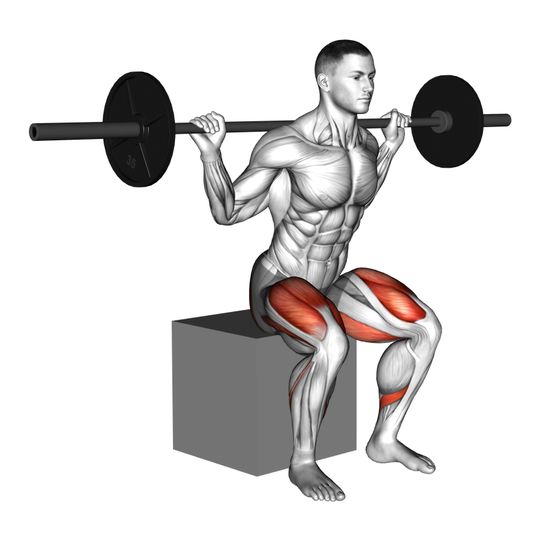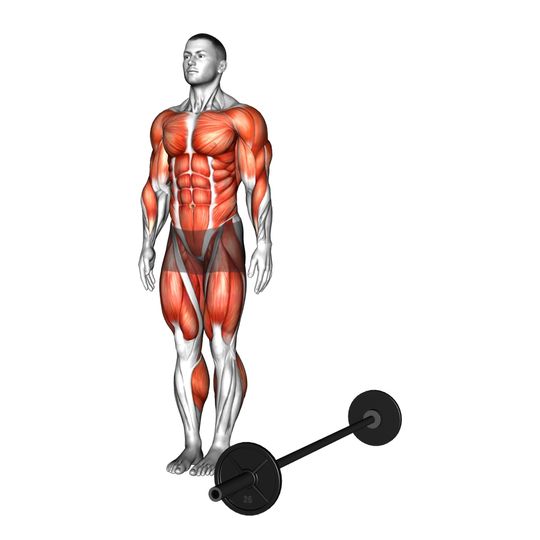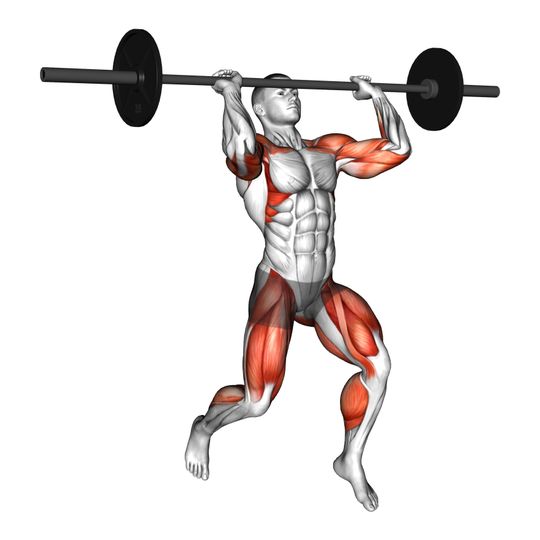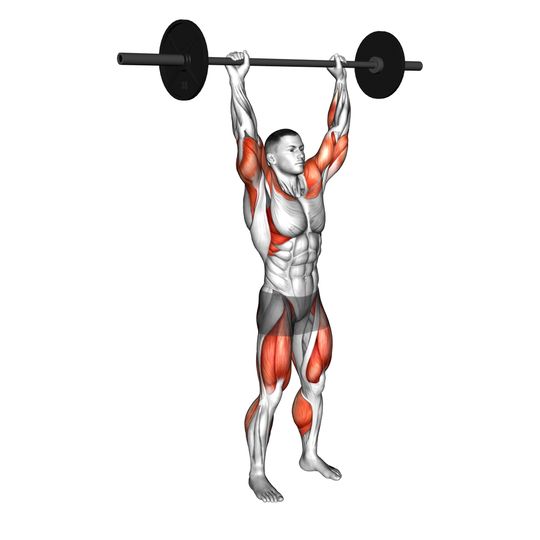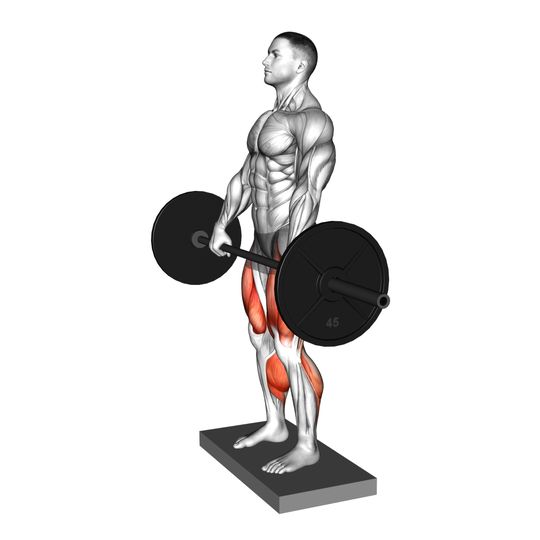


A standing hip-hinge that lifts a loaded barbell from the floor to full standing, primarily working the hamstrings.
How to do the Barbell Deadlift#
- Position the bar over the middle of your feet, set feet about shoulder-width, and grip the bar outside your legs.
- Hinge at the hips and bend the knees until your shins touch the bar, lift your chest, and brace your core.
- Drive through your heels to extend your hips and knees, bringing the bar to hip level while keeping it close to your legs.
- Reverse the motion by pushing your hips back and bending your knees to lower the bar to the floor under control.
Muscles worked#
- Primary: Glutes (Gluteus Maximus), Hamstrings (Biceps Femoris, Semitendinosus & Semimembranosus), Lower back (Erector Spinae)
- Secondary: Quads (Quadriceps Femoris), Traps (Trapezius), Upper back (Rhomboids & Middle Trapezius), Forearms (Forearm Flexors & Extensors (incl. Brachioradialis)), Abs (Rectus Abdominis)
Common mistakes#
- Rounding the lower back during the lift.
- Letting the bar drift away from the legs.
- Hips rising before the torso and breaking the hinge pattern.
- Overextending the lower back at the top.
How much should you deadlift?#
What the average deadlift actually is, and what counts as beginner, intermediate, advanced, or elite at your bodyweight — for men and women, in kg and lbs.
See deadlift strength standards →
Barbell Deadlift vs other exercises#
Head-to-head breakdowns of muscles worked, loading, joint stress, and which one to pick for your goal.
- Romanian Deadlift vs Deadlift →
- Sumo vs Conventional Deadlift →
- Deadlift vs Squat →
- Rack Pull vs Deadlift →
Why it works#
The deadlift trains the glutes, hamstrings and spinal erectors under the heaviest load you can handle, and it is the one big lift that starts from a dead stop, so there is no stretch reflex to hide behind.
It also builds everything that holds the bar and your torso together: traps, upper back, forearms and abs. Back thickness and grip are side effects of pulling heavy rather than separate projects.
Sets, reps and setup#
Three to four sets of 3-6 reps, resting 3-5 minutes. Deadlifts cost more fatigue per set than other lifts, so one heavy day a week plus a lighter hinge day covers most lifters.
- Setup
- Bar over midfoot with your shins about an inch away, hips higher than a squat but below the shoulders. Pull the slack out of the bar, brace, then push the floor away and keep the bar against your legs.
- Progression
- Add 5-10 lb a week while every rep looks the same. When your back position starts changing mid-set, end the set.
Variations#
- Romanian Deadlift (Barbell) Starts at the top and stops at mid-shin. Builds hamstrings under a long stretch.
- Sumo Deadlift (Barbell) Wide stance, hands inside the knees. Shorter range with more quad and adductor work.
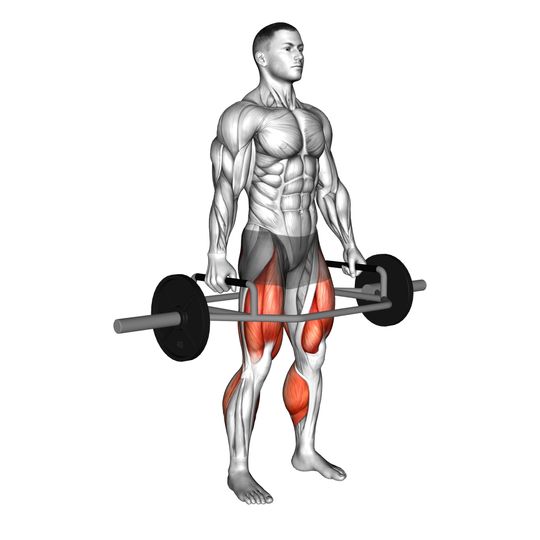
- Deadlift (Trap Bar) Handles at your sides keep the load closer and the torso more upright.
- Pause Deadlift (Barbell) A pause below the knee exposes and fixes a weak first pull.
Conventional vs sumo deadlift#
Conventional puts more work on the hamstrings and spinal erectors. Sumo shortens the range of motion and shares more of the load with the quads and adductors.
Lifters with long limbs and a short torso often pull more sumo, while long-torso lifters usually prefer conventional. If you deadlift for size, rotating both across a year is fine.
Common questions#
How many sets and reps should I deadlift?
Three to four sets of 3-6 reps for most goals, resting 3-5 minutes. Higher reps work, but form fades fast, so stop when your position changes.
How often should I deadlift?
One heavy pulling day a week is enough for most lifters, plus a lighter hinge session with Romanian deadlifts or hip thrusts if you want more volume.
Are straps or a mixed grip cheating?
No. Grip usually gives out before the back and legs do, so straps let you train the muscles you were targeting. Keep double-overhand for warm-up sets.
My lower back rounds. What should I change?
Start the hips slightly higher, brace harder before the bar moves, and drop the weight until every rep holds position. Keep the bar over midfoot and against your legs.