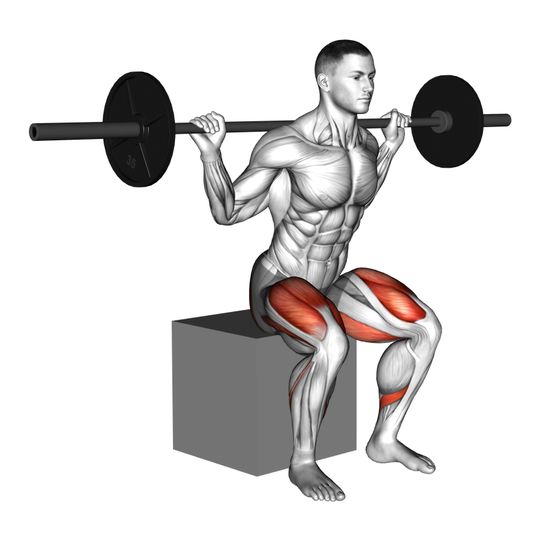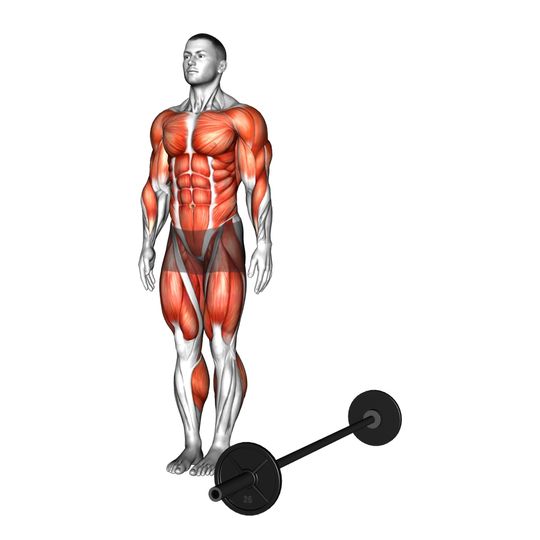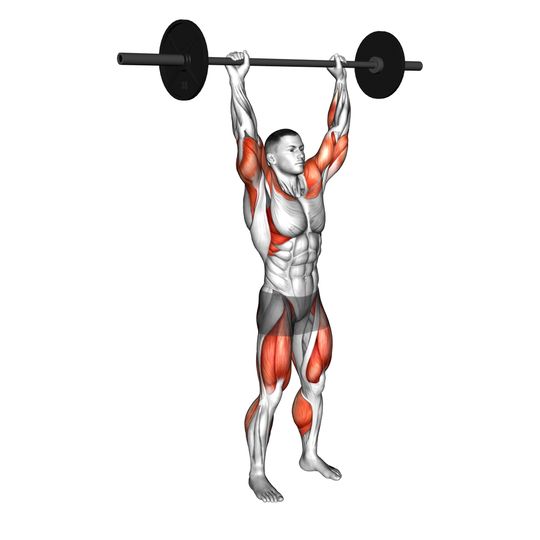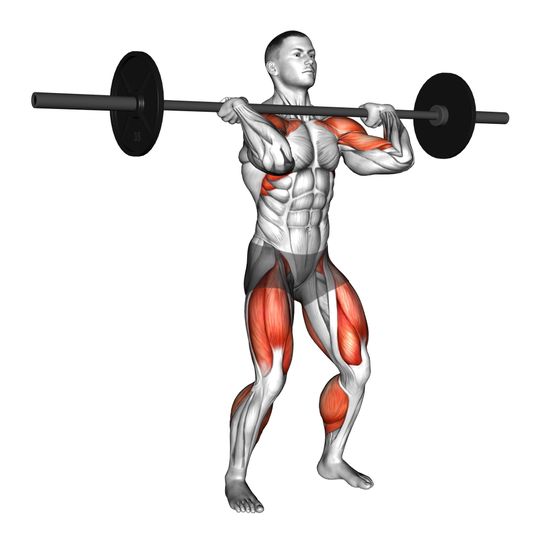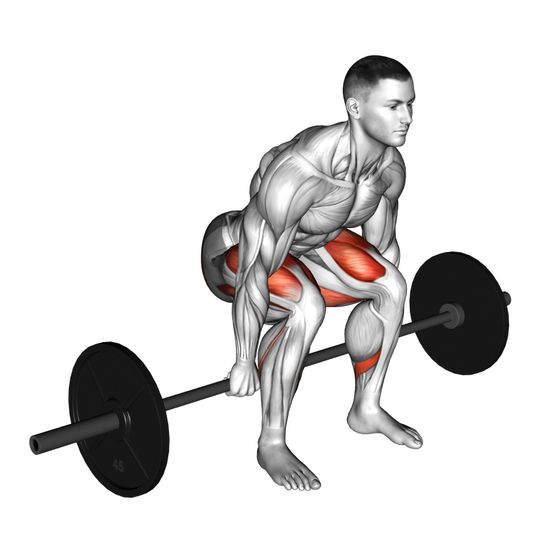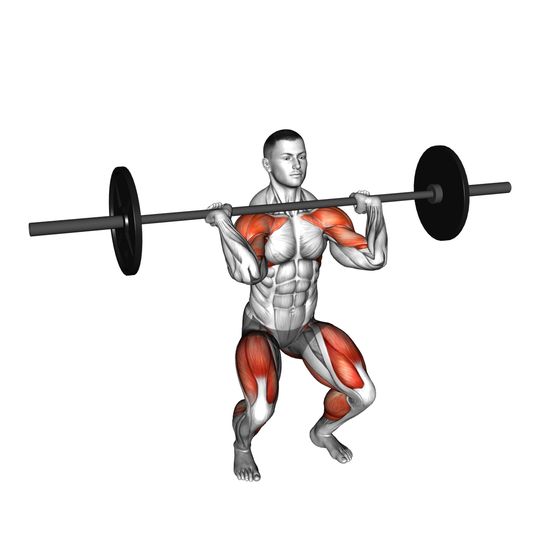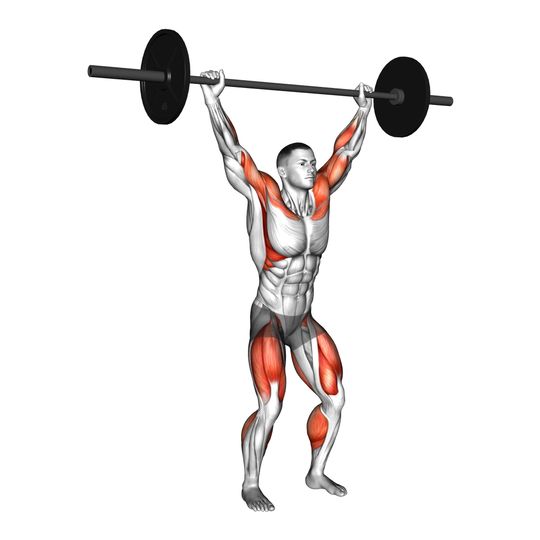


An explosive two-stage barbell lift that pulls the weight to the front rack and then drives it overhead, engaging the legs, back, shoulders, arms, and core.
How to do the Clean and Jerk#
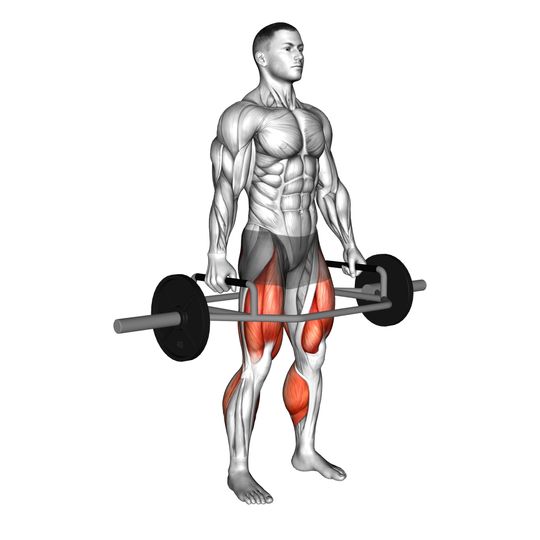
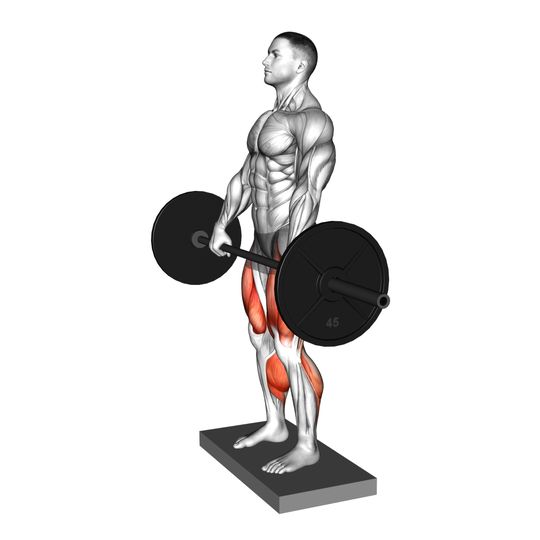
- Stand feet about shoulder-width, brace your core, keep a neutral spine, and grip the bar overhand just outside shoulder width.
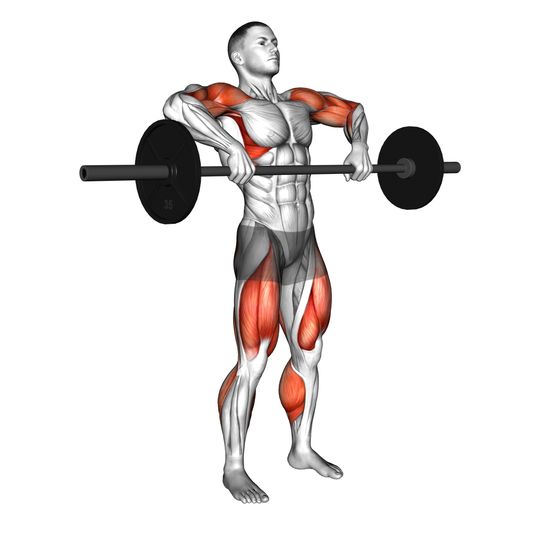
- Drive through your heels to begin the pull, extending hips and knees while keeping the bar close to the front of your body.
- As the bar accelerates upward, extend explosively and drop your body under the bar.
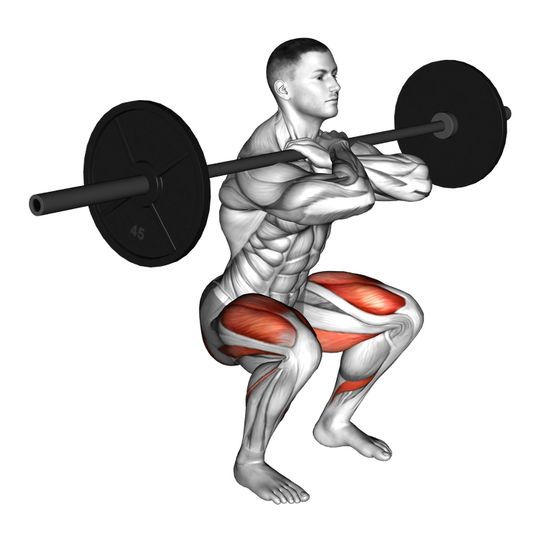
- Catch the bar on your shoulders in a shallow front squat with elbows high and chest up.
- Stand up from the rack position, then use leg drive to push the bar overhead until arms are locked.
- Lower the bar back to the front rack in control and reset before repeating.
Muscles worked#
The clean and jerk uses almost every muscle in the body, but the quads and glutes do the heavy lifting twice. They drive the bar off the floor and through the explosive second pull, stand it up out of the deep front squat, and then dip and drive it overhead in the jerk. The hamstrings and lower back hold position in the pull, the traps shrug the bar high, and the front delts and triceps lock the weight overhead. Few exercises hit legs and shoulders this hard in one rep.
The upper back and front delts rack the bar in the clean and keep it steady during the jerk dip, the calves finish every extension, and the forearms hold a bar that is moving at speed. The abs and obliques brace hard in the front squat and again overhead to stop the load from folding you forward or arching you back. The lift feels like a whole-body effort and taxes coordination and the nervous system more than any single muscle.
- Primary: Quads (Quadriceps Femoris), Glutes (Gluteus Maximus), Front delts (Anterior Deltoid)
- Secondary: Hamstrings (Biceps Femoris, Semitendinosus & Semimembranosus), Traps (Trapezius), Triceps (Triceps Brachii), Calves (Gastrocnemius & Soleus), Upper back (Rhomboids & Middle Trapezius)
Why it works#
The clean and jerk is the heaviest weight a human can lift from the floor to overhead, and training it develops power in the legs and hips that slow lifts cannot. It teaches you to produce force quickly and then to absorb and stabilise a load, twice per rep, which is why it sits at the centre of most strength and conditioning programs for sprinting, jumping, and contact sports.
It also builds mobility and full-body coordination as a side effect. A good clean needs deep squat depth, an open front rack, and a stable overhead position, and lifters who train it end up with hips, ankles, and shoulders that move better than most gym-goers'. On top of that, heavy clean and jerks build thick traps, upper backs, and legs, and they are hard to beat for conditioning when done for moderate reps with light weight.
Sets, reps and setup#
Four to six sets of 1-3 reps with two to three minutes of rest, once or twice a week, done first in the session. Work between 70 and 85 percent of your best lift on most days and touch 90 percent or more only occasionally. Sets of five or more turn into a grind and teach slow habits; the lift is about speed and precision.
- Setup
- Grip the bar a thumb outside the legs with a hook grip, hips higher than the knees, shoulders over the bar. Push the floor away, keep the bar close, extend explosively when it passes mid-thigh, and pull under into a front squat with the elbows whipping through. Stand, reset the feet, dip straight down a few inches, drive the bar off the shoulders, and punch under it into a split or power position with the arms locked.
- Progression
- Learn the pieces separately: front squats for the catch, hang cleans and power cleans for the pull, push presses and push jerks for the overhead drive. Add 2.5 kilograms only when every rep of a session is caught in the same position. Filming from the side and checking that the bar travels in a near-vertical line is the fastest way to find and fix faults.
Variations#
- Power Clean The clean received in a quarter squat with no jerk, the most common way to train the pull in general strength programs.
- Hang Clean Starts with the bar at the knees or thighs, isolating the explosive second pull and the catch.
- Push Jerk The overhead half of the lift on its own, taken from the rack to build the dip and drive.
- Split Jerk The jerk received in a split stance, the version most lifters use for maximal weights.
- Barbell Snatch The other Olympic lift, which takes the bar from the floor to overhead in one movement with a wide grip.
Clean and jerk vs snatch#
The snatch takes the bar from the floor to overhead in one continuous movement with a wide grip, so it is faster, lighter, and far more demanding on shoulder and hip mobility. A small position error usually means a missed lift, which makes it the harder of the two to learn and the more sensitive to fatigue.
The clean and jerk breaks the lift into two parts with a pause in the front rack, so it allows roughly 20 to 25 percent more weight and is more forgiving of imperfect positions. For general athletes and lifters after power and strength it is the more practical of the two, and most beginners learn it, or its pieces, first.
Common questions#
What muscles does the clean and jerk work?
The quads and glutes drive the pull, the front squat, and the jerk, with the hamstrings, lower back, and traps working hard in the pull. The front delts, upper back, and triceps rack the bar and lock it overhead, and the abs, calves, and forearms brace and hold throughout.
Is the clean and jerk a good exercise for building muscle?
It builds legs, traps, and upper back, but the low reps and long rest make it an inefficient hypertrophy tool. Use it for power and coordination and rely on squats, presses, and rows for size.
How much should I be able to clean and jerk?
Bodyweight for a single is a solid milestone for a recreational lifter, and around 1.25 to 1.5 times bodyweight is strong for anyone who is not a competitive weightlifter. Skill matters as much as strength, so most beginners are limited by technique long before muscle.
Should I split jerk or push jerk?
Learn the push jerk first because it is simpler, then move to the split jerk if you want to lift maximal weights. The split lets you receive the bar lower and with a wider base, which is why nearly all competitive lifters use it.
How often should I train the clean and jerk?
Once or twice a week is enough for most people, always early in the session when you are fresh. Weightlifters train it or its pieces more often, but they keep the weights moderate on most days and treat the lift as practice, not a test.
Why do I miss the jerk forward?
Usually the dip drifts forward onto the toes or the bar leaves the shoulders before the legs finish driving. Dip straight down through the heels, keep the elbows slightly in front of the bar, and drive with the legs before the arms do anything.