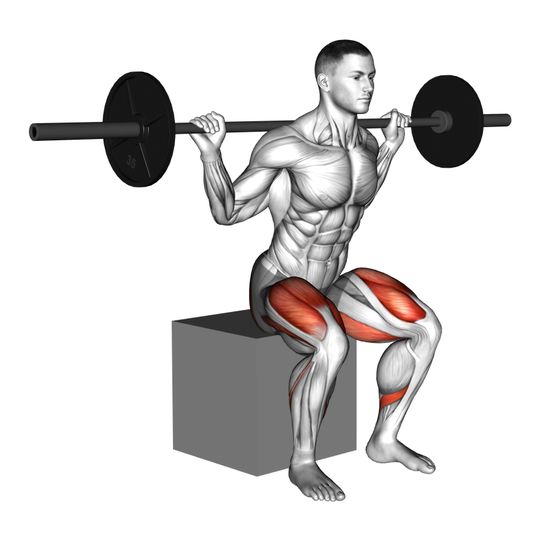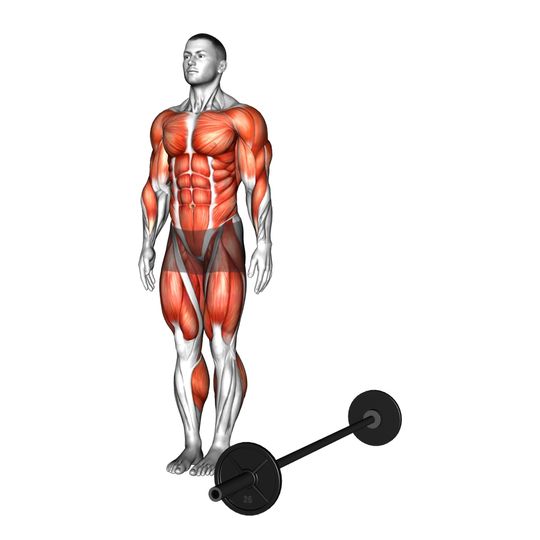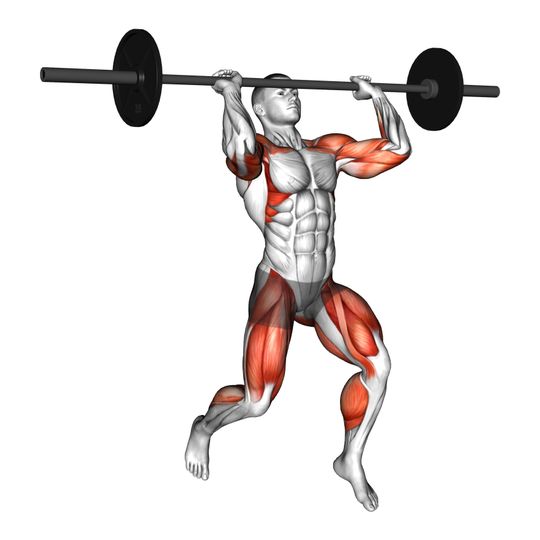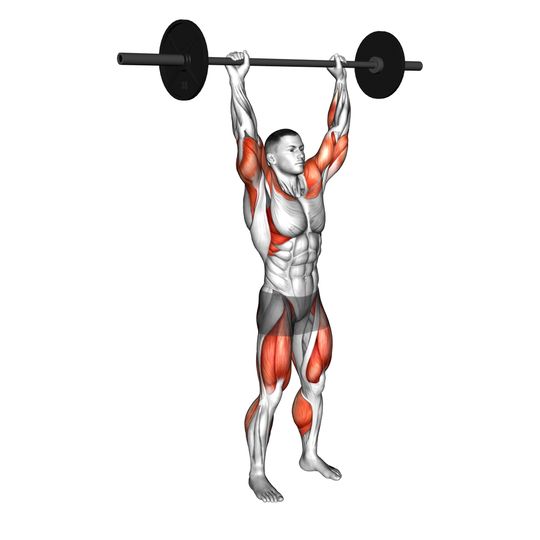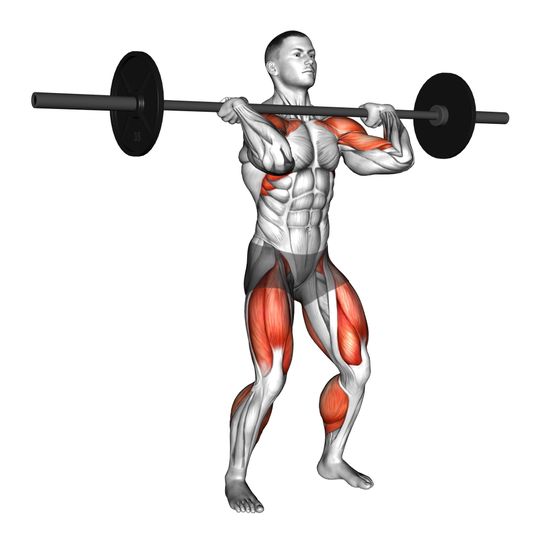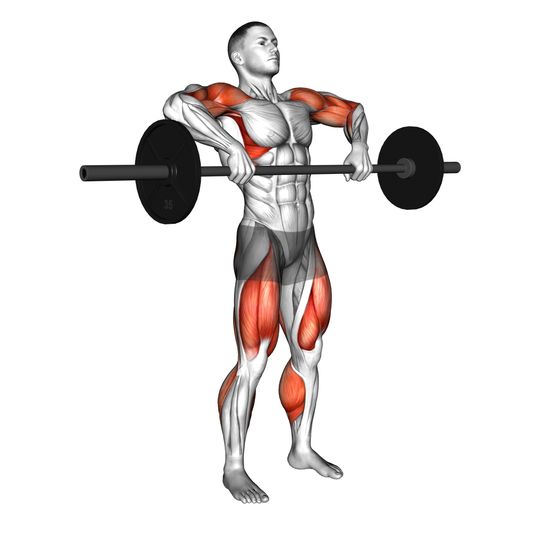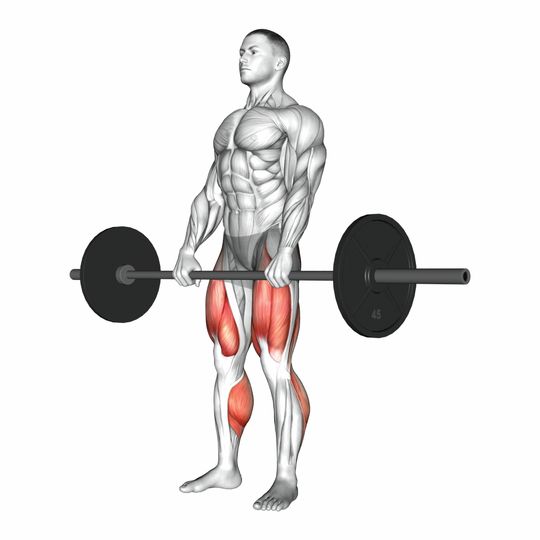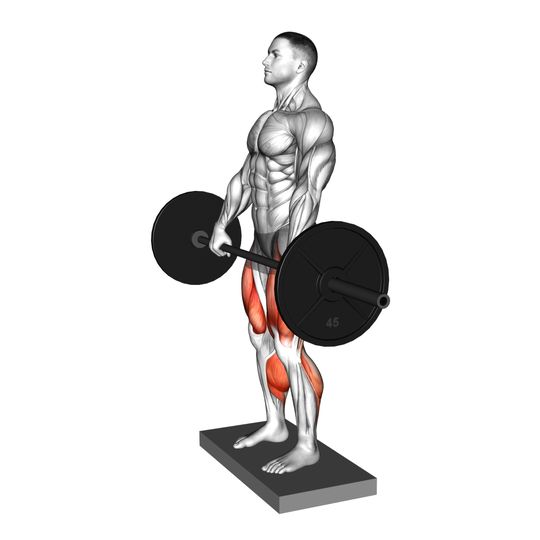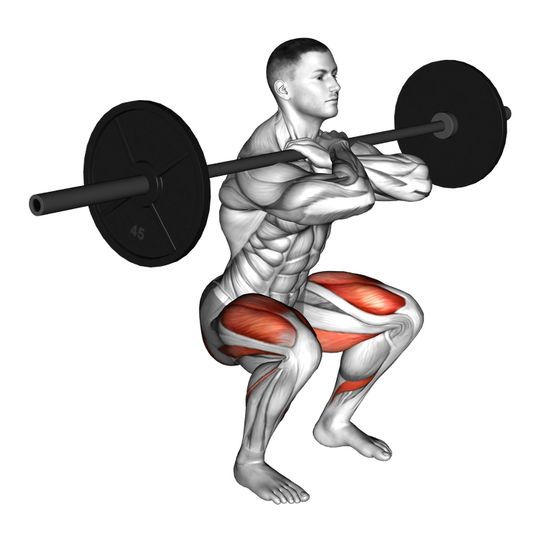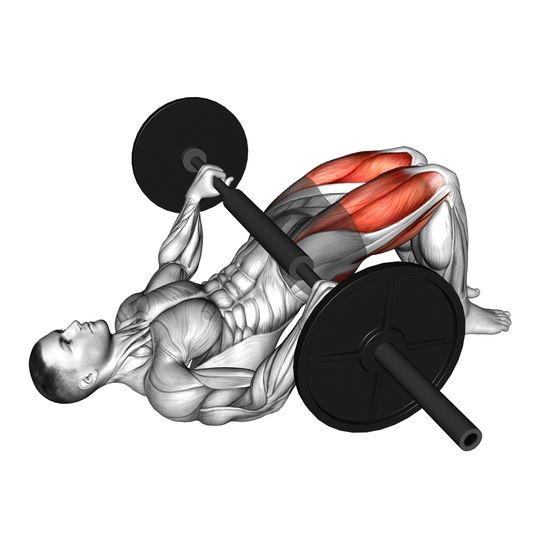


Stand inside a trap (hex) bar and extend hips and knees to lift the weight, emphasizing hip-drive that primarily loads the hamstrings. The movement combines a hip hinge with knee extension to rise to standing with the bar.
How to do the Trap Bar Deadlift#
- Load the trap bar and position your feet roughly hip- to shoulder-width apart inside the frame; grasp the handles with a neutral grip.
- Hinge at the hips and bend the knees slightly while keeping a tall chest and a neutral spine; look forward.
- Brace your core, inhale, then drive through your midfoot and extend your hips and knees to stand the bar up.
- Pause briefly with hips and knees fully extended and shoulders over the hips.
- Lower the bar under control by sending the hips back first, then bend the knees once the bar clears them; reset and repeat.
Muscles worked#
The trap bar deadlift is a full lower-body lift. Because the handles sit at your sides rather than in front of your shins, you can drop your hips lower and let the knees travel forward, which puts the quads to work alongside the glutes and hamstrings. The glutes (gluteus maximus) drive hip extension out of the floor, the hamstrings hold the hips back during the descent, and the quads straighten the knees, so the movement lands somewhere between a squat and a conventional pull.
Everything from the hands to the mid-back is working to keep the weight from folding you forward. The spinal erectors of the lower back hold a neutral position under a heavy load, the traps and upper back keep the shoulders packed over the bar, and the forearms carry a neutral grip that is far friendlier than a double overhand on a straight bar. Expect the traps to be sore after heavy sessions even though they never move.
- Primary: Glutes (Gluteus Maximus), Quads (Quadriceps Femoris), Hamstrings (Biceps Femoris, Semitendinosus & Semimembranosus)
- Secondary: Lower back (Erector Spinae), Traps (Trapezius), Forearms (Forearm Flexors & Extensors (incl. Brachioradialis)), Abs (Rectus Abdominis), Upper back (Rhomboids & Middle Trapezius)
Common mistakes#
- Rounding the lower back during setup or the lift.
- Pushing through the toes instead of driving through the midfoot or heels.
- Allowing the hips to shoot up faster than the shoulders, reducing hip drive.
- Bending the knees too early on the descent, causing the bar to collide with them.
How much should you deadlift?#
What the average deadlift actually is, and what counts as beginner, intermediate, advanced, or elite at your bodyweight — for men and women, in kg and lbs.
See deadlift strength standards →
Why it works#
The trap bar is the easiest way to load a hinge heavily without teaching a complex setup. The centred load means the bar cannot drift away from you, the neutral handles remove grip as a limiting factor for most lifters, and the more upright torso lowers the shear on the lower back. Most people pull more on a trap bar than on a straight bar within a few sessions, and they get there with less technique coaching.
It is also the better choice when the goal is legs rather than the lift itself. Athletes, older lifters, and anyone with a history of back irritation get most of the training effect of a deadlift with less of the cost.
Sets, reps and setup#
For strength, three to five sets of 3-6 reps at 75-88 percent of your max with two to three minutes of rest. For size and general work capacity, three or four sets of 6-10 reps with 90 seconds of rest works well, once or twice a week.
- Setup
- Stand in the centre of the frame with the handles in line with the middle of your feet. Hinge down, take the handles with a neutral grip, pull the slack out of the bar until you feel tension in your lats and hamstrings, then push the floor away. Stand tall at the top without leaning back and lower by sending the hips back first.
- Progression
- Add 5 kg per week while form holds, then switch to smaller jumps of 2.5 kg. When you stall, move to the low handles to increase range, add a two-second pause just off the floor, or run a deficit standing on a plate.
Variations#
- Barbell Deadlift The straight-bar version with the load in front of the shins, which shifts more work to the hamstrings and lower back and demands a tighter setup.
- Barbell Romanian Deadlift Starts from the top and stops just below the knee, keeping the hamstrings and glutes under constant stretch with far less quad involvement.
- Block Pull Pulling from raised blocks shortens the range so you can overload the top half and the lockout.
- Deficit Deadlift Standing on a plate lengthens the pull, which builds strength off the floor and gives the quads more to do.
- Trap Bar Shrug Uses the same bar and neutral grip to hit the traps directly once the deadlift sets are done.
Trap bar deadlift vs barbell deadlift#
The trap bar puts the load in line with your body, so the torso stays more upright and the knees bend more. That means more quads, less lower back, and a lift that most people can learn in a session. Peak force and power output are typically a little higher on the trap bar, which is why it shows up so often in athletic programs.
The barbell deadlift is the competition lift and a better teacher of hip hinge mechanics because the bar forces you to keep it close and the hips back. If you compete in powerlifting or want the biggest posterior chain stimulus per rep, pull a straight bar. If you want strong legs and a resilient back with less technical baggage, the trap bar is the smarter default.
Common questions#
What muscles does the trap bar deadlift work?
The glutes, quads, and hamstrings do the lifting, with the spinal erectors, traps, upper back, and forearms holding position under the load. Compared with a barbell deadlift it brings in more quads and puts less strain on the lower back.
Is the trap bar deadlift easier than a barbell deadlift?
It is easier to learn and easier on the lower back, and most people lift more weight on it. That does not make it a lesser exercise; it simply spreads the work more evenly between the hips and the knees.
Should I use the high or low handles?
The low handles give a full range of motion equivalent to a barbell pull. The high handles raise the start by around 10 cm, which suits taller lifters, anyone with limited mobility, or heavy overload work. Use the low handles by default and the high ones with purpose.
Is the trap bar deadlift a squat or a deadlift?
It sits between the two. The hinge is real and the hips travel back, but the knee bend and upright torso resemble a squat. Treat it as a deadlift in your program and expect it to build your quads more than a conventional pull would.