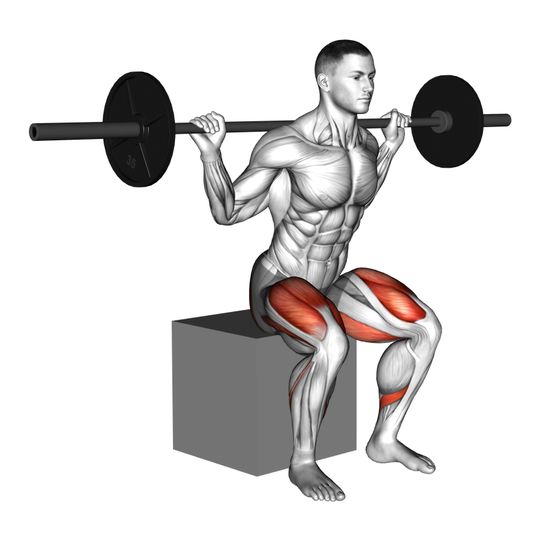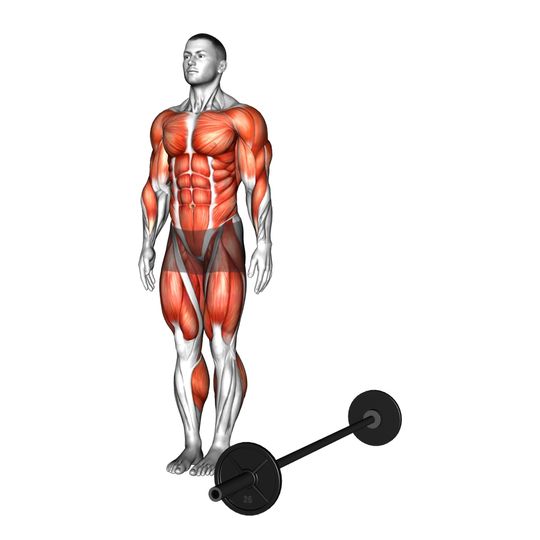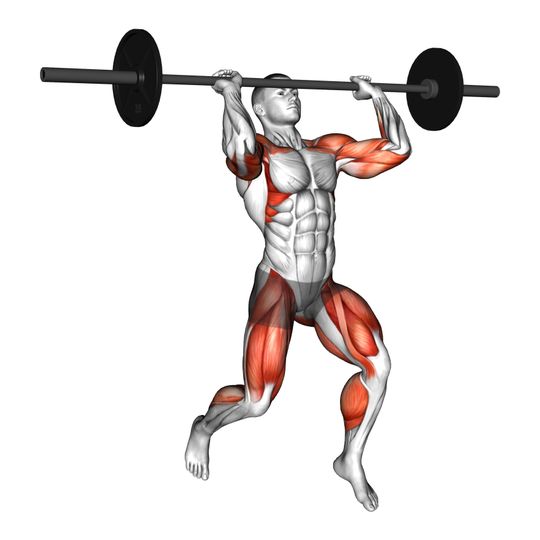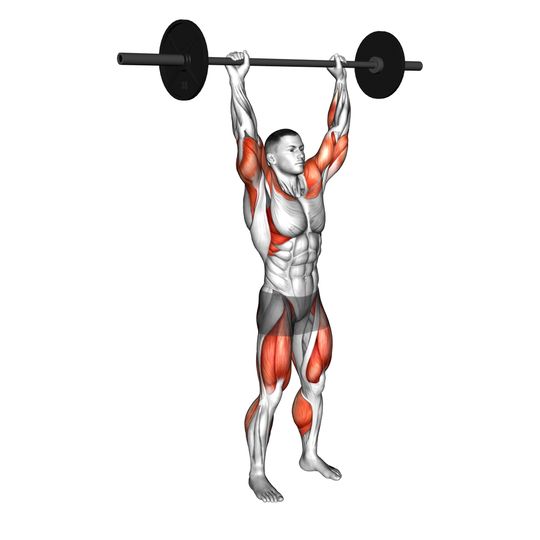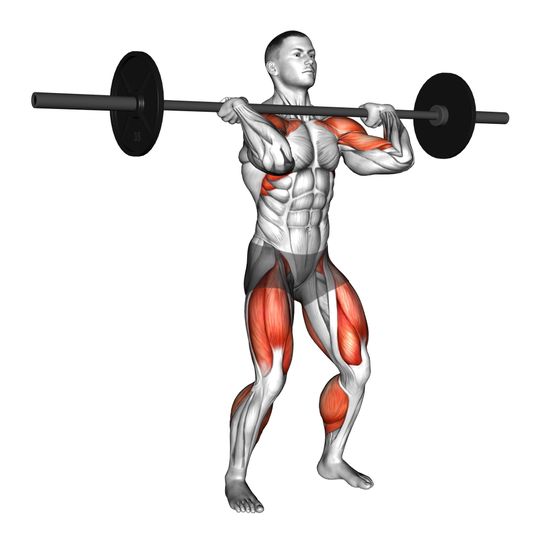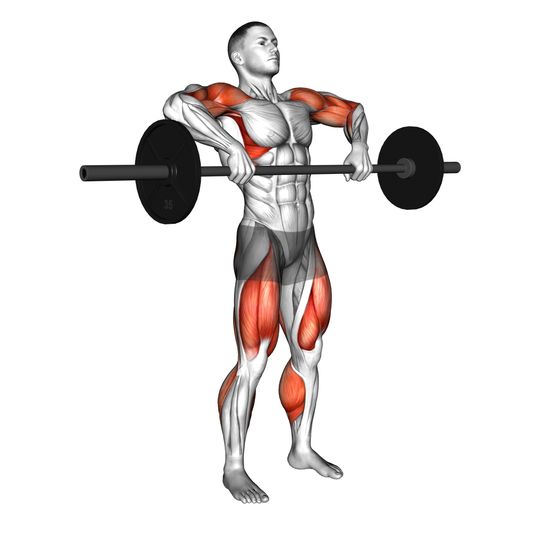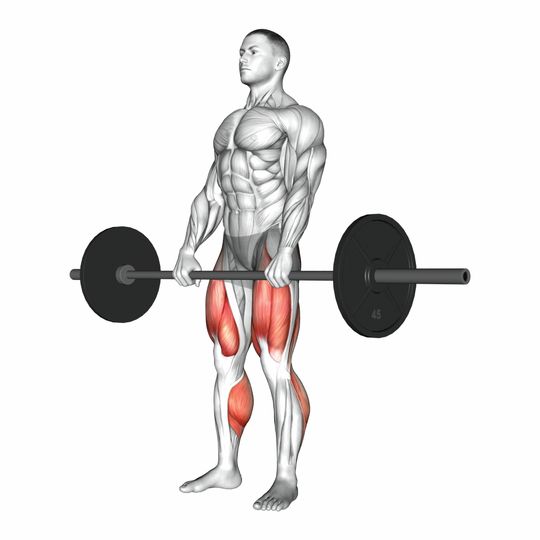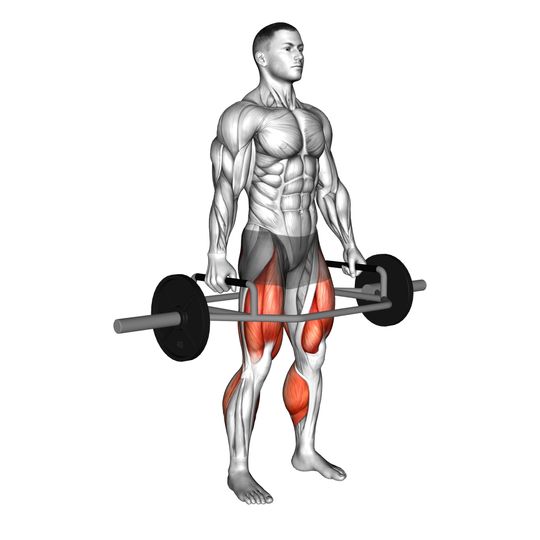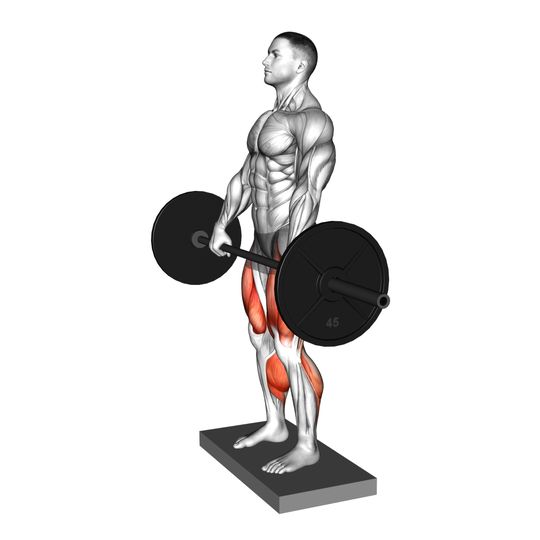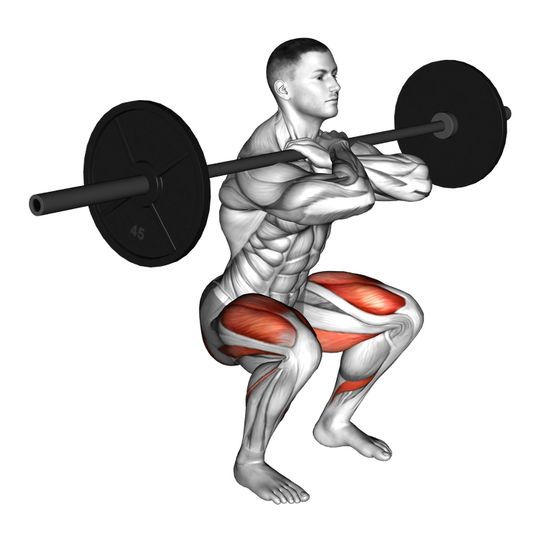


An explosive barbell movement that lifts the weight from the floor to the front rack by powerful hip and knee extension and a rapid drop-under; it primarily develops the legs, hips, upper back, shoulders, and arms.
How to do the Power Clean#
- Stand with feet about shoulder-width, brace your core, keep a neutral spine, and grip the barbell with a pronated grip just outside shoulder width.
- Begin the lift by driving through your heels: extend your knees and hips while keeping the bar close to your body.
- When the bar passes the knees, forcefully extend the hips and knees to accelerate the bar upward.
- As the bar reaches its peak, drop quickly beneath it into a shallow front-rack catch on the shoulders.
- Stand up to full extension to complete the rep, then lower the bar under control or reset for the next repetition.
Muscles worked#
The power clean is a full-body pull that ends with the bar on the shoulders. The glutes and quads produce the force: the quads push the floor away off the start and the glutes and hamstrings snap the hips open at the top of the pull. The upper traps and shoulder girdle finish the bar's upward path with a violent shrug and keep it close before you drop under and catch it in the front rack.
The hamstrings, spinal erectors, and lower back keep the bar path straight and the back flat off the floor, and the calves add to the drive as you extend onto the balls of the feet. The upper back, front delts, and forearms take over in the catch, absorbing the bar in a quarter squat with the elbows high. Nothing is isolated; the whole posterior chain and legs fire in one sequence.
- Primary: Glutes (Gluteus Maximus), Quads (Quadriceps Femoris), Traps (Trapezius)
- Secondary: Hamstrings (Biceps Femoris, Semitendinosus & Semimembranosus), Calves (Gastrocnemius & Soleus), Lower back (Erector Spinae), Upper back (Rhomboids & Middle Trapezius), Front delts (Anterior Deltoid)
Common mistakes#
- Using the arms to lift early instead of generating force from the hips.
- Allowing the bar to drift away from the body during the pull.
- Rounding the lower back during the initial pull.
- Catching too deep into a full squat instead of a shallow front rack.
Why it works#
The power clean is the most direct way to train explosive hip and knee extension with a barbell. You cannot lift the bar to the shoulders slowly, so every rep forces fast force production, which is why it has been a staple of athletic strength programs for decades. It carries into jumping, sprinting, and any sport where you move quickly against resistance.
It also builds the traps and upper back faster than shrugs or rows, because the second pull loads them with weights they could never lift under control, and the catch trains the body to absorb force. Compared to the full clean, the shallow catch needs less mobility, is easier to learn, and can be trained hard without deep squat positions.
Sets, reps and setup#
Four to six sets of 2-4 reps with two to three minutes of rest, early in the session while fresh. Above five reps technique degrades into conditioning. Work between 70 and 85 percent of your best for most sets; heavy singles are fine occasionally but form should never break down.
- Setup
- Bar over the mid-foot, feet under the hips, hook grip just outside the legs, shoulders slightly ahead of the bar, back flat, arms straight. Push the floor away, keep the bar brushing the thighs, then extend the hips and knees fully before the arms bend. Pull yourself under into a quarter squat, catch with the elbows high, and stand.
- Progression
- Add 2.5 kilos when every rep is caught above parallel with no forward jump. A bar drifting away, arms bending early, or a catch that sinks into a full squat means the weight is ahead of your technique. Hang cleans fix a weak second pull; clean pulls fix a weak first pull.
Variations#
- Hang Clean Starts from the thighs, removing the first pull and isolating the hip extension and turnover.
- Barbell Clean The full lift caught in a deep front squat, heavier but demanding more mobility.
- Clean Pull The pull without the catch, overloading the drive with weights above your best clean.
- Clean and Jerk Adds the jerk overhead after the clean, making it a full Olympic lift.
Power clean vs hang clean#
The power clean starts from the floor, so the first pull, the transition past the knees, and the explosive second pull all have to be done well. That makes it the more complete exercise and the better one for total strength and for anyone who also deadlifts. It also means more can go wrong, and most faults show up in the first pull.
The hang clean starts from the thighs, so the lifter only executes the hip extension and the catch. It is easier to learn, harder on the traps and upper back because there is no momentum from the floor, and a good choice for athletes who want the explosive part without the deadlift part. Many programs use hang cleans to teach and power cleans to train.
Common questions#
What muscles does the power clean work?
The glutes, quads, and hamstrings drive the bar, the traps and upper back finish the pull, and the spinal erectors keep the back flat. The front delts, upper back, and forearms absorb the bar in the catch.
What is the difference between a power clean and a clean?
The catch height. A power clean is caught in a quarter squat with the hips above the knees; a full clean is caught in a deep front squat, which allows heavier weights because the bar does not need to be pulled as high.
How heavy should power cleans be?
Most training sets should be 70-85 percent of your best for two to four reps with perfect technique. Roughly bodyweight is a good power clean for an intermediate lifter; well beyond that takes years of practice.
Should the arms bend during the power clean?
Not until the hips and knees are fully extended. Bending early is the most common fault and it kills the leg drive. Treat the arms as ropes until the bar reaches the hips, then pull yourself down under it.