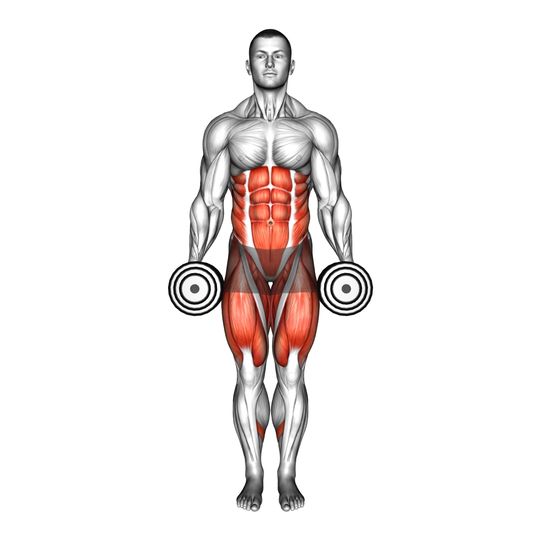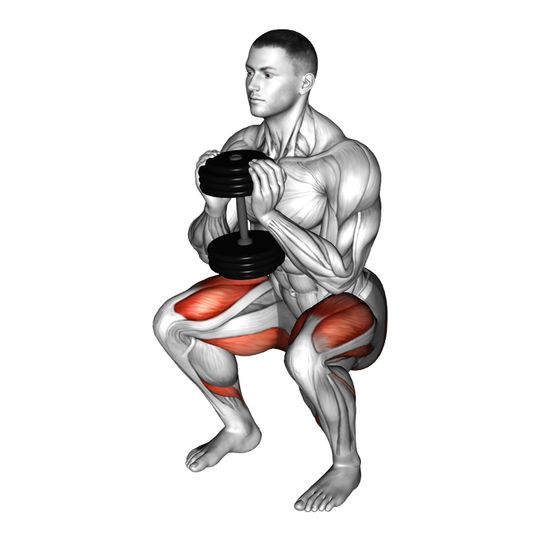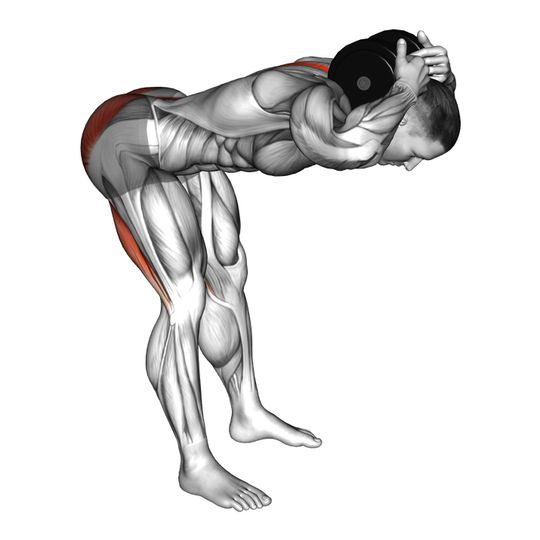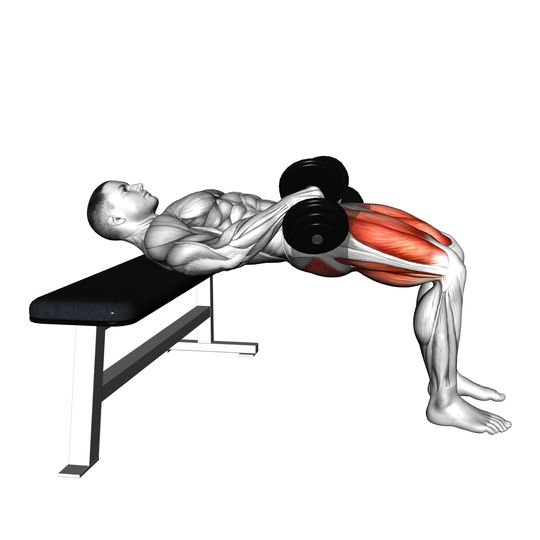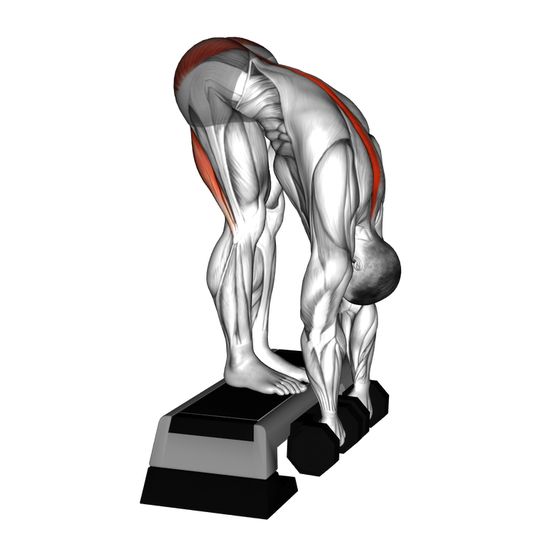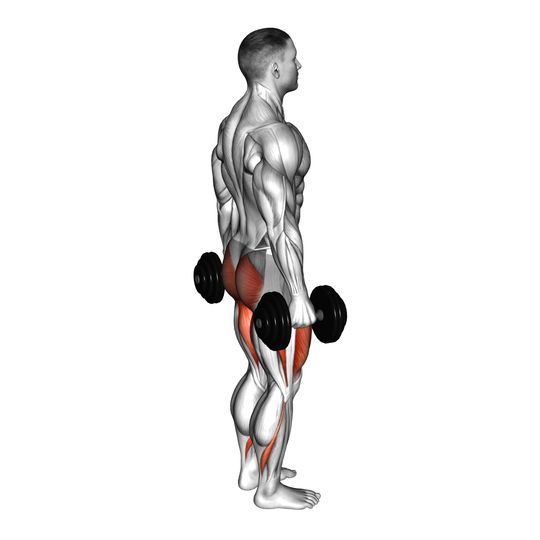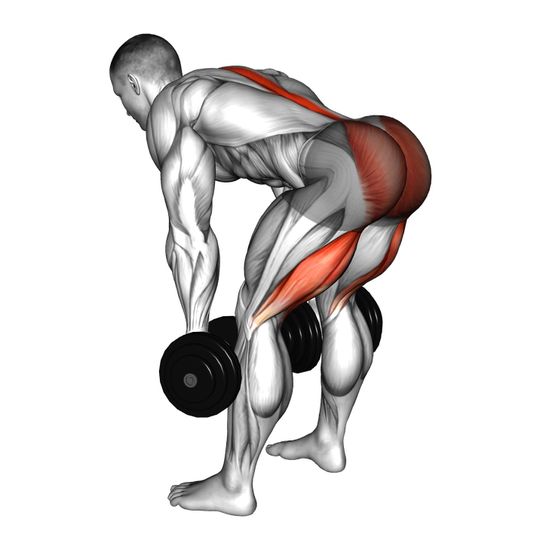


A hip-hinge dumbbell deadlift performed by extending the hips and straightening the torso, primarily loading the hamstrings.
How to do the Dumbbell Deadlift#
- Stand feet shoulder-width apart holding a dumbbell in each hand at your sides.
- Push your hips back with a slight bend in the knees, lift your chest, tighten your core, and draw your shoulders back so the dumbbells stay near your shins.
- Drive your hips forward to stand tall, extending the hips and bringing the torso upright while keeping the weights close to your legs.
- Hinge back at the hips to lower the dumbbells in a controlled manner and return to the starting position.
Muscles worked#
The dumbbell deadlift is a hip hinge that loads the whole back of the body. The glutes and hamstrings extend the hips to stand up with the weight, and because the dumbbells start low beside the shins, the hamstrings are stretched under load at the bottom of every rep. The quads help push the floor away in the first part of the lift, more than in a Romanian deadlift, because the knees bend enough to let the weights reach the floor.
The spinal erectors of the lower back hold the spine flat against the pull of the weights, and the upper back and traps keep the shoulders from rounding forward. The forearms hold the dumbbells for the whole set with no bar to hook onto, so grip often runs out first. The abs brace to keep the torso rigid. It is a full-body movement with the glutes and hamstrings doing the largest share.
- Primary: Glutes (Gluteus Maximus), Hamstrings (Biceps Femoris, Semitendinosus & Semimembranosus), Quads (Quadriceps Femoris)
- Secondary: Lower back (Erector Spinae), Traps (Trapezius), Forearms (Forearm Flexors & Extensors (incl. Brachioradialis)), Abs (Rectus Abdominis)
Common mistakes#
- Rounding the lower back during the descent.
- Allowing the dumbbells to drift away from the legs.
- Bending the knees too much and turning the movement into a squat.
- Hyperextending the lower back at the top of the lift.
Why it works#
The dumbbell deadlift is the best way to learn the hip hinge before touching a barbell. The weights hang at your sides where they cannot hit your shins, the load is light enough to think about position, and there is nothing to rack or unrack. Coaches use it to teach the pattern to beginners, and it is the deadlift that works at home or in a hotel gym without a barbell and plates.
It also has a hidden advantage over the barbell for hypertrophy: the dumbbells can travel further, so the hamstrings and glutes are stretched more at the bottom, and higher reps are possible without the fatigue a heavy barbell deadlift produces. As a second hinge in the week, it builds the posterior chain with much less recovery cost.
Sets, reps and setup#
Three to four sets of 8-12 reps with 90 seconds to two minutes of rest, once or twice a week. The dumbbells you can hold limit the weight, so this is a moderate-load, higher-rep exercise; use a two to three second descent to make the most of it. Grip fails before the legs at heavy weights, and straps are fine once that happens.
- Setup
- Stand with the feet hip-width and the dumbbells at your sides or in front of the thighs. Push the hips back, bend the knees slightly, and lower the weights along the legs to mid-shin or the floor, keeping the back flat and the chest up. Drive the hips forward to stand tall, squeezing the glutes without leaning back.
- Progression
- Add reps to twelve, then move up a dumbbell size and drop back to eight. When the heaviest dumbbells in the gym stop being a challenge for eight reps, move to a trap bar or barbell deadlift for load and keep the dumbbell version for higher-rep work. Single-leg versions add difficulty without heavier weights.
Variations#
- Dumbbell Romanian Deadlift Starts from the top and stops at mid-shin with straighter knees, keeping the load on the hamstrings and glutes.
- Kettlebell Deadlift A single kettlebell between the feet, closer to the midline and ideal for complete beginners.
- Trap Bar Deadlift Handles at the sides like the dumbbells but with barbell-level loading, the natural next step up.
- Barbell Deadlift The heaviest version of the pattern, with the bar in front of the shins and no limit on the load.
Dumbbell deadlift vs dumbbell Romanian deadlift#
The two look similar and are often confused. The dumbbell deadlift starts from the bottom with the weights near the floor, bends the knees enough to get there, and stands up with a mix of quads, glutes, and hamstrings. It is the more complete pattern, the closer relative of the barbell deadlift, and the better one for learning to lift something off the ground.
The Romanian deadlift starts standing and lowers the weights to mid-shin with the knees only slightly bent, then returns before the hamstrings lose tension. The range is shorter but the hamstrings and glutes never rest, so it is the better exercise for building them. Beginners should learn the deadlift first; lifters who already deadlift with a barbell get more from the Romanian version.
Common questions#
What muscles does the dumbbell deadlift work?
The glutes and hamstrings extend the hips, the quads help off the floor, and the lower back, upper back, and traps hold the spine and shoulders in position. The forearms and grip hold the weights throughout.
Is a dumbbell deadlift as good as a barbell deadlift?
For learning the hinge and building the posterior chain with moderate loads, yes. For maximal strength, no, because the dumbbells you can hold run out long before your legs and back do. Use dumbbells for volume and technique, and a barbell or trap bar for heavy work.
Should the dumbbells be at your sides or in front?
Either is fine. At the sides mimics a trap bar deadlift and keeps the weights clear of the shins. In front mimics a barbell deadlift and puts a little more on the lower back.
How heavy should dumbbell deadlifts be?
Heavy enough that 8-12 reps with a flat back is challenging, which for most trained lifters means 20-40 kilos in each hand. Once the heaviest pair in the gym is easy for eight, move the heavy work to a barbell or trap bar.