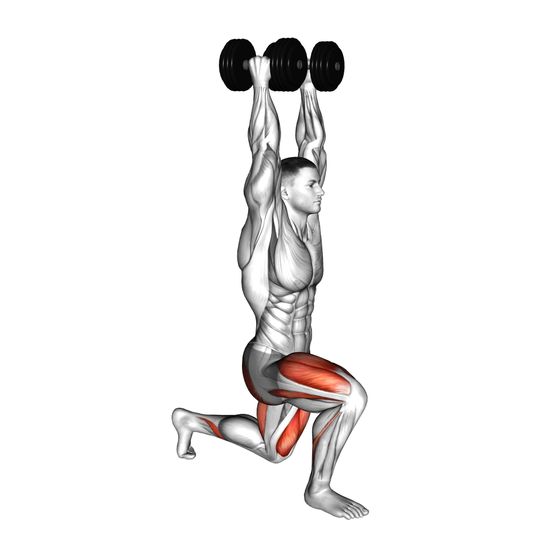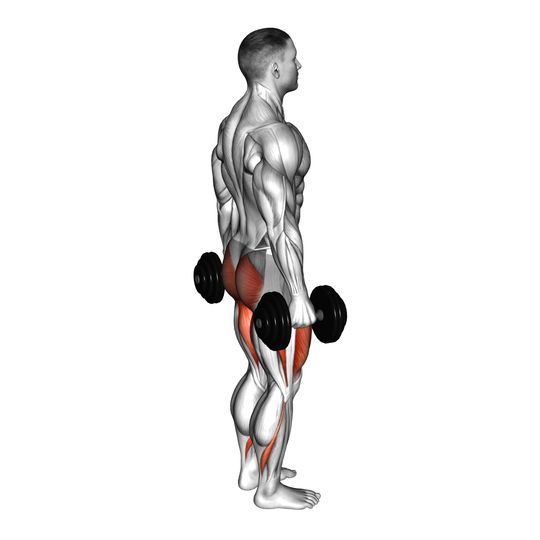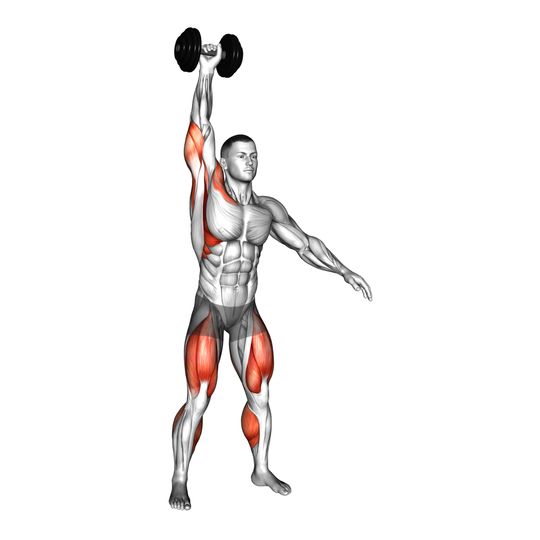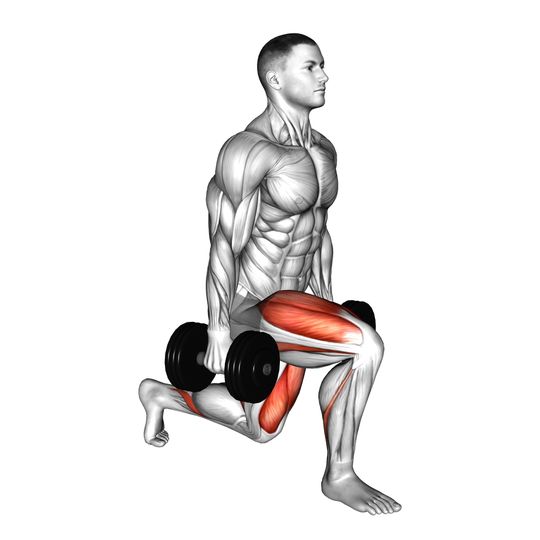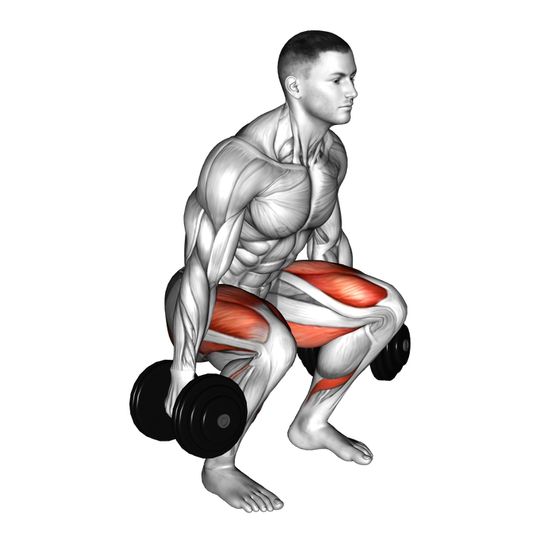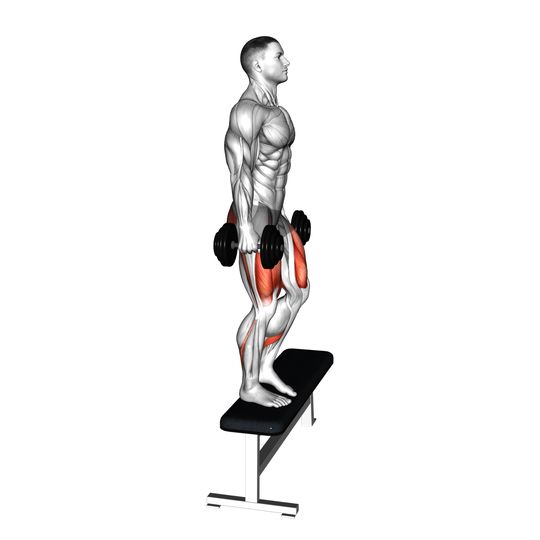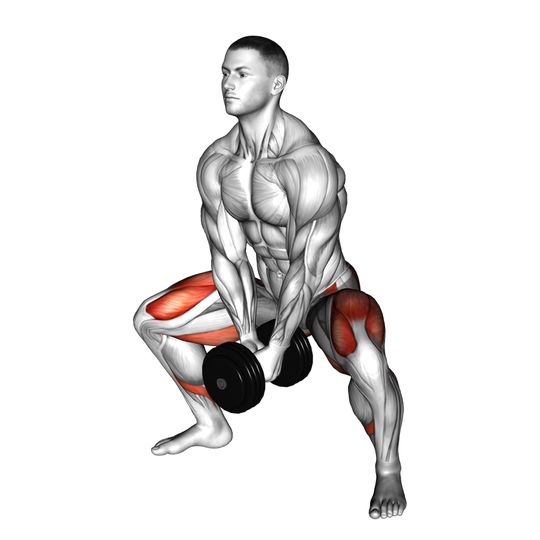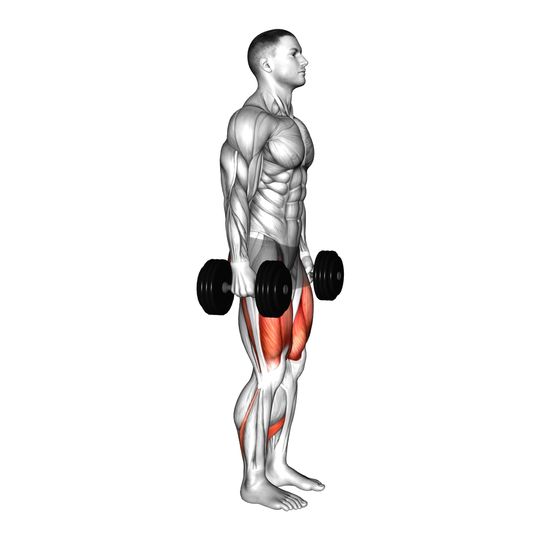


Hold a dumbbell at chest height and sit back into a squat, driving primarily with the quadriceps while the glutes and hamstrings assist.
How to do the Goblet Squat#
- Stand with feet about shoulder-width apart and toes slightly turned out.
- Grip the dumbbell with both hands and hold it close to your chest.
- Brace your core and keep your chest tall as you push your hips back and bend your knees to lower into the squat.
- Descend until your thighs are about parallel to the floor or as far as your mobility allows.
- Drive through your heels to stand back up, keeping the weight steady against your chest.
Muscles worked#
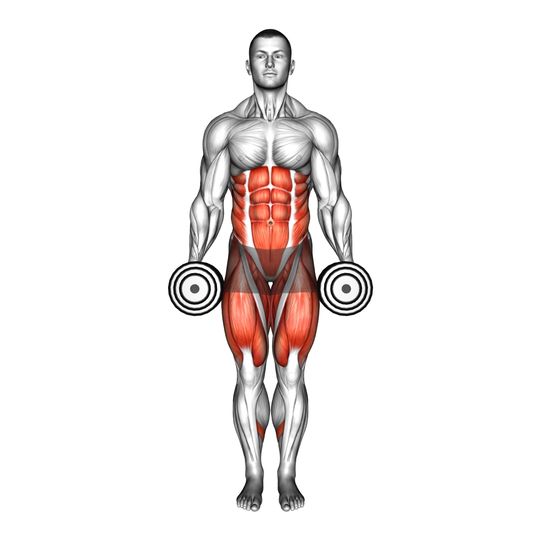
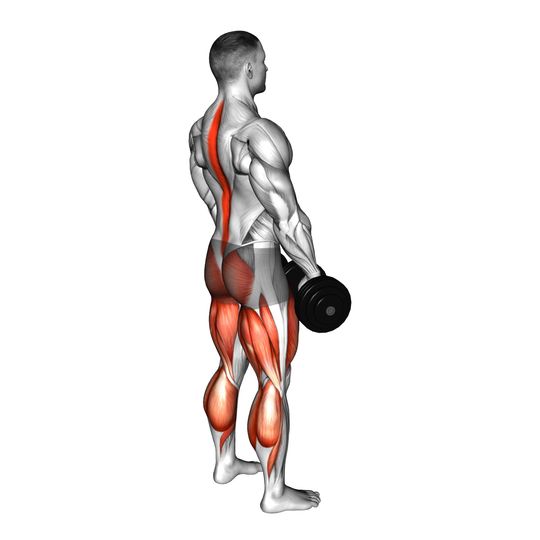
The goblet squat is a quad-dominant squat. Holding the dumbbell in front of the chest shifts your centre of mass forward, which lets the torso stay upright and pushes the knees further forward over the toes than a back squat allows. That extra knee bend is what loads the quadriceps so hard, and the glutes take over as you drive out of the bottom and extend the hips.
The front load also turns the upper back into a working muscle. Your rhomboids, mid traps and rear delts fight the whole set to stop the dumbbell rolling you forward, and the abs and obliques brace against the same pull. The adductors and hamstrings assist at depth. Most people feel it as a quad burn first and an upper-back pump second, which is exactly what it should feel like.
- Primary: Quads (Quadriceps Femoris), Glutes (Gluteus Maximus)
- Secondary: Hamstrings (Biceps Femoris, Semitendinosus & Semimembranosus), Adductors (Adductor Magnus, Longus & Brevis (Hip Adductors)), Abs (Rectus Abdominis), Upper back (Rhomboids & Middle Trapezius)
Common mistakes#
- Allowing the knees to cave inward.
- Leaning the torso too far forward.
- Lifting the heels off the ground during the squat.
- Holding the dumbbell away from the chest instead of close to the torso.
Goblet Squat vs other exercises#
Head-to-head breakdowns of muscles worked, loading, joint stress, and which one to pick for your goal.
Why it works#
It teaches the squat better than any other loaded variation. The dumbbell acts as a counterbalance so beginners can sit deep between their heels without falling backward, and the position makes the two most common faults — a collapsing chest and knees caving in — obvious and easy to correct. Elbows tracking inside the knees at the bottom is a built-in cue for keeping the knees out.
It also stays useful long after you have learned to squat. Deep goblet squats for sets of 15-20 build a lot of quad without loading the spine, they work as a warm-up before heavy barbell work, and they are a practical option in a busy gym or a hotel with nothing but a dumbbell rack. The limit is the weight you can hoist to your chest, not the weight your legs can move.
Sets, reps and setup#
Three to four sets of 8-15 reps with 60-90 seconds of rest, once or twice a week. Beginners should stay at 10-15 and treat every rep as a chance to hit full depth; stronger lifters get more from 8-10 with a dumbbell heavy enough that the last two reps slow down.
- Setup
- Hold one head of the dumbbell in both palms, elbows pointing down and the weight touching your sternum. Feet shoulder-width, toes turned out slightly, heels flat. Sit straight down, let the elbows pass between the knees, and keep the dumbbell glued to your chest the whole time — a drifting dumbbell means your upper back has given up before your legs have.
- Progression
- Go up one dumbbell increment whenever you complete every set at the top of the rep range with clean depth. When the gym's biggest dumbbell is no longer challenging for 10 reps, slow the lowering to a three-second count and add a two-second pause at the bottom, or move on to a front squat, which loads the same pattern with a barbell.
Variations#
- Kettlebell Goblet Squat Held by the horns, the kettlebell sits closer to the chest and is easier to hold for longer sets.
- Barbell Front Squat The same upright, quad-dominant pattern with a barbell, which removes the dumbbell weight ceiling.
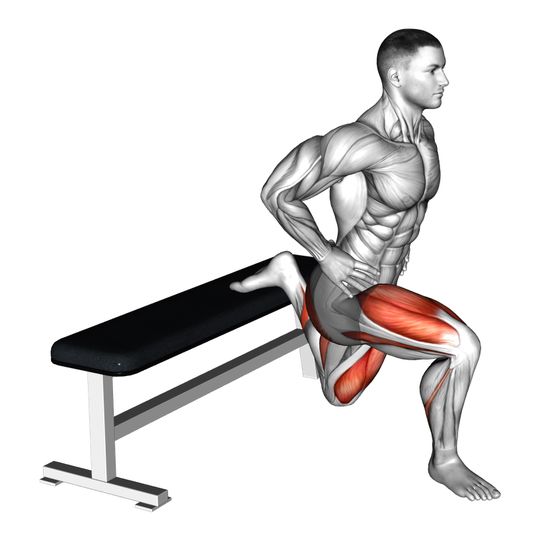
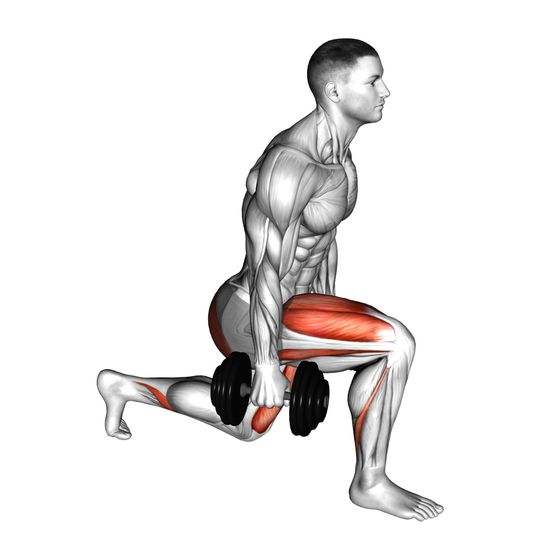
- Dumbbell Bulgarian Split Squat One leg at a time, so each quad gets loaded harder with lighter dumbbells.
- Hack Squat A machine version of the same knee-forward squat that lets you load the quads much heavier.
- Cossack Squat A side-to-side squat that adds adductor and hip mobility work to the pattern.
Goblet squat vs back squat#
The goblet squat wins on learning and on joints. The counterbalance makes depth easier, the upright torso keeps the lower back out of the lift, and there is no bar on your spine. For a beginner, or for anyone who wants quad work without a heavy axial load, it is the better tool, and it is the only one of the two you can do with a single dumbbell.
The back squat wins on load. Once you can goblet squat the heaviest dumbbell in the gym for sets of ten, the limiting factor is your arms and your ability to get the weight into position, not your legs. At that point the barbell squat lets you keep adding weight for years. Most lifters use the goblet squat as a warm-up or a high-rep second movement once they have graduated to the bar.
Common questions#
What muscles does the goblet squat work?
Mainly the quads, with the glutes driving hip extension out of the bottom. The adductors and hamstrings assist, and the upper back and abs work hard as stabilisers to hold the dumbbell against the chest and keep the torso upright.
Are goblet squats good for beginners?
They are the best loaded squat to start with. The front-held weight lets you sit deep without tipping back, the elbows-inside-the-knees position keeps the knees tracking well, and you cannot load it heavily enough to get hurt before your technique is ready.
How heavy should a goblet squat be?
Start with a dumbbell you can hold at your chest comfortably for 12-15 deep reps — for most beginners that is 8-16 kg. Add weight when every set is clean. Experienced lifters typically top out around 30-40 kg, at which point a front squat is the sensible next step.
How many goblet squats should I do?
Three to four sets of 8-15 reps, once or twice a week, is plenty. If you use them as a warm-up before barbell squats, two sets of 10 with a light dumbbell is enough to open the hips and rehearse the pattern.
Should the dumbbell be vertical or horizontal?
Vertical, held by the top head with both palms cupped underneath. That keeps the weight close to the sternum and the elbows pointing down so they can pass between the knees. Holding it horizontally pushes the load forward and tires the arms first.