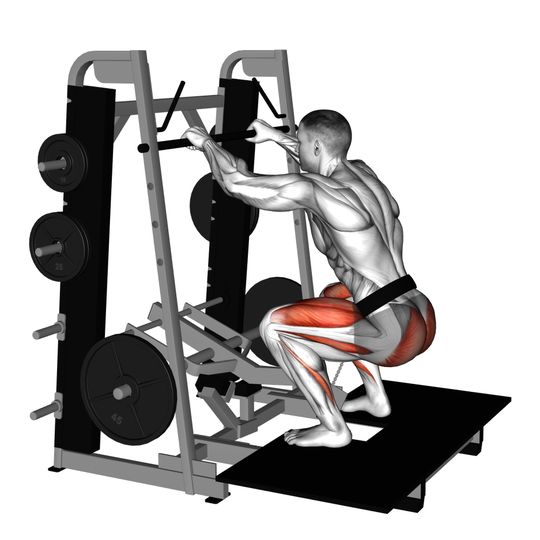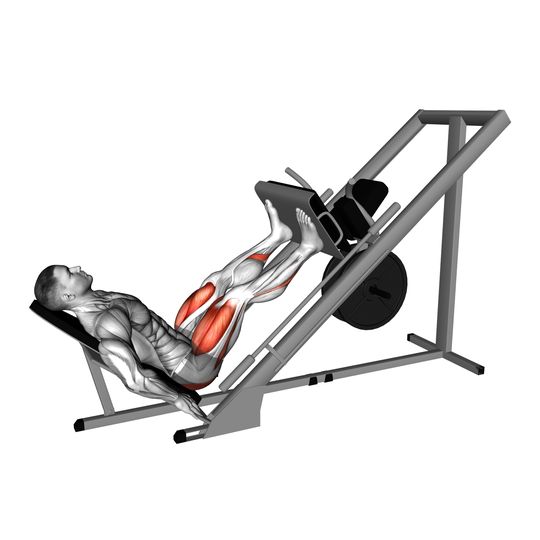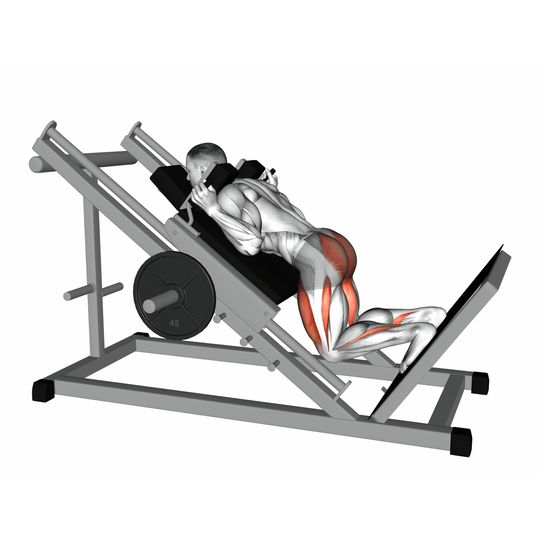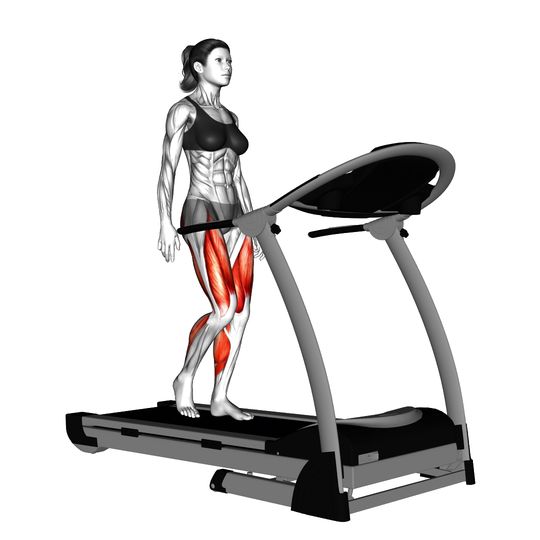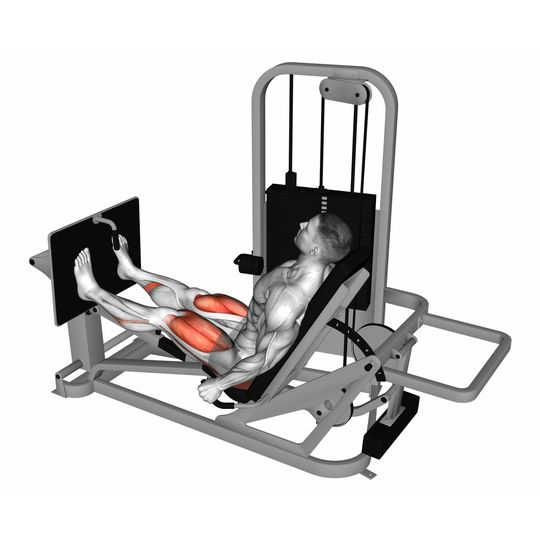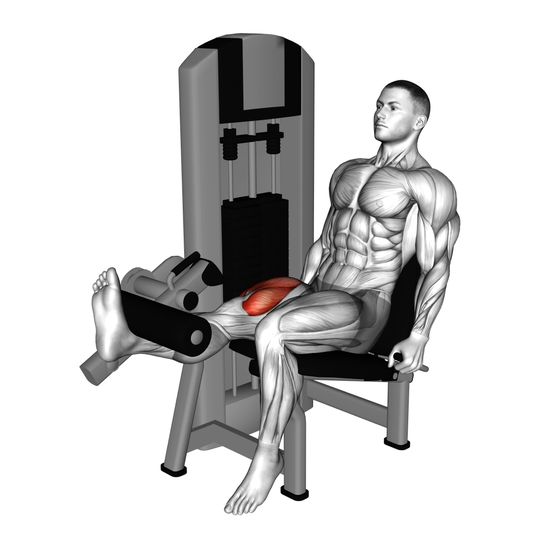


A sled-based hack squat is a vertical, knee-dominant squat performed with your back on the machine pad, primarily working the quadriceps.
How to do the Hack Squat#
- Set your back and shoulders flat against the pads and place your feet about shoulder-width apart, slightly ahead of your torso.
- Brace your core and lift your chest, then disengage the safety to allow the sled to move.
- Bend at the knees and hips and lower under control until your knees are roughly at a 90° angle.
- Drive through your heels and mid-foot to extend your legs and return to the starting position while exhaling.
- Re-engage the safety before stepping off and repeat for the desired number of reps.
Muscles worked#
The hack squat is one of the most direct quad exercises in the gym. Your back is on the pad and the sled tracks on a fixed angle, so the torso stays upright and the knees travel far forward as you descend. That deep knee bend loads all four heads of the quadriceps, and the rectus femoris and vastus medialis in particular, harder than a free squat where the hips travel back and share the load.
The glutes still extend the hips at the top of the rep and the adductors help from the bottom, especially with a wider stance. Because the machine handles balance, the core and lower back contribute little. The result is a lift that feels almost entirely like quads, with a deep burn above the knees that a back squat rarely produces.
Common mistakes#
- Allowing the knees to cave inward during the descent.
- Lifting the heels off the footplate and shifting weight onto the toes.
- Placing the feet too far forward or too high on the plate, which reduces quadriceps emphasis.
- Rounding the lower back or lifting the hips away from the pad.
Cannot do this one today?#
Machine taken, gym closed, or the movement just not agreeing with you? Here is what to run instead, and what each substitute changes.
8 best hack squat alternatives →
Hack Squat vs other exercises#
Head-to-head breakdowns of muscles worked, loading, joint stress, and which one to pick for your goal.
Why it works#
It builds quads with less technique and less spinal load than a barbell squat. The pad supports the back, the path is fixed, and the safety catches are always there, so you can sit deep and push hard sets to failure without a spotter. For lifters whose squat is limited by mobility, back tolerance or simply nerves under a heavy bar, it delivers the quad stimulus without the compromise.
It also plays well with the rest of a leg day. Hack squats after heavy barbell work add quad volume when the low back is already tired, and a few sets of 12-15 taken close to failure are a proven way to bring up stubborn quads. Foot position lets you steer the stimulus, and the fixed path makes progress easy to measure from week to week.
Sets, reps and setup#
Three to four sets of 8-12 reps with two to three minutes of rest, once or twice a week. Sets of 6-8 with a heavier sled work well as a main strength movement if you do not barbell squat; sets of 12-15 are better as a second quad exercise.
- Setup
- Shoulders under the pads, back and hips flat against the backrest, feet about shoulder-width and placed in the middle of the plate or slightly forward. Release the safeties, lower under control until the knees are past 90 degrees or the hips start to lift, then drive through the whole foot. Keep the heels down and the knees tracking over the toes.
- Progression
- Add weight when all sets hit the top of the range with full depth and no hip lift. Once loads get heavy enough that depth suffers, cut back 10 percent and rebuild with a two-second pause at the bottom, or move the feet slightly lower on the plate to keep the quads doing the work as strength climbs.
Variations#
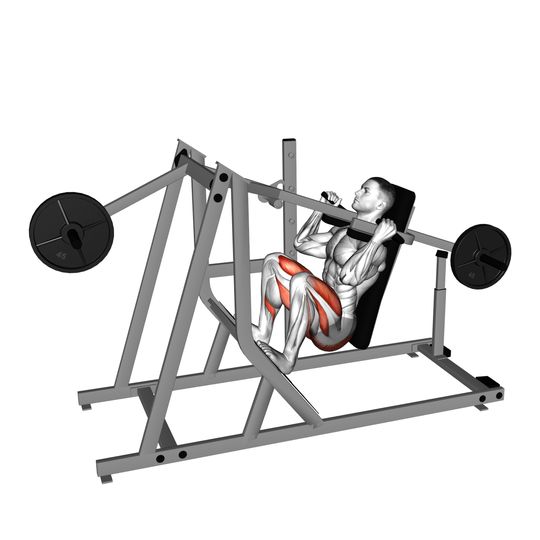
- Reverse Hack Squat Facing the pad instead of leaning on it, which shifts the emphasis toward the glutes and hamstrings.
- Pendulum Squat An arcing path that keeps the load on the quads even deeper into the bottom.
- Leg Press Seated with the same fixed track, a little less quad emphasis and easier to load very heavy.
- Barbell Hack Squat The original version, deadlifting a bar from behind the legs, with far more grip and balance demand.
- Machine Squat A lever-based squat that keeps the feet on the floor and asks slightly more of the hips.
Hack squat vs leg press#
The hack squat puts more of the work on the quads. Standing on the sled with the torso upright pushes the knees forward and lets you reach a deeper knee angle, which is exactly what the quads need. It also feels more like a squat, so it carries over better to the barbell version and trains a longer range of motion.
The leg press is easier to load, easier to get into and out of, and kinder to lifters with knee complaints because the knee angle is less extreme. It also brings the glutes in more with a high foot position. If you can only fit one into a session, the hack squat is the better quad builder; the leg press is the better option for very heavy loading and for training around cranky knees.
Common questions#
What muscles does the hack squat work?
Mostly the quads. The upright torso and forward knee travel load the quadriceps through a deep range, while the glutes extend the hips at the top and the adductors assist from the bottom. Core and lower back involvement is minimal because the pad supports the spine.
Is the hack squat better than the squat?
For isolating and growing the quads, yes, because you can go deeper and push harder without the back or balance limiting you. For total strength, core development and athletic carryover, the barbell squat is still better. Many lifters do both in the same week.
Where should I put my feet on the hack squat?
Shoulder-width and in the middle of the plate is the default and gives the most quad. Feet higher or further forward reduce knee travel and shift some work to the glutes. Feet low and close hammer the quads but increase knee stress, so use that placement with lighter loads.
How deep should I go on the hack squat?
As deep as you can while keeping the heels down and the hips on the pad, usually past 90 degrees at the knee. Depth is what makes the hack squat so effective; if the hips start peeling away from the backrest, you have gone slightly past your useful range.
Are hack squats bad for your knees?
Not if you build the load gradually and control the descent. The deep knee angle is demanding, so people with existing knee pain should start light and stop short of the bottom if it hurts. For healthy knees, deep hack squats are a strength-building exercise, not a risk.