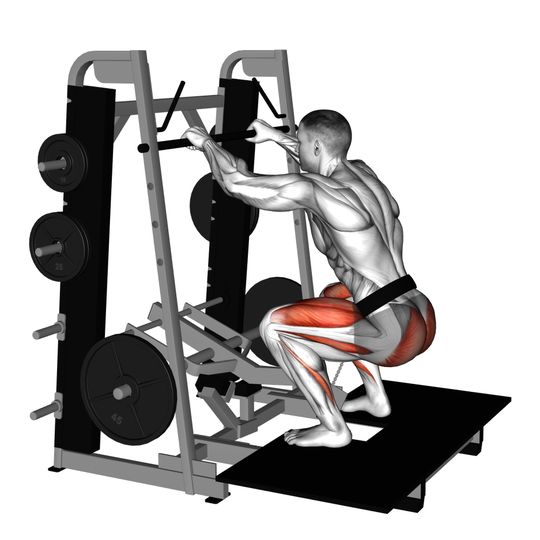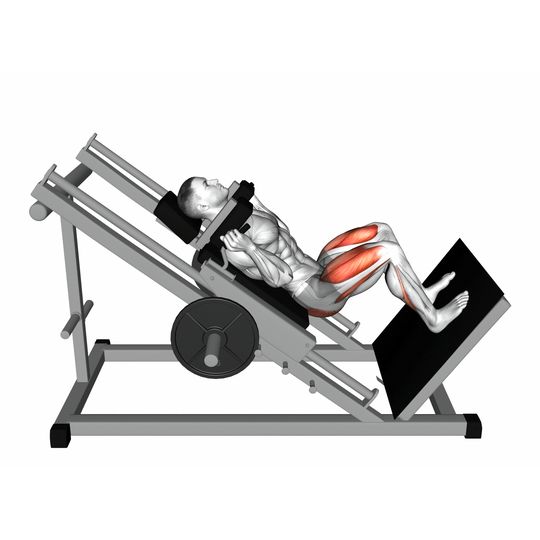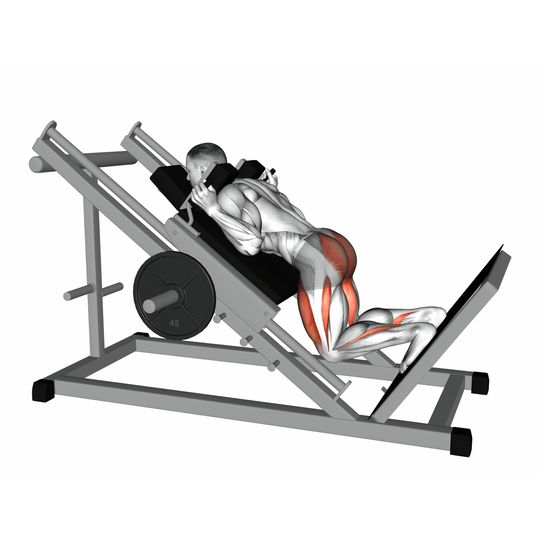


Stand on the pendulum squat machine and lower by bending at the hips and knees, then drive back up to extend the knees and hips, focusing on the quadriceps.
How to do the Pendulum Squat#
- Select a safe load and step onto the platform with feet about shoulder-width apart.
- Brace your core and keep a neutral spine throughout the movement.
- Bend at the hips and knees to descend in a slow, controlled manner.
- Lower until your thighs are roughly parallel to the platform or at a comfortable depth.
- Push through your feet to extend knees and hips and return to standing, controlling the movement on the way up and down.
Muscles worked#
The pendulum squat is a quad exercise first. The machine swings the load through an arc that keeps your torso upright and lets your knees travel far forward over your toes, so the quads (all four heads of the quadriceps) are taken into deep flexion under load and have to drive the whole way out. The glutes join in strongly at the bottom because the hips still bend a long way, but the knee does more of the work than in a barbell squat.
The adductors work hard in the deepest third of the rep, which is why a set of pendulum squats often leaves the inner thighs sorer than the outside of the leg. The hamstrings and calves stabilise the knee and ankle rather than move the weight. Because the pad carries the load and the back is supported, the spinal erectors and core do very little, so the legs are the only thing that fails.
- Primary: Quads (Quadriceps Femoris), Glutes (Gluteus Maximus)
- Secondary: Adductors (Adductor Magnus, Longus & Brevis (Hip Adductors)), Hamstrings (Biceps Femoris, Semitendinosus & Semimembranosus), Calves (Gastrocnemius & Soleus)
Common mistakes#
- Letting the knees collapse inward.
- Allowing the heels to lift off the platform.
- Rounding the lower back or leaning excessively forward.
- Using momentum instead of a controlled tempo.
- Forcing full knee lockout at the top.
Pendulum Squat vs other exercises#
Head-to-head breakdowns of muscles worked, loading, joint stress, and which one to pick for your goal.
Why it works#
The pendulum squat gives you the deep, quad-dominant squat most lifters cannot get from a barbell without the torso folding forward. The arc unloads the weight slightly at the bottom and adds it back as you stand, which matches how strong the legs are at each joint angle, so you can take a set close to failure without a sticking point stopping you two inches out of the hole.
It is also one of the safest ways to load the legs heavily. No bar on the spine, no balance component, and no walkout, which makes it a good choice for high-effort sets, drop sets, and rep work above ten when the lower back is already tired from squats or deadlifts earlier in the week.
Sets, reps and setup#
Three to four sets of 8-15 reps with two to three minutes of rest, as the second leg exercise after a barbell squat or the main quad movement on a machine day. Three-second lowering phases work well because the machine makes the eccentric easy to control.
- Setup
- Set the platform so your knees can pass over your toes without the heels lifting. Feet shoulder-width and slightly turned out, shoulders pushed up into the pad, whole back flat on the support. Descend until the hamstrings touch the calves if your knees allow; if not, stop where the heels start to rise.
- Progression
- Add a plate a side when every set finishes at the top of the rep range at the same depth. If depth shrinks as the weight goes up, you progressed too fast. Once heavy sets of eight are solid, add a one-second pause at the bottom before adding more load.
Variations#
- Hack Squat Straight-line sled instead of an arc, with more knee shear at depth and a more forward torso.
- Leg Press Seated with the hips fixed, more weight but less range at the knee.
- Belt Squat Load hangs from the hips, so still no spinal load but you balance yourself.
- Barbell Front Squat The free-weight upright quad squat, with the core and upper back doing far more.
Pendulum squat vs hack squat#
Both take the spine out of the squat and let you go deep, but the paths differ. The hack squat sled moves in a straight line, so the resistance feels the same at the bottom as at the top and the knees take a lot of shear at depth. The pendulum swings through an arc that eases the load at the deepest point and keeps the torso upright, which most lifters find easier on the knees and harder on the quads.
The hack squat is easier to find and usually easier to load heavily. If your gym has both, use the pendulum for deep, high-rep quad work and the hack squat for heavier sets of six to eight. Neither is worth doing with half range because the weight is too high.
Common questions#
What muscles does the pendulum squat work?
Mostly the quads, with the glutes contributing at the bottom of the rep. The adductors and hamstrings assist, and because the machine supports your back, the spine and core are barely involved.
Is the pendulum squat better than the hack squat?
For deep, quad-focused work it usually is, because the arc keeps the torso upright and reduces knee shear at depth. The hack squat is better for heavy loading and far more common in gyms.
How deep should you go on a pendulum squat?
As deep as you can while keeping the heels down and the back on the pad, ideally hamstrings touching calves. The bottom third is where the quads get most of their stimulus.
Is the pendulum squat good for knees?
For most lifters, yes. The arc reduces load at the deepest position and the fixed path keeps the knees tracking cleanly. If deep flexion hurts, shorten the range and build up over several weeks.