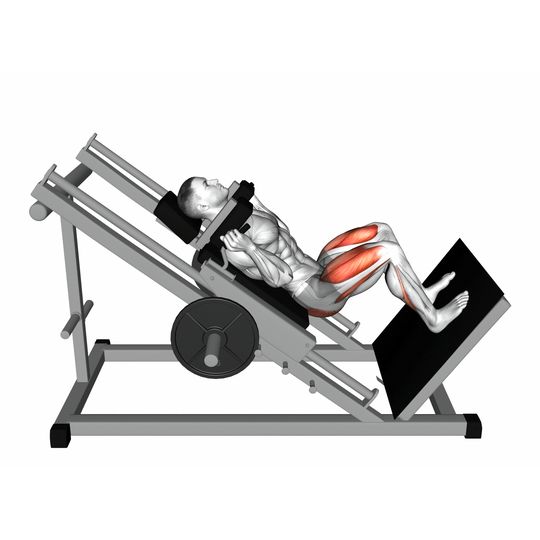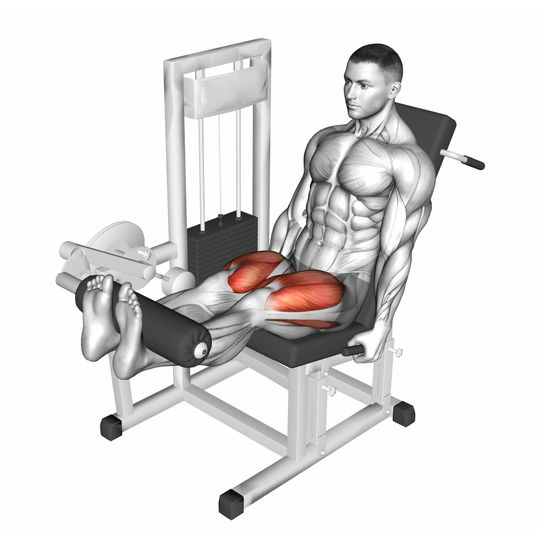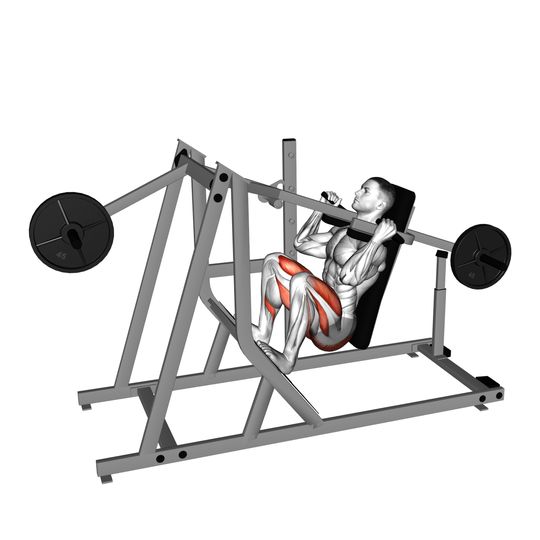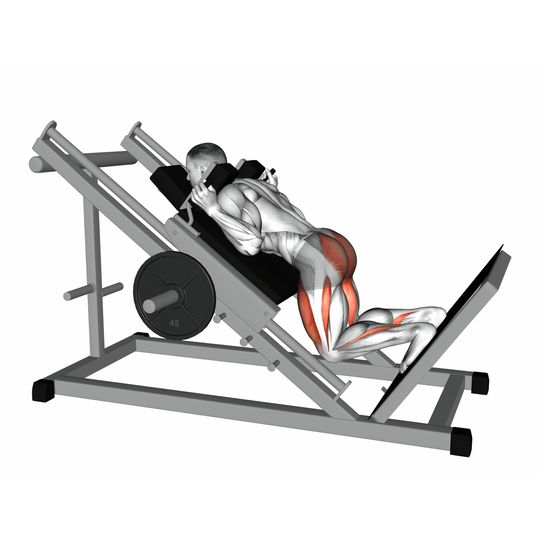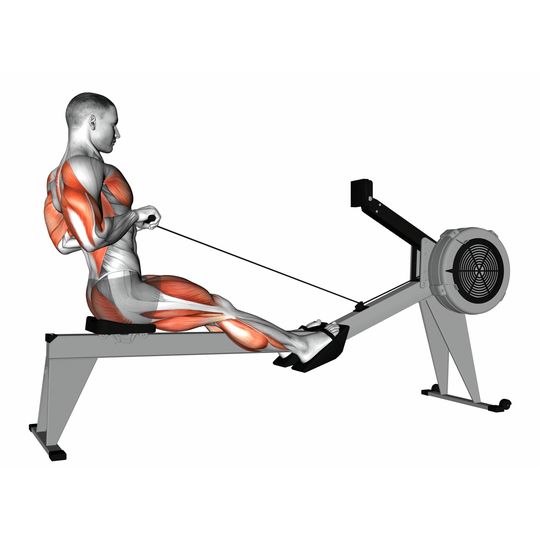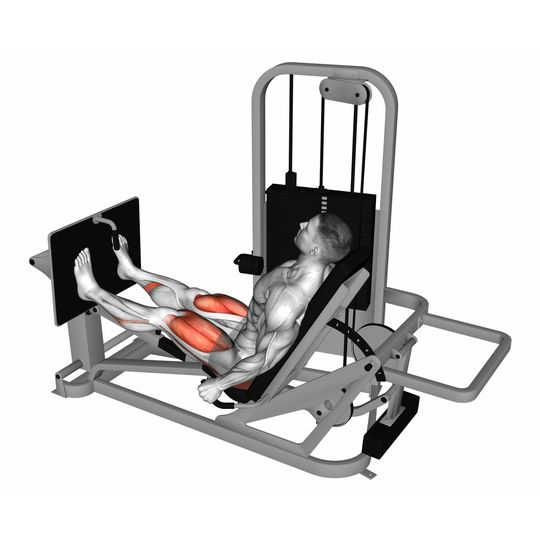


You sit and push a sled-style footplate away using leg extension, primarily loading the quadriceps. The movement extends the knees against the machine while your back remains supported.
How to do the Leg Press#
- Sit with your back against the pad and place your feet about shoulder-width on the plate so your knees will remain behind your toes at the bottom.
- Secure or release the safety catches as required and tighten your core, keeping the knees tracking slightly outward.
- Bend your knees in a controlled manner to lower the platform until your thighs are roughly parallel to the footplate (about 90° at the knee).
- Push the plate back by driving through your heels and mid-foot, extending the legs while maintaining a stable torso.
- Stop short of locking the knees at full extension, control the descent, and repeat for the desired repetitions.
Muscles worked#
The leg press is a quad exercise first. Your back is pinned to the pad, so the only joints that move are the knees and hips, and the knees do most of the work: all four heads of the quadriceps extend the knee against the sled through every centimetre of the rep. The glutes join in as the hips open at the top, and their contribution grows the deeper you let the sled travel and the higher you place your feet.
The hamstrings and adductors assist as hip extensors, and the calves press into the plate to keep the feet stable. What you do not get is much core or lower-back work, because the pad does that job for you. That is why it feels so different from a squat — you can push to a genuine quad failure without your torso ever being the limiting factor.
- Primary: Quads (Quadriceps Femoris), Glutes (Gluteus Maximus)
- Secondary: Hamstrings (Biceps Femoris, Semitendinosus & Semimembranosus), Adductors (Adductor Magnus, Longus & Brevis (Hip Adductors)), Calves (Gastrocnemius & Soleus)
Common mistakes#
- Allowing the knees to travel past the toes at the bottom of the movement.
- Fully locking the knees at the top of the press.
- Failing to brace the core, which lets the lower back lift or round.
- Letting the knees collapse inward instead of tracking slightly outward.
Cannot do this one today?#
Machine taken, gym closed, or the movement just not agreeing with you? Here is what to run instead, and what each substitute changes.
9 best leg press alternatives →
Leg Press vs other exercises#
Head-to-head breakdowns of muscles worked, loading, joint stress, and which one to pick for your goal.
Why it works#
It lets you load the quads harder than almost anything else. With the spine supported and balance removed, the weight you can press is limited by the legs alone, and you can take sets to failure safely with the catches set. That makes it one of the most productive quad builders in the gym, whether you are a beginner who cannot yet squat well or an advanced lifter adding volume after heavy barbell work.
It is also adjustable in a way free weights are not. Move the feet high and wide and the glutes and adductors take more of the load; move them low and narrow and it becomes almost pure quad. Press one leg at a time to fix a strength imbalance. Nothing else gives you that many levers on a single machine, and the injury risk is low as long as you control the depth.
Sets, reps and setup#
Three to four sets of 8-15 reps with two to three minutes of rest, once or twice a week. Eight to twelve reps with a heavy sled builds strength and size; sets of 15-20 with a lighter load are brutal on the quads and a good finisher after squats.
- Setup
- Sit deep in the seat with your lower back and hips flat against the pad. Feet shoulder-width apart in the middle of the plate, toes slightly out. Lower until your knees reach about 90 degrees — or as deep as you can go without your hips lifting off the pad — then press through the mid-foot and stop just short of a full knee lockout.
- Progression
- Add a plate each side whenever you complete every set at the top of the rep range with full depth and no hip lift. Once the stack or your comfort with the load becomes the limit, slow the lowering phase to three seconds, add a one-second pause at the bottom, or switch to single-leg presses at roughly 60 percent of the weight.
Variations#
- Hack Squat Stands you upright on a sled, so the quads work through a longer range and the glutes contribute less.
- Seated Leg Press A horizontal, selectorised version that is easier to load and unload and usually shorter in range.
- Machine Single Leg Press One leg at a time, which exposes and fixes side-to-side strength differences.
- Machine Vertical Leg Press Lying on your back and pressing straight up, with a deeper hip angle and more glute involvement.
- Calf Press on Leg Press The same machine used for heavy straight-leg calf work at the end of the set.
Leg press vs squat#
For growing the quads, the leg press is at least as effective as the squat and often more so per set, because the supported back lets you push closer to true muscular failure and load the legs without the torso, lower back or balance giving out first. If your goal is bigger quads and you have both available, the leg press does the job with less fatigue and less technique.
The squat trains far more than the quads. It loads the glutes, adductors, spinal erectors and core as a unit, builds the trunk stiffness that transfers to every other lift, and develops the skill of moving a load in space. The leg press cannot replace that, so most well-built programs squat first and press second rather than picking one.
Common questions#
What muscles does the leg press work?
Primarily the quadriceps, with the glutes working as the hips extend at the top of each rep. The hamstrings and adductors assist, and the calves stabilise the feet against the plate. Foot placement shifts the emphasis: high and wide brings in more glute and adductor, low and narrow is more quad.
Is the leg press as good as squats?
For quad growth, yes, and it is easier to take safely to failure. For overall lower-body strength, core stability and athletic transfer, the squat wins clearly. Treat them as complementary: squat for the pattern, leg press for extra quad volume without the fatigue.
How much should I leg press?
A useful starting point is a load you can press for 12 clean reps with your hips staying on the pad — for most beginners that is 40-80 kg on the sled. Leg press numbers are not comparable to squat numbers because the machine's angle and friction change how heavy the load actually feels.
Where should I put my feet on the leg press?
In the middle of the plate, shoulder-width apart, for a balanced quad and glute stimulus. Higher and wider shifts work to the glutes and adductors; lower and closer targets the quads but is harder on the knees, so use that placement with lighter loads.
Should I lock my knees out at the top?
No. Stop a few degrees short of straight. A hard lockout under heavy load puts the knee joint, not the muscle, in charge of holding the sled and it gives the quads a rest you did not want.
Why does my lower back hurt on the leg press?
Usually because you are lowering the sled so far that your hips lift off the pad and your lumbar spine rounds under load. Shorten the range so the hips stay planted, or move the feet slightly higher on the plate, and the problem normally disappears.