

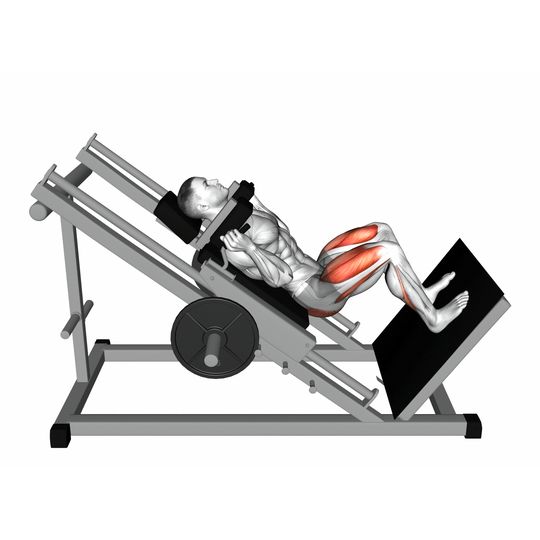
The hack squat exists to give you a squat without the barbell on your back. The sled carries the load through shoulder pads, the platform fixes your foot position, and the angled track keeps your torso upright while you sink into a deep knee bend. It looks like a squat and it trains a lot like one.
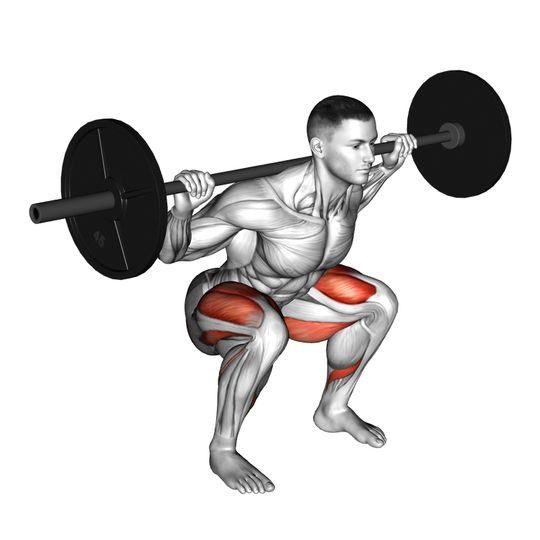
The barbell back squat is the original: a free weight on your upper back that you have to balance, brace against, and drive through a path you control yourself. It trains more muscle, builds more general strength, and costs far more in recovery and skill. Which one belongs in your program depends on what you are training for.
| Factor | Hack Squat | Barbell Squat |
|---|---|---|
| Main target | Quads | Quads, glutes, adductors, spinal erectors |
| Stability demand | Very low, machine guides the path | High — balance, bracing, bar control |
| Spinal loading | Low | High — the bar sits on your spine |
| Skill required | Minimal, learned in one session | Significant, takes months to refine |
| Carryover | To squat pattern strength and quad size | To sport, other lifts, and total-body strength |
| Best for | Isolating quads, training around a sore back | Strength, athletic development, main leg lift |
Hack Squat vs Barbell Squat: muscles worked#
Hack Squat
- Primary: Quads
- Secondary: Glutes, Adductors
Barbell Squat
- Primary: Quads, Glutes
- Secondary: Hamstrings, Adductors, Lower back, Abs, Calves
Muscles worked#
Both are knee-dominant squats built on the quads, glutes, and adductors. The hack squat isolates the quads more, because the machine removes the need to keep your torso upright and the track prevents the hips from shooting back — the two things that pull a barbell squat toward the glutes and hamstrings.
The back squat trains everything the hack squat does and adds the spinal erectors, the whole core, and the upper back holding the bar in place. That extra muscle is why the squat builds more total strength and why it fatigues you far more per set.
Range of motion#
The hack squat makes depth easy. With your back on the pad, there is no forward lean to manage and no balance to lose, so most lifters can hit a deeper bottom position than they can with a barbell — and depth under load is the stimulus that grows quads.
Back squat depth is limited by mobility, bracing, and technique. Many lifters cut squats above parallel without realising it because the hips drift back and the torso folds forward. That is not a flaw in the exercise, but it means the hack squat often delivers a longer, more quad-focused range for the average lifter.
Spinal and joint stress#
The back squat compresses the spine under the bar and asks the lower back to hold position through the whole rep. That is a training effect as much as a risk — a strong squat builds a strong back — but it is also the reason lifters with back issues stop squatting first.
The hack squat takes the spine almost entirely out of the equation and moves the stress to the knees, which travel further forward under load than in most barbell squats. Healthy knees adapt well. Knees with patellar tendon problems often prefer the barbell squat, or a hack squat with the feet placed slightly higher.
Strength carryover and programming#
If you want a stronger squat, you have to squat. The hack squat builds quad strength that transfers to the pattern, but it cannot teach bracing, balance, or bar control, and a big hack squat does not guarantee a big back squat. Powerlifters and athletes need the barbell as the main lift.
If you want bigger quads and you are not measured on a squat number, the hack squat can be the main leg exercise. It is easier to take close to failure safely, easier to recover from, and easier to progress week to week because technique never becomes the limiting factor. Many physique-focused lifters run the hack squat first and skip the barbell entirely during hypertrophy blocks.
The verdict#
Pick the back squat if you train for strength, for a sport, or want the most total muscle and carryover per exercise. It is harder, riskier, and more demanding to learn, and that is exactly why it delivers more.
Pick the hack squat if your goal is quad size, your lower back needs a break, or technique on the barbell keeps limiting your leg training. Most intermediate lifters do best with the barbell squat as the main lift and the hack squat as the second quad exercise — and swap their order during blocks where the spine needs a rest.
Frequently asked questions#
Is the hack squat as good as the back squat?
For quad growth it is at least as good, and for many lifters better, because it makes depth and hard effort easier. For total-body strength, balance, and carryover to sport it is not — the barbell squat trains far more muscle and skill. They are good at different things.
Can hack squats replace back squats?
For bodybuilding-style leg training, yes. For strength sports or general athletic development, no — the squat pattern under a free barbell has to be practised to improve. A common compromise is to run the barbell squat in strength blocks and the hack squat in hypertrophy blocks.
Which is safer, hack squat or back squat?
The hack squat is safer for the spine and easier to bail out of, which makes it the better choice with a sore back or without a spotter. The back squat is often kinder to the knees because the forward knee travel is smaller. Neither is dangerous with sensible loading and full control of the lowering phase.
Why is my hack squat weaker than my back squat?
Usually because of the machine angle, the deeper range, and the fact that the quads are doing more of the work alone. On some hack squats you also lift against friction on the track. A hack squat number that is lower than your barbell squat is completely normal and does not mean anything is wrong.
Should beginners do hack squats or back squats?
Learn the barbell squat early, because the skill takes time and pays off for years — but there is nothing wrong with using the hack squat alongside it while technique develops. If a beginner can only do one, the barbell squat with light weight and good coaching builds the better long-term foundation.