
Moving the bar from your upper back to the front of your shoulders changes everything about a squat except the name. The front squat forces an upright torso, drives the knees forward, and turns the movement into a quad exercise with the upper back working overtime to hold the rack position. The back squat lets you lean, sit back, and lift a lot more weight by recruiting the whole hip.
Both are excellent. The question is what you want from a squat: the most weight and the most total muscle, or the most quad and the least spinal shear. Here is how they compare and how to decide.
| Factor | Barbell Front Squat | Barbell Squat |
|---|---|---|
| Main target | Quads, upper back | Quads, glutes, adductors, lower back |
| Torso angle | Upright, forced by the bar | Leans forward, more with low bar |
| Typical load | About 80–85% of your back squat | Your heaviest squat |
| Lower back stress | Lower shear, high upper back demand | Higher, especially with forward lean |
| Mobility needed | Wrists, ankles, thoracic spine | Hips and ankles |
| Best for | Quad growth, Olympic lifting, upright posture | Maximal strength, glute development, powerlifting |
Barbell Front Squat vs Barbell Squat: muscles worked#
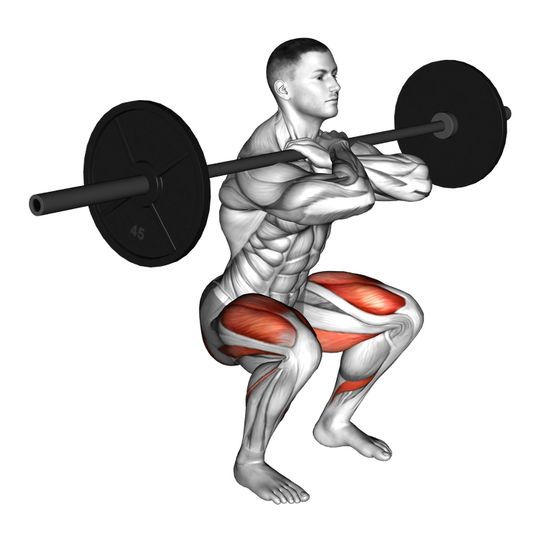
Barbell Front Squat
- Primary: Quads, Glutes
- Secondary: Adductors, Hamstrings, Abs, Upper back, Lower back
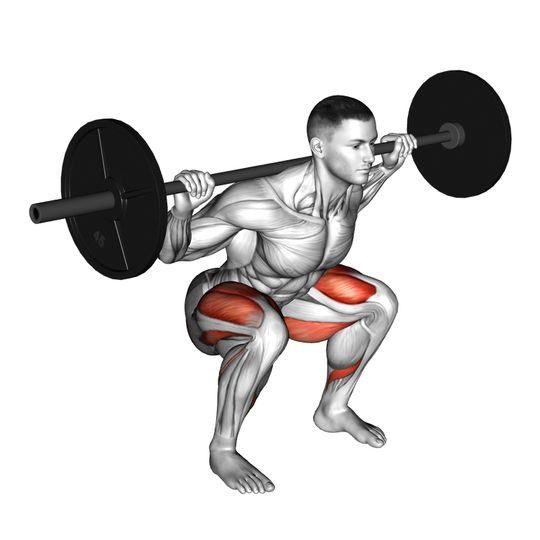
Barbell Squat
- Primary: Quads, Glutes
- Secondary: Hamstrings, Adductors, Lower back, Abs, Calves
Muscles worked#
Both squats are built on the quads, glutes, and adductors. The front squat shifts the balance toward the quads because the upright torso keeps the hips under the bar and the knees travel further forward, so knee extension does most of the work. It also loads the upper back and core hard: if you round forward, the bar rolls off.
The back squat brings the glutes and hamstrings in more, because the forward lean and the hips sitting back lengthen those muscles under load. The lower back works harder to hold the angle, and the total muscle involved is greater, which is why the back squat builds more overall strength per rep.
Strength and loading#
Most lifters front squat 80–85 percent of their back squat. The front rack is the limit as often as the legs are — the upper back and core give out before the quads on heavy sets, and the bar position stops you using the hip drive that adds weight to a back squat.
That makes the back squat the better choice when strength is the goal. It lets you load the whole lower body heaviest and progress longest. The front squat is a strength exercise in its own right, but its ceiling is set by the rack position, not by leg strength.
Back and joint stress#
The front squat is kinder to the lower back in one important way: the upright torso reduces the shear force on the lumbar spine. Lifters with lower back complaints often tolerate front squats when back squats hurt. The trade is that the wrists, elbows, and upper back have to work harder, and some people struggle to hold the rack at all.
The back squat puts more shear on the lower back, especially in a low-bar position with a big forward lean, but the knees generally travel less far forward, which some knees prefer. Neither is inherently dangerous — both punish rounding and reward bracing.
Programming and who should choose which#
Powerlifters and anyone chasing a squat number train the back squat as the main lift and use the front squat as a variation for quads and posture. Olympic lifters do the reverse, because the front squat is the receiving position for the clean. Athletes often use both.
For hypertrophy, the front squat is arguably the more efficient quad builder: deep, upright, and self-limiting so you rarely cheat depth. The back squat wins for glutes and total lower-body mass. Many lifters run one as the main squat for a block and switch, which keeps both patterns strong and gives the upper back and lower back alternating rest.
The verdict#
Choose the back squat if you want the heaviest possible squat, the most total muscle per set, or you compete in powerlifting. It is the better default main lift for most people.
Choose the front squat if quads are the priority, your lower back dislikes the forward lean, or you Olympic lift. It also makes an excellent second squat variation on a different day. If you can only keep one and you are not measured on a number, the front squat is a strong pick for physique goals — but learn both.
Frequently asked questions#
Is the front squat better than the back squat for quads?
Slightly, in most studies and in most lifters’ experience. The upright torso and forward knee travel keep the quads doing the work while the back squat shares the load with the glutes and hamstrings. The back squat still trains the quads hard, and because you can load it heavier, the total quad stimulus over a program is often similar.
How much less should I front squat than back squat?
Around 15–20 percent less is normal. If your front squat is within 10 percent of your back squat, your back squat technique is probably leaving weight on the table. If it is more than 30 percent lower, your upper back or rack mobility is the limit rather than your legs.
Is the front squat safer for the lower back?
It reduces shear on the lumbar spine because the torso stays upright, so many lifters with lower back complaints tolerate it better. It is not stress-free: the load still compresses the spine, and a rounded upper back under a front rack has its own problems. Bracing matters in both.
Can I do front squats and back squats in the same week?
Yes, and it is a common setup. Back squat heavy on one lower day and front squat for higher reps on another, or alternate them week to week. Avoid doing both heavy in the same session — the second one will be a shadow of what it could be on its own day.
Which squat is better for beginners?
Most beginners should start with the back squat: it is easier to hold, tolerates small technique errors better, and lets them load progressively from day one. Learn the front squat once the back squat is competent, or start with it if the goal is Olympic lifting or if back squats cause lower back discomfort.