
The conventional deadlift and the Romanian deadlift share a barbell and a hip hinge, and people use the names interchangeably far more often than they should. They are different exercises with different jobs: the deadlift is a full-body strength lift that starts from a dead stop on the floor, and the RDL is a hamstring and glute exercise performed entirely from the top down.
The deadlift starts with bent knees and a lower hip position and involves the quads in breaking the bar off the floor. The RDL starts standing, keeps the knees only slightly bent, and lowers the bar to mid-shin or wherever the hamstrings run out of stretch, never resting it on the ground. That single change moves the work from the whole body to the posterior chain.
| Factor | Barbell Romanian Deadlift | Barbell Deadlift |
|---|---|---|
| Starts from | Standing, bar in hand | The floor, dead stop |
| Knee bend | Slight, stays constant | Significant at the start, quads involved |
| Main target | Hamstrings and glutes | Whole posterior chain, back, quads, grip |
| Bottom position | Mid-shin, hamstrings loaded in stretch | Plates on the floor |
| Typical load | About 60–75% of your deadlift | Your heaviest lift |
| Best for | Hamstring and glute growth, hip hinge practice | Maximal strength, total-body development |
Barbell Romanian Deadlift vs Barbell Deadlift: muscles worked#
Barbell Romanian Deadlift
- Primary: Hamstrings, Glutes
- Secondary: Lower back, Forearms, Upper back
Barbell Deadlift
- Primary: Glutes, Hamstrings, Lower back
- Secondary: Quads, Traps, Upper back, Forearms, Abs
Muscles worked#
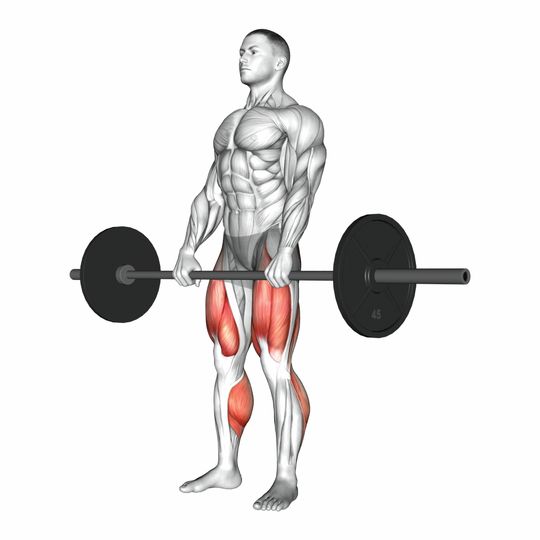
The conventional deadlift is the most complete strength exercise there is: quads and glutes drive the bar off the floor, hamstrings and glutes extend the hips through the middle, the spinal erectors hold the back rigid throughout, the lats keep the bar close, and the grip and traps hold everything together at the top.
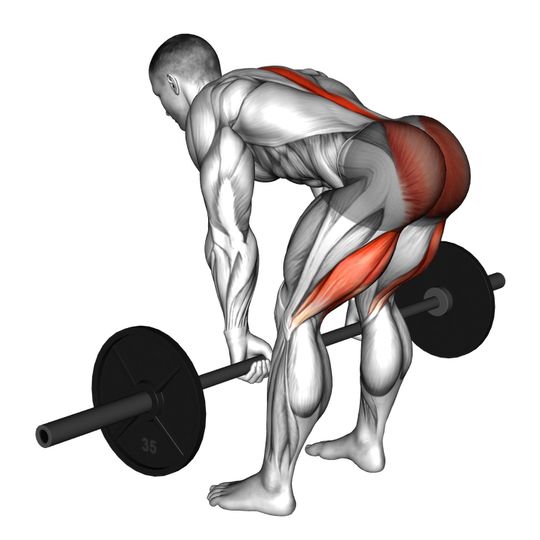
The Romanian deadlift narrows the focus. With the knees fixed in a slight bend, the quads barely contribute and the hamstrings do the work of controlling the bar down and pulling the hips back through. The glutes finish the rep, and the spinal erectors work hard isometrically. It is the best barbell exercise for loading the hamstrings in a stretched position.
Range of motion and mechanics#
A deadlift rep begins at the hardest point: the bar is on the floor, there is no stretch reflex to help, and you have to build tension from nothing. That dead-stop start is what makes it such a strength builder and what makes it so fatiguing.
An RDL rep begins at the easiest point and the hardest part is the bottom, where the hamstrings are stretched and the bar is furthest from the hips. You lower under control, feel the stretch, and reverse without pausing or touching down. The bar travels a shorter distance and the eccentric — the lowering — is the point of the exercise, which is the opposite emphasis from the deadlift.
Loading and fatigue#
The deadlift is your heaviest lift, and heavy deadlifts are expensive: the whole body is under load, the nervous system takes a hit, and most lifters can only pull heavy once a week without it eating into everything else. That is why programs prescribe it in low reps and low sets.
The RDL uses roughly 60–75 percent of your deadlift for sets of 8–12 and recovers far faster, because the load is lighter and the range is shorter. It fits comfortably into a lower or pull day as the second movement, and it can be trained twice a week without much cost.
Which to use when#
Use the deadlift when the goal is strength, when you compete in a sport that tests it, or when you want one exercise that trains the most muscle per rep. Program it as a main lift: 3–5 sets of 3–6 reps, progressed carefully, usually once a week.
Use the RDL when the goal is hamstring and glute development, when you need a hip hinge that will not wreck your recovery, or when you are learning the hinge pattern before pulling from the floor. Program it as an accessory: 3–4 sets of 8–12, controlled lowering, stopping where the hamstrings stop stretching rather than where the bar touches the floor.
The verdict#
These are not competing for one slot. The deadlift is a main strength lift; the Romanian deadlift is a hamstring and glute exercise. Most good programs contain both, with the deadlift trained heavy once a week and the RDL trained for volume on a different day.
If you have to choose, strength-focused lifters keep the deadlift and physique-focused lifters keep the RDL — it builds more hamstring per unit of fatigue and the glutes get plenty of work from squats and hip thrusts. Beginners should learn the RDL first, because it teaches the hinge that makes the deadlift safe.
Frequently asked questions#
Is the Romanian deadlift better than the regular deadlift?
Better for hamstrings and glutes, yes. Better as an all-round strength exercise, no. The RDL isolates the posterior chain with a lighter load and less fatigue; the conventional deadlift trains far more muscle with far more weight. They are different exercises with different purposes.
Should I do Romanian deadlifts and deadlifts in the same workout?
You can, but it is a lot of hinge work in one session. A cleaner approach is to deadlift heavy on one day and do RDLs on another. If you keep them together, deadlift first with low reps and follow with lighter RDLs for 8–12 reps.
How much should I RDL compared to my deadlift?
Around 60–75 percent of your deadlift for sets of 8–12 is typical. The RDL is a control exercise: if you are RDLing close to your deadlift weight, you are almost certainly shortening the range, bending the knees too much, or bouncing the bar rather than lowering it slowly.
Can Romanian deadlifts replace deadlifts?
For hamstring and glute growth, yes. For strength or for a sport that tests the deadlift, no — the dead-stop start from the floor has to be trained to improve. Many lifters who do not compete drop the conventional deadlift during hypertrophy blocks and keep the RDL without losing anything they care about.
Should the bar touch the floor in a Romanian deadlift?
No. The RDL stops where your hamstrings run out of stretch with a flat back, which is usually around mid-shin. Touching the floor either means you have the mobility to go further than most or, more often, that your back is rounding to get there. If you want to touch down, do a stiff-leg deadlift from the floor instead.