
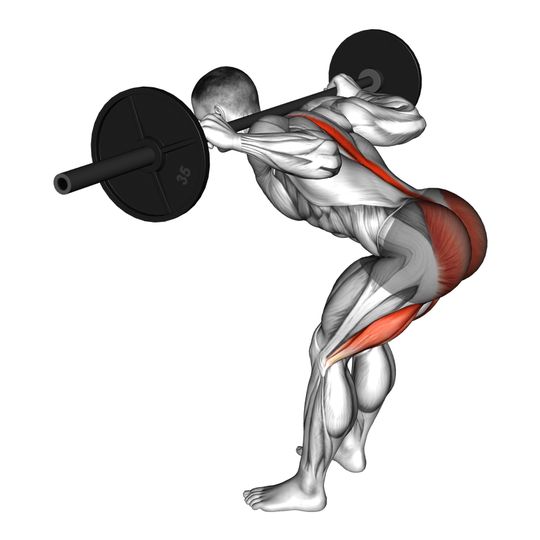
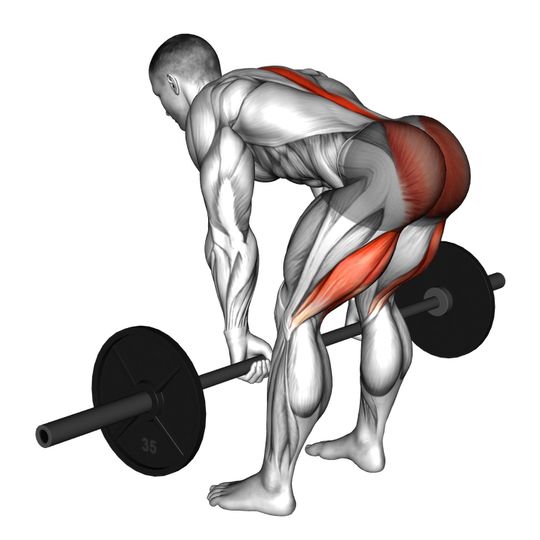
The good morning and the Romanian deadlift are both hip hinges: the knees stay slightly bent, the hips travel back, the torso folds forward and the hamstrings, glutes and lower back bring it back up. The difference is where the bar is. In the RDL it hangs from your hands and travels down the legs; in the good morning it sits on your upper back like a squat, and the whole torso becomes the lever.
That change moves the load far from the hips and turns a hamstring and glute exercise into one that hammers the spinal erectors too. It also cuts the weight you can use by more than half and takes grip out of the equation. The good mornings vs RDL question is really about how much lower back you want in your hamstring work and how heavy you need it to be.
| Factor | Barbell Good Morning | Barbell Romanian Deadlift |
|---|---|---|
| Main target | Hamstrings, glutes and spinal erectors | Hamstrings and glutes, erectors assist |
| Bar position | On the upper back, as in a squat | In the hands, travelling down the thighs |
| Typical load | Roughly 30–50% of your squat | Roughly 60–75% of your deadlift |
| Lower back demand | Very high — the torso is the lever | High but shared with the hamstrings |
| Grip limit | None | Often the limiting factor at heavy loads |
| Typical reps | 6–10, moderate load | 8–12, controlled eccentric |
| Best for | Erector strength, squat and deadlift carryover | Hamstring and glute growth, learning the hinge |
Barbell Good Morning vs Barbell Romanian Deadlift: muscles worked#
Barbell Good Morning
- Primary: Hamstrings, Glutes, Lower back
- Secondary: Abs, Upper back
Barbell Romanian Deadlift
- Primary: Hamstrings, Glutes
- Secondary: Lower back, Forearms, Upper back
Muscles worked#
Both lifts train the posterior chain. In the Romanian deadlift the hamstrings do the bulk of the work controlling the bar down and pulling the hips back through, the glutes finish the rep, and the spinal erectors work hard isometrically to keep the back flat. Because the bar hangs close to the hips, the lever on the spine is manageable and the load can be high enough to grow the hamstrings under a deep stretch.
The good morning shifts a large share of the work onto the spinal erectors. With the bar on the back, every degree of forward lean lengthens the lever between the load and the hips, so the erectors have to produce far more force to hold position and the hamstrings and glutes extend the hips against that same long lever. The glutes get less relative work than in the RDL; the erectors get far more.
Load and leverage#
The RDL is the heavier lift by a wide margin. Most lifters use 60–75 percent of their conventional deadlift for sets of 8–12, and at the top end grip is what gives out first, which is why straps are common. The hardest point is the bottom, where the hamstrings are stretched furthest.
A good morning uses roughly 30–50 percent of your back squat, and it should feel much heavier than the number suggests. Because the load sits on the shoulders, a torso near parallel puts far more torque on the hips and spine than the same weight held in the hands. Lifters who load good mornings like RDLs end up with a lower back that hurts for a week.
Back stress and who should do which#
The good morning is harder on the lower back and less forgiving of technique. A rounded spine under a bar on your back is a bad place to be, and there is no dropping it. It suits lifters who already hinge well, who want to strengthen the erectors directly for a bigger squat or deadlift, or who need to train the posterior chain without using the hands.
The Romanian deadlift is the safer default for almost everyone else. The bar is in the hands, so it can be set down if position is lost; the load is closer to the hips, so the same hamstring stimulus comes with less spinal stress; and it is the standard way to teach a hip hinge before pulling from the floor. If you only know one of the two, know the RDL.
Programming and how to use both#
Use the Romanian deadlift as the main hamstring builder: 3–4 sets of 8–12 with a slow lowering, stopping where the hamstrings stop stretching rather than where the bar touches the floor, once or twice a week on a lower or pull day. It fits after a squat or deadlift and recovers quickly enough to run year-round.
Use the good morning as a supplementary lift for the erectors and the squat: 3 sets of 6–10 at moderate load after your main lift, or as a lighter warm-up hinge with an empty bar. Powerlifters have used it for decades to teach staying tight when a squat tips forward, and that is where it earns its place. Running both in one week is fine if total hinge volume stays sane; alternating blocks is simpler.
The verdict#
Pick the good morning if you are an experienced lifter chasing a stronger squat or deadlift, if your lower back is the weak link in your hinge, or if you need to load the posterior chain without using your hands. Keep the weight moderate and treat it as an erector exercise that also trains the hamstrings, not a heavy hamstring builder.
Pick the Romanian deadlift if the goal is hamstring and glute growth, if you are still learning to hinge, or if your lower back already gets enough work from squats and deadlifts. It is heavier, safer and easier to progress, and most lifters should run it year-round with the good morning as a periodic accessory.
Frequently asked questions#
Are good mornings better than RDLs?
For the lower back, yes; for the hamstrings and glutes, no. The good morning loads the spinal erectors far harder because the bar sits on the back and the torso becomes the lever. The RDL puts the bar in the hands, lets you use roughly twice the weight, and stretches the hamstrings under more load.
What muscles do good mornings work compared to Romanian deadlifts?
Both train the hamstrings, glutes and spinal erectors. The RDL splits the work with the hamstrings and glutes doing most of it and the erectors holding position. The good morning shifts a much larger share onto the erectors and brings in the upper back and abs to keep the bar stable.
How much weight should I use for good mornings vs RDL?
Roughly 30–50 percent of your back squat for good mornings and 60–75 percent of your deadlift for RDLs. If you squat 120 kg and deadlift 150 kg, that is about 40–60 kg on good mornings and 90–110 kg on RDLs. If you are matching your RDL weight on good mornings, the range is too short or the back is rounding.
Are good mornings bad for your back?
Not with a moderate load and a neutral spine; they are one of the best exercises for strengthening the lower back directly. They become a problem when lifters load them like a deadlift, round under the bar, or lean forward past the point their hamstrings can control. Start with an empty bar and add weight slowly over weeks.
Can I do good mornings and Romanian deadlifts in the same workout?
You can, but it is a lot of hinge work for one session and the lower back will fatigue first. A cleaner approach is RDLs on one lower day and light good mornings on another, or alternating them by block. If you keep them together, RDL first with the heavier load and follow with 2–3 sets of light good mornings.