

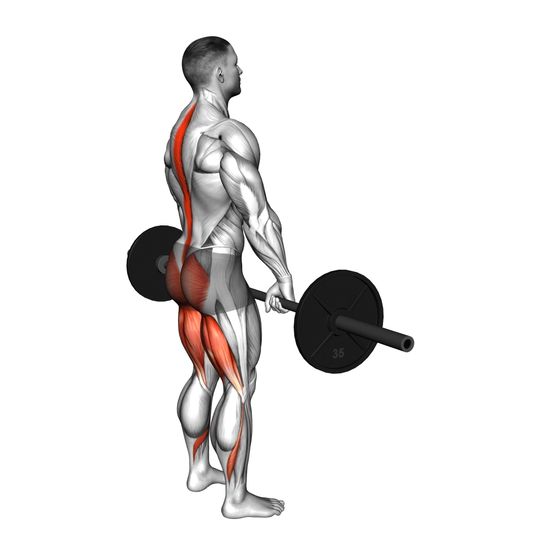
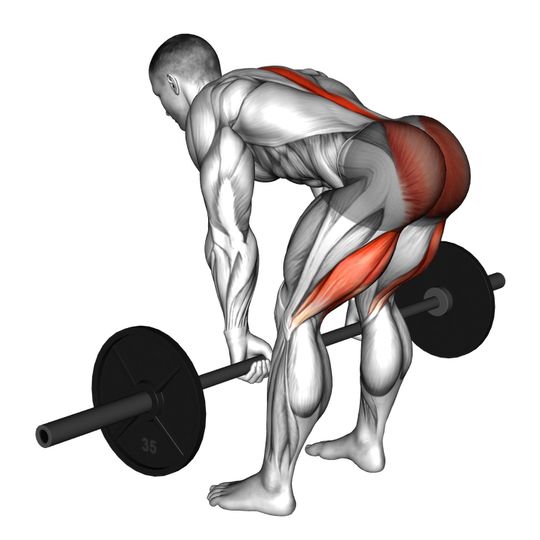
The stiff leg deadlift and the Romanian deadlift are both hip hinges that keep the knees mostly still and load the hamstrings under stretch, and lifters mix the names up constantly. The difference is how still the knees stay and how far the bar travels. In an RDL the knees soften and the hips push back hard, so the bar stops around mid-shin. In an SLDL the knees stay nearly straight and the bar travels as low as your hamstrings allow, often to the floor.
That sounds trivial and is not. The straighter knee of the stiff leg deadlift lengthens the hamstrings further and puts the lower back in a more demanding position, while the RDL's hips-back movement keeps the bar closer to the body, spares the spine, and lets you lift more. SLDL vs RDL is a question of how much stretch you want versus how much load you want.
| Factor | Barbell Stiff Leg Deadlift | Barbell Romanian Deadlift |
|---|---|---|
| Knee position | Nearly straight, held in a very slight bend | Soft bend of about 15–20 degrees, hips travel back |
| Bar path | Lowers almost vertically, drifts slightly forward | Slides down the thighs, stays against the legs |
| Bottom position | As low as the hamstrings allow, often the floor | Mid-shin, never touches down |
| Main target | Hamstrings under maximum stretch, spinal erectors | Hamstrings and glutes |
| Lower back stress | Higher — longer lever, more forward reach | Moderate — hips back keeps the load close |
| Typical load | About 70–85% of your RDL | About 60–75% of your deadlift |
| Best for | Hamstring stretch, lighter volume work | Heavy hamstring and glute training |
Barbell Stiff Leg Deadlift vs Barbell Romanian Deadlift: muscles worked#
Barbell Stiff Leg Deadlift
- Primary: Hamstrings, Glutes
- Secondary: Lower back, Abs, Forearms, Traps
Barbell Romanian Deadlift
- Primary: Hamstrings, Glutes
- Secondary: Lower back, Forearms, Upper back
Muscles worked#
Both lifts are hamstring and glute exercises with the spinal erectors working hard to keep the back flat. The RDL vs stiff leg deadlift muscle list is the same; what changes is the split. With the knees bent slightly and the hips pushed back, the RDL loads the glutes more at the bottom — the hips sit further behind the bar, so they do more work bringing it back — and the hamstrings work through a long but not extreme range.
The stiff leg deadlift puts more on the hamstrings and lower back. Straighter knees mean the hamstrings reach a longer length at the bottom, which is the stretch that drives growth, and the torso reaches further forward with the bar further from the hips, so the erectors carry a bigger bending moment. It is more hamstring stretch and more back exercise at once, which is why it is loaded lighter.
Range of motion and bottom position#
The RDL ends where the hamstrings run out of stretch with a neutral spine, which for most lifters is around mid-shin. The bar never touches the floor. The hips move back rather than the torso folding forward, so the shins stay vertical and the bar stays on the legs, and the rep is one controlled lowering followed by a hip drive back to standing.
The stiff leg deadlift keeps going. With the knees nearly straight, the only way to lower the bar further is to hinge deeper at the hip, and if the hamstrings allow it the bar can reach the floor. Old-school SLDLs were done off a block and allowed the back to round; the modern version stops where the spine stays flat. Either way the bar is further from the body at the bottom, which makes the lower back more involved.
Loading and safety#
The RDL is the heavier lift. Because the hips travel back, the bar stays close to the centre of mass and the glutes contribute strongly, so lifters comfortably use 60–75 percent of their conventional deadlift for sets of 8–12 and progress it for years. It is also the safer default: the pattern it teaches — hips back, bar on the legs, flat back — keeps every other pull safe.
The stiff leg deadlift needs more respect and less weight. The longer lever on the lower back and the deep hamstring stretch make it easy to round the spine if the load is too heavy or the flexibility is not there; a heavy straight leg deadlift vs RDL contest usually ends with a strained back on the SLDL side. Use roughly 70–85 percent of your RDL and stop where the back stays neutral.
Programming and how to use both#
Make the RDL the main hinge accessory. Program it after squats or deadlifts for 3–4 sets of 8–12 with a two- to three-second lowering, once or twice a week, adding weight when every set hits the top of the range without the bar drifting away from the legs.
Use the stiff leg deadlift as a stretch-focused variation rather than a second heavy hinge. It works as a lighter second hamstring exercise for 3 sets of 10–15 with a pause at the bottom, or as the go-to for lifters who feel RDLs in their glutes and lower back rather than their hamstrings. Alternating blocks — RDL for eight weeks, SLDL for four — gets both benefits without doubling the hinge volume.
The verdict#
Pick the stiff leg deadlift if you want the deepest hamstring stretch available with a barbell, if your RDLs feel like a glute exercise, or if you are working on hamstring flexibility and can keep the back flat at the bottom. Keep it light, slow, and paused, and treat it as a hamstring specialist rather than a strength lift.
Pick the Romanian deadlift if you want a hinge you can load heavy for hamstring and glute growth, if you have any lower back history, or if you are learning to hinge before pulling from the floor. It is the safer, more scalable default; most lifters should run it as their primary hamstring exercise and rotate the SLDL in for variety and range.
Frequently asked questions#
What is the difference between SLDL and RDL?
The knees and the bottom position. In an RDL the knees bend slightly and the hips push back, so the bar stops around mid-shin against the legs. In an SLDL the knees stay nearly straight and the bar travels as low as your hamstrings allow, often to the floor. The RDL is heavier and friendlier to the back; the SLDL stretches the hamstrings harder.
Is a stiff leg deadlift or an RDL better for hamstrings?
Both build hamstrings, and the RDL usually wins on total growth because you can load it heavier and progress it longer. The stiff leg deadlift produces a deeper stretch at the bottom, which suits hamstring flexibility work. If you can only do one, RDL; if you have room for two hinges, use both.
Should the stiff leg deadlift touch the floor?
Only if you can reach it with a flat back, and most people cannot. The point of the exercise is the hamstring stretch, not the depth. Stop where the spine stays neutral, or stand on a low block for a longer range. Rounding the back to touch down turns a hamstring exercise into a lower back exercise.
Is the straight leg deadlift the same as the stiff leg deadlift?
Yes, the names describe the same lift: a deadlift with the knees held nearly straight and the bar lowered as far as hamstring flexibility allows. Some lifters use straight leg for the fully locked version and stiff leg for a very slight bend, but in practice they are used interchangeably and programmed the same way.
How much weight should I use on a stiff leg deadlift vs an RDL?
Less on the SLDL. A typical RDL is 60–75 percent of your conventional deadlift for sets of 8–12; a stiff leg deadlift is usually 70–85 percent of your RDL for the same reps, because the longer lever makes the bottom much harder. If your SLDL matches your RDL, you are almost certainly bending the knees or cutting the range.