
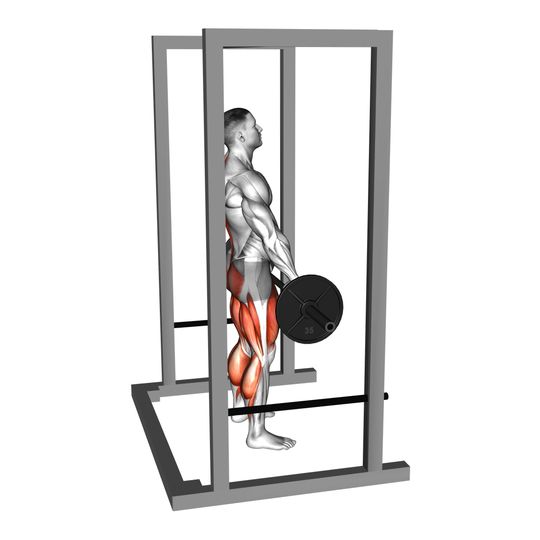
A rack pull is a deadlift with the bottom cut off. Instead of starting on the floor, the bar sits on the safety pins of a power rack, usually just below the kneecap, and you pull it from there to lockout. Everything above that point is the same as a conventional deadlift. Everything below it, including the hardest part of the lift, is gone.
That is why the rack pull vs deadlift comparison matters more than it looks. Removing the bottom of the pull lets you handle 10–20 percent more than your deadlift, shifts the work away from the quads and toward the back and traps, and cuts the recovery cost per kilo lifted. It also means rack pulls do not train the thing most people most need to train.
| Factor | Rack Pull | Barbell Deadlift |
|---|---|---|
| Starts from | Pins just below the knee | The floor, dead stop |
| Main target | Lower back, glutes, traps and upper back | Whole posterior chain, back, quads, grip |
| Quad involvement | Minimal — knees almost straight at the start | Significant off the floor |
| Typical load | About 110–120% of your deadlift | Your heaviest lift |
| Range of motion | Top half only | Full |
| Recovery cost | Lower per kilo, heavy on the back and grip | Highest of any lift |
| Best for | Lockout strength, trap and upper back size | Maximal strength, total-body development |
Rack Pull vs Barbell Deadlift: muscles worked#
Rack Pull
- Primary: Lower back, Glutes, Hamstrings
- Secondary: Traps, Upper back, Quads, Forearms, Lats
Barbell Deadlift
- Primary: Glutes, Hamstrings, Lower back
- Secondary: Quads, Traps, Upper back, Forearms, Abs
Muscles worked#
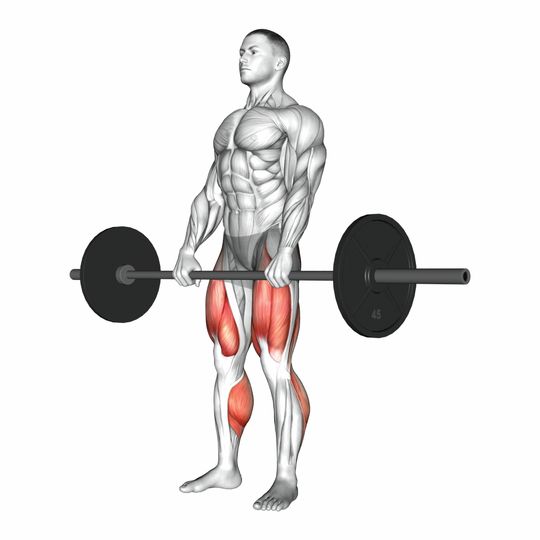
The conventional deadlift trains more muscle per rep than almost any other exercise. Quads and glutes break the bar off the floor, hamstrings and glutes drive the hips through the middle, the spinal erectors hold the back rigid from start to finish, the lats keep the bar against the body, and the forearms and traps hold everything together at the top. The dead stop is where the quads and erectors work hardest, because there is no stretch reflex or momentum to help.
The rack pull trains the muscles that finish a deadlift. With the bar starting below the knee the legs are already mostly straight, so the quads contribute little and the glutes, hamstrings and lower back extend the hip to lockout. The traps and upper back get the biggest dose of any variation, because at the top of a heavy rack pull they are supporting more weight than you could ever deadlift, and the grip is often the first thing to fail. That is why rack pulls appear in bodybuilding programs as a back and trap builder as often as in powerlifting ones as a lockout drill.
Range of motion and the start position#
A deadlift rep begins at its hardest point. The bar is on the floor, the hips are low, the knees are bent, and you have to create full-body tension from nothing before it moves. That off-the-floor position is where beginners struggle and where most of the strength benefit of the lift is earned.
A rack pull skips all of that and starts in the strongest part of the range, with the hips already high and the back at a comfortable angle. The height of the pins decides how much you skip: just below the knee keeps the lift honest and demanding, mid-thigh turns it into a heavy shrug with a lot of ego attached. Pulling from pins also lets you reset every rep and lower the bar onto steel rather than the floor, which spares the lower back a full eccentric with a bar this heavy.
Loading, carryover and fatigue#
Because the weakest part of the range is gone, a well set rack pull handles roughly 10–20 percent more than your deadlift for the same reps. That overload is its point: it teaches the body what a heavier bar feels like, and lifters who stall at the knee or at lockout use it to strengthen exactly that section. The carryover only works if the pins are low enough that the rack pull looks like the top of your deadlift.
Heavy deadlifts are the most fatiguing thing most lifters do, which is why programs prescribe them in low sets and reps once a week. Rack pulls cost less per rep because the range is shorter, but they cost more per kilo on the back and grip, and lifters who treat them as a chance to load every plate in the gym end up with a lower back that never recovers. Treat the number as a training load for that pin height, not as a deadlift you can claim.
Programming and how to use both#
Program the deadlift as the main lift. Three to five sets of 3–6 reps, once a week, progressed slowly, is the standard prescription, and it is the exercise that should improve when the program is working. No amount of rack pulling replaces the dead-stop start from the floor, so anyone who wants a bigger deadlift has to keep pulling from the ground.
Program the rack pull as a supplemental lift. For strength, 3–5 sets of 3–6 at 105–115 percent of your working deadlift weight, after your main pull or on a separate day, with the pins just below the knee. For back and trap size, 3 sets of 8–10 with a lighter load and a controlled lower. Once a week is enough either way. If you do rack pulls and deadlifts in the same session, deadlift first.
The verdict#
Pick the rack pull if you want to build lockout strength, load the traps and upper back heavier than any other exercise allows, or keep pulling heavy while an injury or mobility issue keeps you off the floor. Set the pins low, keep the load honest, and treat it as a supplement to the deadlift rather than a substitute for it.
Pick the deadlift if you want strength that transfers, if you compete, or if you want the one exercise that trains the most muscle per rep. The rack pull is a tool for improving the top half of it, not a replacement, and lifters who drop the full pull for rack pulls end up with a big number on the pins and a deadlift that has stopped moving.
Frequently asked questions#
Are rack pulls as good as deadlifts?
No, not as a whole-body strength exercise. Rack pulls skip the bottom of the lift, which is where the quads work, where full-body tension is built, and where most of the deadlift's strength benefit comes from. They are excellent for the traps, upper back and lockout strength, but they are a supplement to the deadlift rather than an equal.
How much more should I rack pull than deadlift?
With the pins just below the knee, most lifters rack pull about 10–20 percent more than their deadlift for the same reps. If the gap is much bigger than that, the pins are probably too high and the lift has turned into a heavy shrug that no longer resembles the top of your deadlift. Lower the pins a hole rather than adding plates.
Do rack pulls build the traps?
Yes, better than almost anything else. At the top of a heavy rack pull the upper traps are holding more weight than you could deadlift, and the rhomboids and rear delts work hard to keep the shoulders from rounding. Sets of 8–10 with a one-second hold at lockout are the best way to use them for trap size.
Can rack pulls replace deadlifts if I have a bad back?
Temporarily, often. Starting below the knee removes the low hip position that many lifters with lower back complaints cannot tolerate, and setting the bar down on pins removes the heavy eccentric. Keep the load moderate, keep the back rigid, and treat it as a bridge back to the floor rather than a permanent change.
Where should the pins be set for a rack pull?
Just below the kneecap for most purposes. That height keeps the lift close to the top half of a real deadlift, so the strength carries over and the load stays honest. Pins above the knee shorten the range so much that the exercise becomes a very heavy partial that mainly trains the grip and traps.