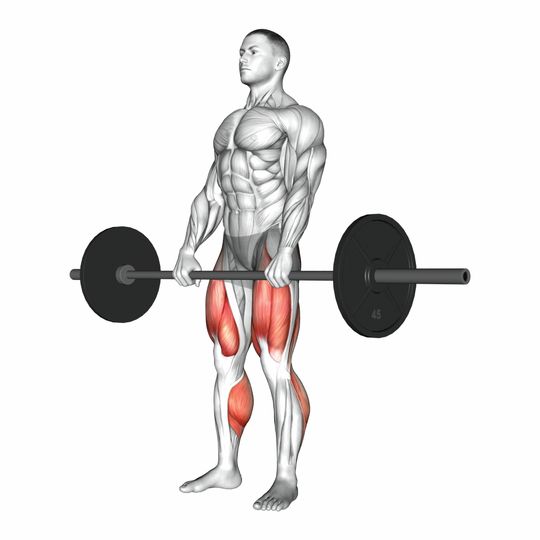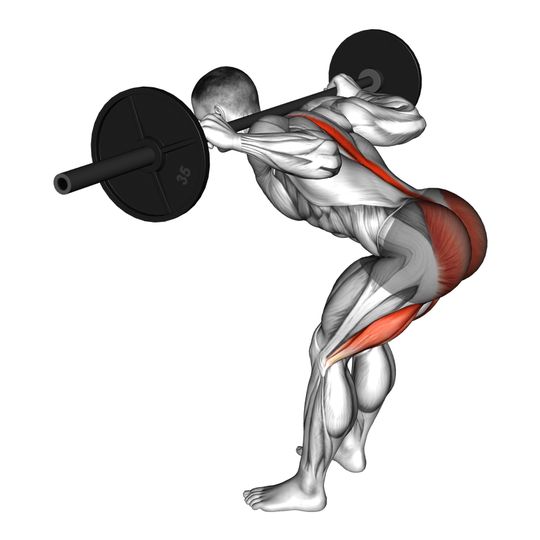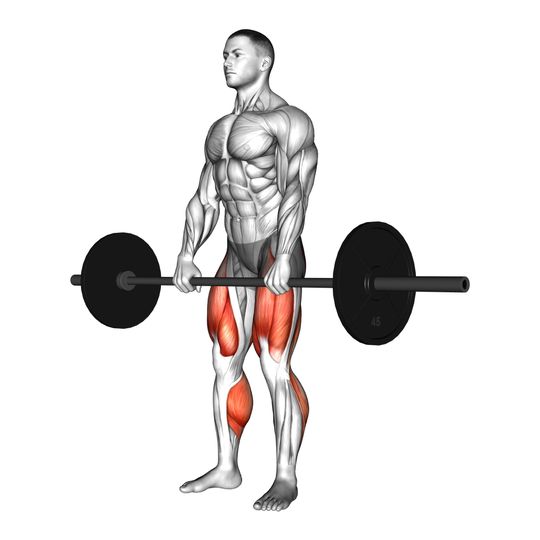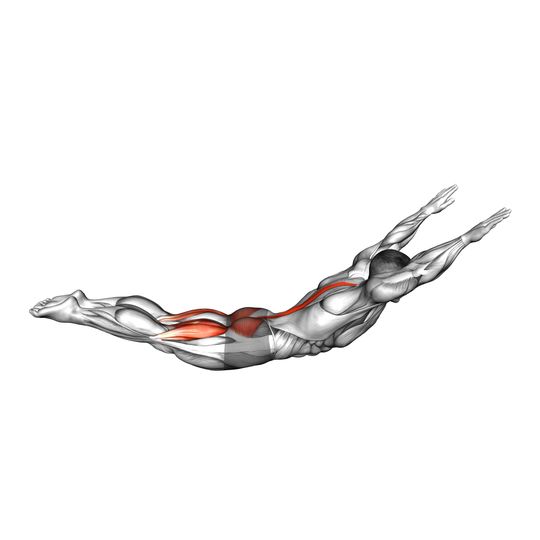


A hip-hinge barbell lift performed from rack pins just below the knees that strengthens the posterior chain, especially the glutes and hamstrings.
How to do the Rack Pull#
- Set the safety pins so the bar sits slightly below your knees.
- Stand with the bar over mid-foot and hinge at the hips to grip the bar with a double overhand or mixed grip.
- Brace your core and keep a neutral, flat back before you begin the pull.
- Drive your hips forward and extend your knees together to lift the bar, keeping it close to your legs.
- Retract your shoulder blades briefly at the top, then lower the bar under control back to the pins.
Muscles worked#
The rack pull is a deadlift with the bottom cut off, so it trains the muscles that finish a deadlift. The glutes drive the hips through to lockout, the hamstrings help extend the hip from a slightly bent knee, and the spinal erectors along the lower back hold a rigid spine against a load that is usually heavier than you could pull from the floor. Because the knee is already mostly straight at the start, the quads do little.
The traps and upper back get an enormous dose of work simply by holding position. At the top of a heavy rack pull the upper traps are supporting the whole bar, which is why lifters use it as a trap builder. The lats keep the bar tucked against the thighs, and the forearms and grip are often the first thing to give out, so straps are common for the heaviest sets.
- Primary: Lower back (Erector Spinae), Glutes (Gluteus Maximus), Hamstrings (Biceps Femoris, Semitendinosus & Semimembranosus)
- Secondary: Traps (Trapezius), Upper back (Rhomboids & Middle Trapezius), Quads (Quadriceps Femoris), Forearms (Forearm Flexors & Extensors (incl. Brachioradialis)), Lats (Latissimus Dorsi)
Common mistakes#
- Rounding the lower back during the pull.
- Letting the bar drift away from the legs.
- Bending the knees excessively so the movement turns into a squat.
- Hyperextending the spine at the top of the lift.
Rack Pull vs other exercises#
Head-to-head breakdowns of muscles worked, loading, joint stress, and which one to pick for your goal.
Why it works#
Rack pulls let you overload the top half of the deadlift. Most lifters fail a deadlift somewhere between the knee and lockout, and the rack pull puts 10-20 percent more than your deadlift max exactly into that range. It teaches the body what a heavier bar feels like in the hands, and the strength that comes with it shows up at the sticking point of the full lift.
It is also a back builder that spares the recovery cost of full deadlifts. Cutting the range removes the deepest, most demanding part of the pull, which means less lower back fatigue per kilo lifted and a much heavier load for the traps, upper back and grip to hold. That is why it appears in bodybuilding programs as often as in powerlifting ones.
Sets, reps and setup#
Three to five sets of 3-6 reps with two to three minutes of rest as a strength movement, or three sets of 8-10 with a lighter load for back size. Once a week is enough; it is a heavy pull however you dress it up.
- Setup
- Set the pins so the bar starts just below the kneecap. Take your deadlift stance, grip the bar with a double overhand or mixed grip, pull the slack out and lock the lats before the bar leaves the pins. Drive the hips forward, stand tall without leaning back, then lower to the pins under control rather than dropping the bar onto them.
- Progression
- Add 2.5-5 kg per week while the reps stay clean. When you stall, lower the pins a hole so the range gets longer at the same weight. If your back rounds off the pins or you have to hitch the bar up your thighs, the load has outrun your positioning.
Variations#
- Barbell Deadlift The full-range lift, with the quads and a much deeper hinge added at the bottom.
- Block Pull Plates rest on blocks instead of the bar sitting on pins, so the bar flexes like a real deadlift and the pull starts lower.
- Barbell Romanian Deadlift Starts at the top and lowers to below the knee under control, training the same muscles with a longer hamstring stretch.
- Trap Bar Deadlift Neutral handles and a centred load make it easier on the lower back with more knee bend.
- Barbell Shrug Isolates the trap work that the rack pull does incidentally at lockout.
Rack pull vs deadlift#
The deadlift trains everything from the floor: quads and hips off the ground, back through the knee, glutes and traps at the top. The rack pull only trains the last part, but it lets you do so with more weight than the full lift allows, which is why it is used to strengthen a lockout or overload the back.
The rack pull is not a replacement. Because the bar starts on pins, it also removes the hardest portion for the lower back and hamstrings and can leave a lifter with a heavy top half and a weak start. Use it as a supplement to the deadlift, or as a back exercise, not as the whole hinge in a program.
Common questions#
What muscles does the rack pull work?
The glutes, hamstrings and lower back extend the hips and hold the spine rigid, while the traps, upper back and lats take a heavy load at lockout. The forearms and grip work hard, and the quads contribute only slightly because the knees start nearly straight.
Are rack pulls good for building traps?
Yes. Supporting a supra-maximal bar at the top with a brief hold trains the upper traps under heavier loads than any shrug allows. Add a one-second pause at lockout and keep the shoulders down and back rather than shrugging, and the traps will grow.
How high should the bar be for a rack pull?
Just below the kneecap is the standard position because it matches where most deadlifts stall. Setting the pins above the knee turns it into a trap and grip exercise; lower pins make it closer to a full deadlift. Choose the height for the job you want done.
Should rack pulls be heavier than deadlifts?
Usually, by 10-20 percent when the pins are at knee height. If your rack pull is not heavier than your deadlift, your lockout is your weak point and the exercise is well chosen. If it is more than 30 percent heavier, the pins are probably set too high to transfer.
Are rack pulls bad for your back?
Not when done with a neutral spine and a load you can control. The risk comes from lifters treating them as an ego lift, rounding off the pins and hitching the bar. Keep the reps low, lower the bar rather than dropping it, and they are as safe as any other hinge.