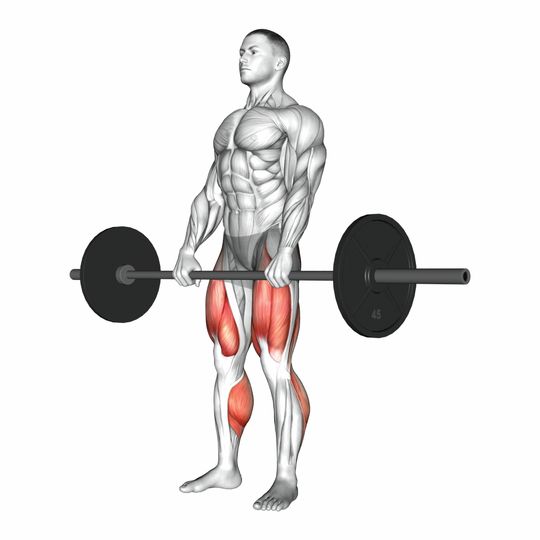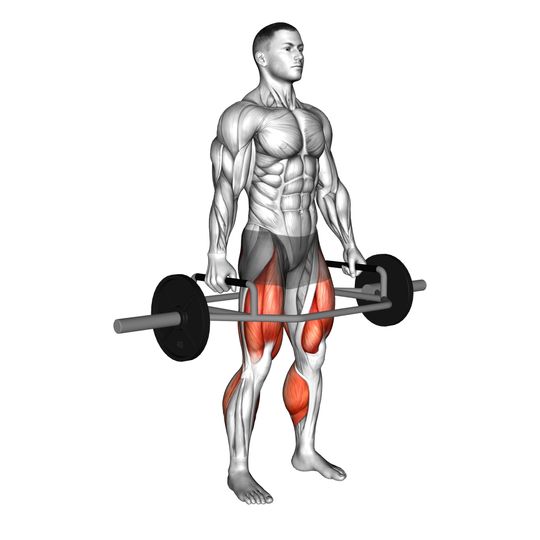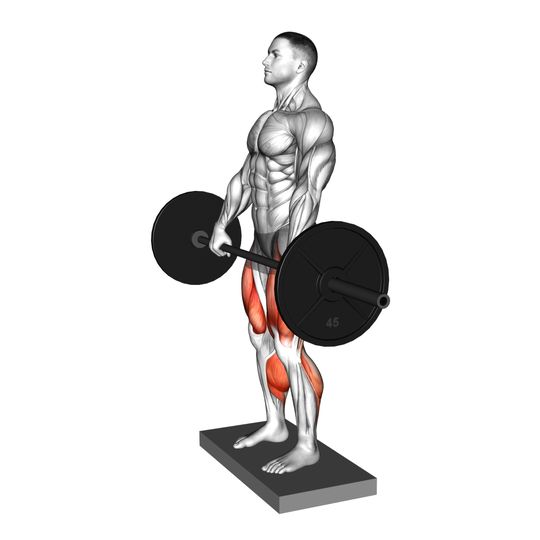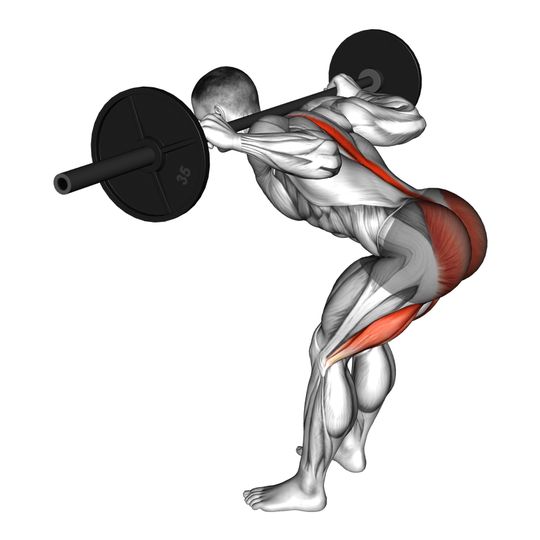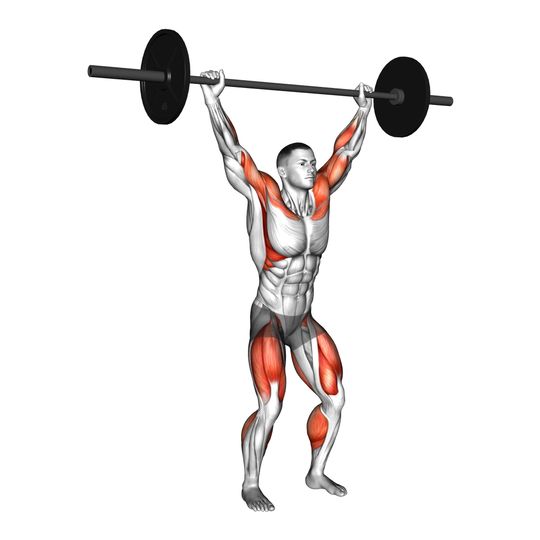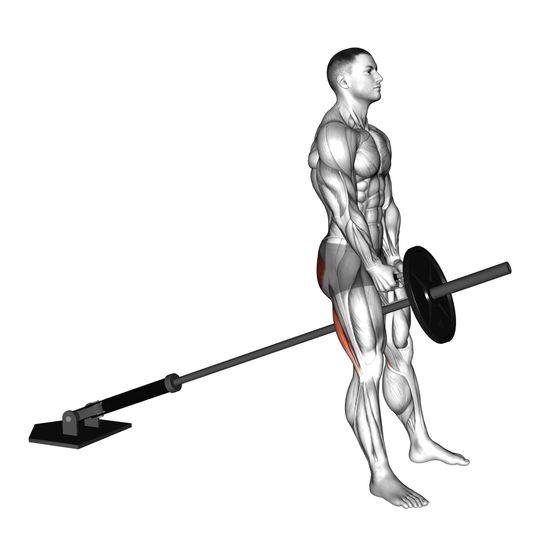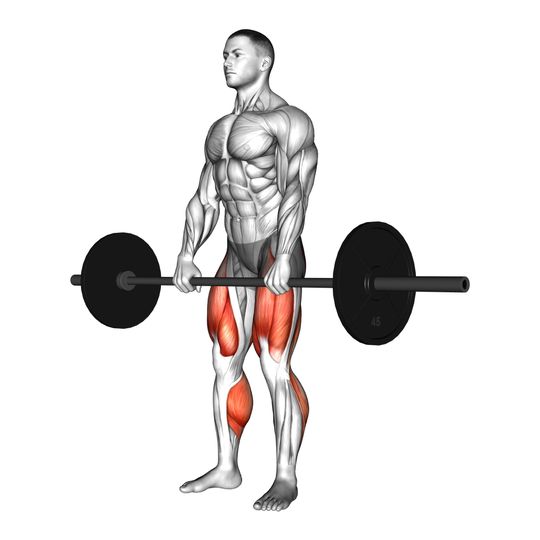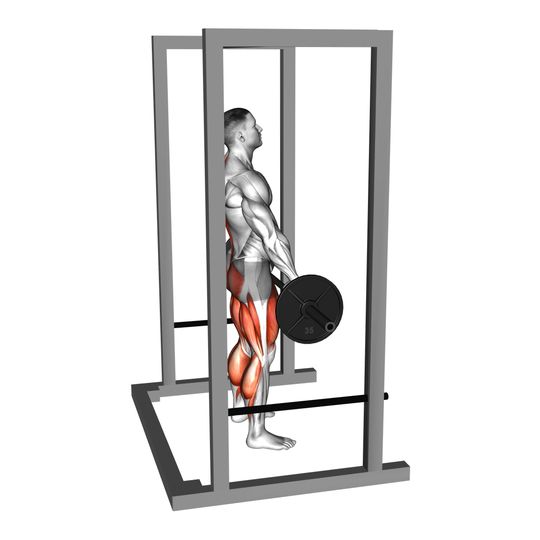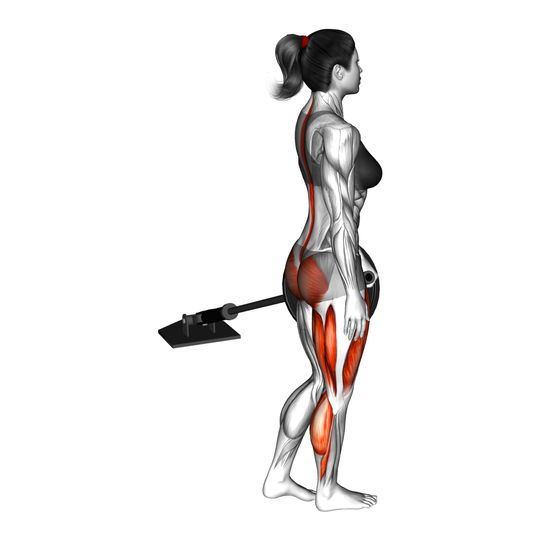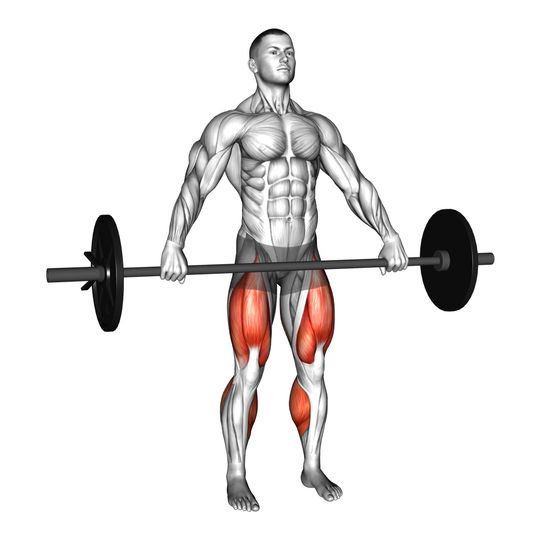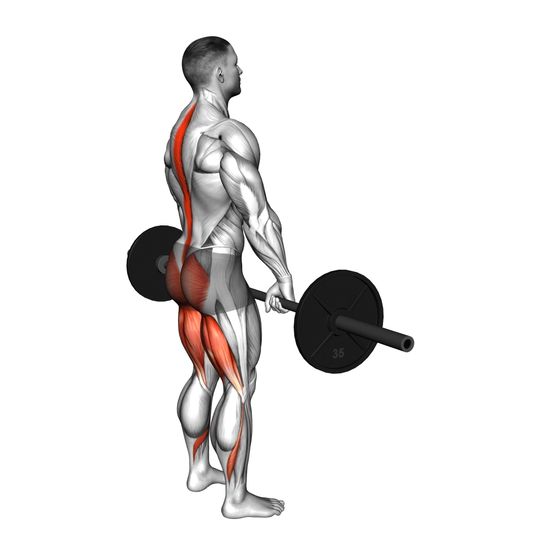


A barbell hip-hinge that loads the hamstrings and glutes by pushing the hips back while keeping the torso steady. Maintain a neutral spine and a slight knee bend throughout the movement.
How to do the Barbell Romanian Deadlift#
- Stand with feet about hip-to-shoulder width and grasp the barbell with an overhand grip at roughly shoulder width.
- Push your hips rearward and initiate the descent by hinging at the hips while allowing a small bend in the knees.
- Keep the bar close to your legs and your spine neutral as you lower until you feel a strong hamstring stretch, stopping before the bar reaches the floor.
- Drive your hips forward and contract the glutes to return to an upright position, extending hips and knees together.
- Draw your shoulder blades back slightly at the top, reset your stance, and repeat for reps.
Muscles worked#
The Romanian deadlift is a hip hinge, and the hamstrings and glutes do the work. With the knees held at a slight bend, pushing the hips back stretches the hamstrings at the hip end while the knee end stays fixed, and driving the hips forward to stand up contracts them together with the gluteus maximus. That combination of a long stretch and a strong contraction is what makes the RDL the most productive hamstring exercise you can do with a barbell.
The spinal erectors work hard to hold the back flat as the bar travels down the thighs, and the lats pull the bar into the legs so it does not drift forward. The upper back and grip carry the weight the whole time, and the adductors help the glutes extend the hip. Expect the stretch behind the thighs at the bottom, the squeeze in the glutes at the top and, after a hard set, fatigue along the whole lower back.
- Primary: Hamstrings (Biceps Femoris, Semitendinosus & Semimembranosus), Glutes (Gluteus Maximus)
- Secondary: Lower back (Erector Spinae), Forearms (Forearm Flexors & Extensors (incl. Brachioradialis)), Upper back (Rhomboids & Middle Trapezius)
Common mistakes#
- Rounding the lower back instead of maintaining a neutral spine.
- Letting the bar drift away from the thighs.
- Bending the knees too much and turning the hinge into a squat.
- Lowering all the way to the floor instead of stopping at hamstring tension.
- Using a back yank rather than driving the movement with the hips.
How much should you deadlift?#
What the average deadlift actually is, and what counts as beginner, intermediate, advanced, or elite at your bodyweight — for men and women, in kg and lbs.
See deadlift strength standards →
Barbell Romanian Deadlift vs other exercises#
Head-to-head breakdowns of muscles worked, loading, joint stress, and which one to pick for your goal.
- Romanian Deadlift vs Deadlift →
- Stiff Leg Deadlift vs Romanian Deadlift →
- Good Morning vs Romanian Deadlift →
Why it works#
It trains the hamstrings where they matter most for performance and injury. Hamstring strains happen when the muscle is long and working hard, which is exactly the position the RDL loads, and it teaches the hip hinge that every deadlift, clean and swing is built on. Unlike the conventional deadlift, it never starts from the floor, so the back stays in one position and the legs do not help with a knee drive.
It also carries a lot of weight for an exercise that is mostly hamstring. The stretch at the bottom is what grows the muscle, and the RDL lets you load that stretch heavier than any curl or good morning. It is the natural partner for a leg curl: curls train the knee end, the RDL trains the hip end, and between them the hamstrings are fully covered.
Sets, reps and setup#
Three to four sets of 6-10 reps, once or twice a week, after squats or as the main lift on a hinge day. Sets of 10-12 with a lighter bar are good for pure hamstring growth. Sets under five are usually limited by grip and back position rather than hamstrings and are better left to the conventional deadlift.
- Setup
- Stand with the bar in your hands at hip height, feet under the hips, knees slightly bent. Push the hips straight back and let the bar slide down the front of the thighs, keeping the back flat and the bar touching the legs. Stop when the hamstrings are fully stretched, usually just below the knees, then drive the hips forward to stand. The knees stay at the same slight bend the whole way; if they bend more, it has become a squat.
- Progression
- Add weight when every rep of every set keeps the bar on the legs and the back flat at the bottom. Straps are fine once grip limits the set, since the goal is hamstrings, not forearms. To make a lighter weight harder, pause for two seconds at the bottom, slow the lowering phase to three or four seconds, or stand on a low block for a slightly longer range.
Variations#
- Romanian Deadlift (Dumbbell) The same hinge with a dumbbell in each hand, easier on the setup and with the weights kept at the sides.
- Stiff Leg Deadlift (Barbell) Done with straighter knees and often from the floor, which stretches the hamstrings further and asks more of the lower back.
- Single Leg Romanian Deadlift (Dumbbell) One leg at a time, trading load for balance and hip stability.
- Good Morning (Barbell) The same hinge with the bar on the back instead of in the hands, shifting more work to the spinal erectors.
- Deadlift (Barbell) The full lift from the floor, with the quads helping and the heaviest loads of any hinge.
Romanian deadlift vs conventional deadlift#
The conventional deadlift starts from the floor with bent knees, so the quads help break the bar off the ground and the lift is a test of total strength. The Romanian deadlift starts from the top, keeps the knees nearly fixed and stops when the hamstrings are stretched, so the whole rep belongs to the hamstrings, glutes and lower back. You will always lift more on the conventional version, and you will feel the RDL more in the back of the legs.
They are not interchangeable. The conventional deadlift is the strength builder; the RDL is the muscle builder and the technique drill for the hinge. Many programs pair a heavy conventional day with a lighter RDL day, and lifters who only want bigger hamstrings can skip the floor pull entirely and keep the RDL.
Common questions#
What muscles does the Romanian deadlift work?
The hamstrings and glutes do the lifting, the spinal erectors hold the back flat, and the lats, upper back and forearms keep the bar in position. It is the best barbell exercise for the hamstrings at the hip and one of the best for the glutes.
How far down should I go on a Romanian deadlift?
Until the hamstrings are fully stretched with the back still flat, which for most people is a bar height just below the knees. Going lower by rounding the back or bending the knees further adds nothing for the hamstrings and moves the load to the spine.
Should my knees be bent or straight?
Slightly bent, and fixed at that bend for the whole rep. Locked-straight knees make it a stiff-leg deadlift and stress the lower back more; knees that bend as you descend turn it into a squat. Set a soft bend at the top and keep it.
Why does my lower back hurt after RDLs?
Usually because the bar drifted away from the legs or the back rounded at the bottom. Pull the bar into the thighs with the lats, stop the descent when the hamstrings are stretched rather than when the bar reaches a certain height, and lower the weight until every rep stays flat. A tired lower back is normal; a sharp pain is not.
Is the Romanian deadlift better than the leg curl for hamstrings?
They train different halves of the same muscle. The RDL loads the hamstrings at the hip in a stretched position and lets you use heavy weight; the leg curl loads them at the knee. Doing both in a week builds more hamstring than either alone, and the RDL adds glutes and back for free.