

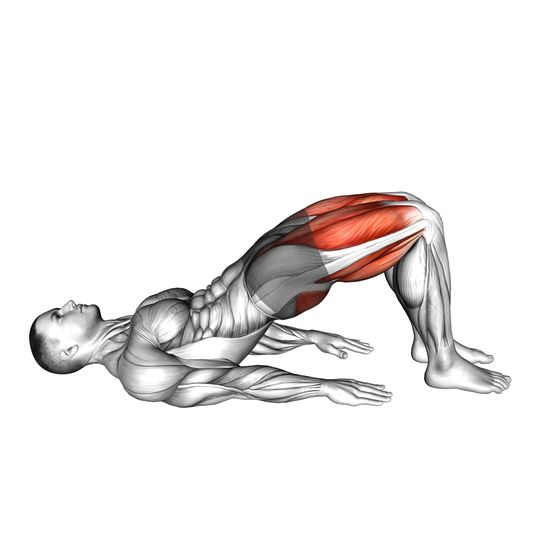
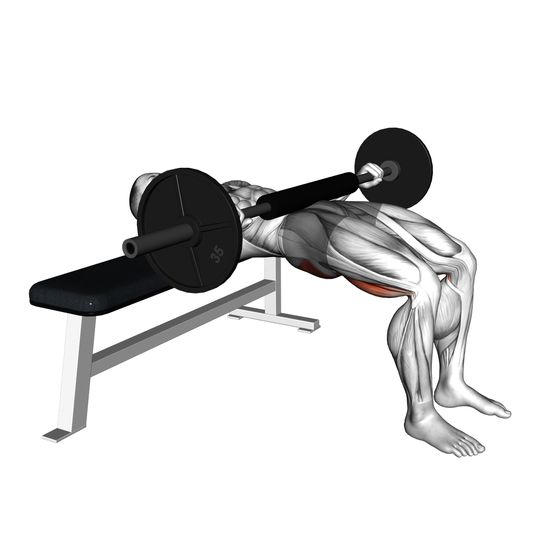
The glute bridge and the hip thrust are the same hip extension pattern from two different heights. In the glute bridge your upper back is on the floor and the hips travel a short distance to lockout. In the hip thrust your upper back is on a bench, the hips start lower and travel further, and the exercise can be loaded with a barbell far beyond what fits across your lap on the floor.
That change of height is the whole story. It decides how much range the glutes work through, how much the hamstrings and quads help, how heavy you can go, and how tempted the lower back is to take over. Hip thrust vs glute bridge is less a beginner-versus-advanced choice than an activation tool versus a heavy glute builder — though a loaded glute bridge blurs that line.
| Factor | Glute Bridge | Barbell Hip Thrust |
|---|---|---|
| Setup | Upper back on the floor, knees bent | Upper back on a bench, feet on the floor |
| Range of motion | Short — hips rise 15–25 cm to lockout | Long — hips start well below the knees |
| Main target | Glutes at peak contraction | Glutes through a longer range, hamstrings assist |
| Loading | Bodyweight, band, dumbbell, or barbell | Barbell, machine, or heavy dumbbell |
| How heavy it goes | Moderate — plates hit the floor first | Heaviest glute exercise there is |
| Lower back stress | Very low | Low, but easy to arch under heavy loads |
| Best for | Activation, warm-ups, home training | Glute strength and size, progressive overload |
Glute Bridge vs Barbell Hip Thrust: muscles worked#
Glute Bridge
- Primary: Glutes
- Secondary: Hamstrings, Abs, Lower back
Barbell Hip Thrust
- Primary: Glutes
- Secondary: Hamstrings, Quads, Abs, Lower back
Muscles worked#
Both are glute exercises first. The gluteus maximus extends the hips against the load and reaches its hardest contraction at the top, where the thighs are level with the torso — the position where squats and deadlifts have already gone slack. The glute bridge vs hip thrust muscles worked list is nearly identical: glutes, then hamstrings, with the abs and spinal erectors holding the pelvis still.
The hip thrust recruits more hamstring and more quad. The lower start position lengthens the hamstrings under load in the bottom half of the rep, and the deeper knee bend drags the quads in, especially with the feet close to the hips. The glute bridge keeps the knees near ninety degrees, which leaves the hamstrings shortened and unable to help much, so the glutes are more isolated.
Range of motion and loading#
The hip thrust wins on range. From a bench, the hips drop well below knee height and travel to a full lockout, so the glutes are loaded in both the stretched and the contracted positions. That longer range plus the ability to roll a loaded barbell over the hips is why lifters progress the hip thrust to 100 kilograms and beyond, and why it builds more glute over time.
The glute bridge is capped by geometry. On the floor, the hips only rise until the torso and thighs form a straight line, and a barbell glute bridge is limited further by the plates touching the floor at the bottom. A barbell glute bridge vs hip thrust with the same weight is easier in the bridge because the range is shorter — fine for a peak-contraction pump, but less total work per rep.
The Kas glute bridge and where it fits#
The Kas glute bridge sits between the two and confuses the question. It uses the hip thrust setup — upper back on a bench, barbell across the hips — but restricts the movement to the top few inches of the range, lowering only slightly from lockout and pressing back up slowly with no momentum. It is a hip thrust performed like a glute bridge, named for the coach who popularised it.
Kas glute bridge vs hip thrust comes down to what you want from the rep. The Kas version keeps constant tension on the glutes, removes the bounce off the bottom, and forces lighter loads with more control, which suits lifters who feel hip thrusts in their hamstrings and lower back. The full hip thrust trains the glutes through more range with more weight, which builds more muscle for most people.
Programming and how to use both#
Use the glute bridge as a warm-up, an activation drill, and a home exercise. Two sets of 12–15 bodyweight reps with a two-second squeeze before squats or deadlifts wakes the glutes up; three sets of 15–20 with a band or a dumbbell works as a finisher. A single-leg glute bridge is the natural progression when the two-leg version gets easy and there is no barbell.
Program the hip thrust as the main glute lift: 3–4 sets of 8–12 with a one-second hold at the top, once or twice a week, adding weight whenever every set hits a full lockout. A weighted glute bridge vs hip thrust decision rarely needs making — with a bench and a bar, thrust; with a floor and a dumbbell, bridge, and progress with pauses and single-leg work.
The verdict#
Pick the glute bridge if you are training at home, warming up for a heavier session, learning to feel your glutes fire, or working around a back that does not want a bar across the hips. It isolates the glutes at peak contraction with almost no equipment and no recovery cost, and a loaded or single-leg version is a real glute exercise rather than a rehab drill.
Pick the hip thrust if glute size and strength are the goal and you have a bench and a barbell or a machine. The longer range and the heavy loading make it the most effective glute builder in the gym, and it can be progressed for years. Most good glute programs use both: the bridge as a warm-up or finisher, the hip thrust as the loaded main movement.
Frequently asked questions#
Is a hip thrust better than a glute bridge for glute growth?
Yes, for most people. The hip thrust moves the glutes through a longer range and lets you load a barbell far heavier than fits across your hips on the floor, and heavier loading through more range builds more muscle. A glute bridge still grows the glutes, especially once loaded or done single-leg, but it plateaus sooner.
What is the difference between a glute bridge and a hip thrust?
The height of your upper back. A glute bridge is done with the shoulders on the floor, which limits the hips to a short range up to lockout. A hip thrust puts the upper back on a bench, so the hips start lower, travel further, and can be loaded much heavier. The muscles are the same; the range, load, and hamstring involvement differ.
What is a Kas glute bridge vs a hip thrust?
A Kas glute bridge uses the hip thrust setup but only moves through the top few inches of the range, slowly and with lighter weight, to keep constant tension on the glutes. A hip thrust uses the full range from a low bottom position to lockout with heavier loads. The Kas version is a control tool; the hip thrust is the mass builder.
Can I do a barbell glute bridge instead of a hip thrust?
You can, and it works well if you have no bench or find the bench position uncomfortable. Expect a shorter range because the plates touch the floor at the bottom, so use a full pause and a hard squeeze at the top to make up for it. Smaller-diameter plates extend the range slightly.
Should I do glute bridges and hip thrusts in the same workout?
Yes, in different roles. Bodyweight or banded glute bridges make an ideal warm-up before heavy hip thrusts, and a high-rep or single-leg bridge finisher afterwards adds glute volume cheaply. Doing both heavy in the same session is redundant.