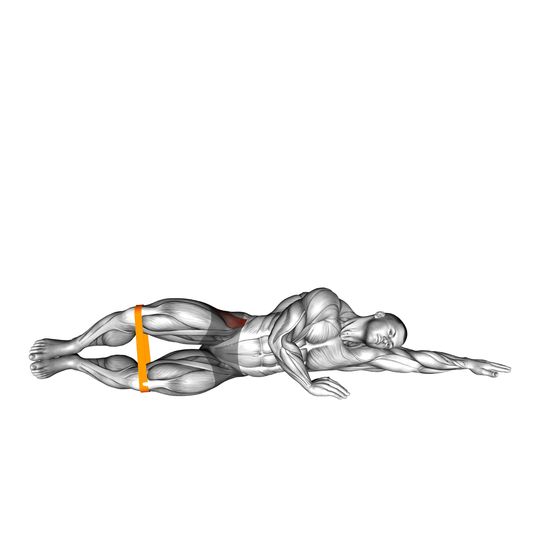


Lift your hips into a bridge by extending at the hips to load the glute muscles. The movement uses hip extension to primarily work the glutes.
How to do the Glute Bridge#
- Lie on your back with knees bent, feet flat and hip-width apart, heels positioned near your glutes.
- Brace your core and press through your heels to lift your hips until your body forms a straight line from shoulders to knees.
- Squeeze your glutes at the top and hold for a moment without overarching your lower back.
- Lower your hips slowly until your tailbone returns toward the floor while maintaining tension in the glutes and core.
- Keep your knees tracking over your feet throughout each repetition and repeat for the desired reps.
Muscles worked#
The glute bridge is a pure hip extension exercise, and the gluteus maximus is the prime mover. Lying on your back with bent knees puts the hamstrings in a shortened position where they cannot contribute much, so the glutes have to do almost all of the lifting. Peak tension arrives at the top, when the hips are fully extended and the glutes are at their shortest — the position where most squats and deadlifts have already gone easy.
The hamstrings assist as the hips rise and help keep the knees from drifting, the abs work to keep the ribs down and stop the lower back arching, and the erector spinae stabilise the spine. Feel-wise it should be a hard squeeze in the glutes at the top and nothing in the lower back. If the low back is what you notice, the hips are going too high or the ribs are flaring.
- Primary: Glutes (Gluteus Maximus)
- Secondary: Hamstrings (Biceps Femoris, Semitendinosus & Semimembranosus), Abs (Rectus Abdominis), Lower back (Erector Spinae)
Common mistakes#
- Arching the lower back at the top instead of using the glutes.
- Pushing through the toes rather than driving through the heels.
- Letting the knees collapse inward or flare outward during the lift.
- Lowering the hips quickly instead of controlling the descent.
Glute Bridge vs other exercises#
Head-to-head breakdowns of muscles worked, loading, joint stress, and which one to pick for your goal.
Why it works#
It teaches you to use your glutes. A lot of people extend their hips with their lower back and hamstrings and never really feel the glutes work, which shows up as a weak lockout on squats and deadlifts and a sore back. The bridge isolates hip extension in a position where the glutes cannot hide, and a few weeks of it usually fixes the mind-muscle problem.
It is also the friendliest glute exercise there is. No equipment, no spinal load, tolerable on almost any bad-back day, and easy to progress from bodyweight to a single leg to a barbell across the hips. It works as a warm-up before heavy lower-body sessions, as rehab for the hips and back, and as a legitimate glute builder once you load it.
Sets, reps and setup#
Three sets of 12-20 reps with a two-second squeeze at the top and 45-60 seconds of rest, two or three times a week. As a warm-up, two sets of 10-15 unloaded reps. Once you add weight, sets of 8-12 with a full pause at the top build more muscle than fast, high-rep pumping.
- Setup
- Lie on your back, knees bent, feet flat and hip-width, heels close enough that your fingertips can brush them. Tuck the ribs down and press the lower back gently into the floor before you start. Drive through the heels, lift the hips until the thighs and torso form a straight line, squeeze the glutes hard for two seconds, then lower under control.
- Progression
- Add the two-second hold first, then a three-second lowering phase. When sets of 20 are easy, move to the single-leg version, which more than doubles the load on each glute. After that, place a dumbbell or barbell across the hips, or elevate your shoulders on a bench for a hip thrust, which lengthens the range and lets you load far heavier.
Variations#
- Single Leg Glute Bridge One foot on the floor, which doubles the load on the working glute and exposes side-to-side imbalances.
- Dumbbell Glute Bridge A dumbbell across the hips for the simplest way to add external load.
- Barbell Glute Bridge A barbell across the hips for heavy loading without leaving the floor.
- Bodyweight Hip Thrust Shoulders on a bench, which lengthens the range and lets the glutes work through more hip flexion.
- Dumbbell Frog Pumps Soles of the feet together and knees out, a high-rep glute finisher with the hamstrings taken out.
Glute bridge vs hip thrust#
The glute bridge is done flat on the floor, so the range of motion is short and the movement is easy to learn, easy to load with a dumbbell, and gentle on the lower back. It shines as a warm-up, a beginner's introduction to hip extension, and a high-rep glute exercise you can do anywhere.
The hip thrust elevates the shoulders on a bench, which lets the hips travel through a much larger range and makes heavy barbell loading practical. For building glute size and strength, the hip thrust is the more powerful tool. Most lifters start with bridges, move to single-leg bridges, and then graduate to the hip thrust when they need more load than the floor allows.
Common questions#
What muscles does the glute bridge work?
The gluteus maximus is the prime mover, with the hamstrings assisting at the hip and the abs and lower back stabilising the spine. Bent knees shorten the hamstrings, which is why the bridge isolates the glutes better than most hip extension exercises.
Do glute bridges actually build glutes?
Yes, particularly once you slow them down and add load. Bodyweight bridges build strength and activation for beginners; single-leg bridges, weighted bridges and long pauses at the top provide enough tension to grow the muscle for most people.
How many glute bridges should I do a day?
You do not need them daily. Three sets of 12-20 reps, two or three times a week, with a two-second squeeze at the top, is enough. If you are using them as a warm-up before lower-body training, two sets of 10-15 on training days is all it takes.
Why do I feel glute bridges in my lower back?
Because you are lifting the hips too high and arching the spine to get there. Stop when the thighs and torso form a straight line, tuck the ribs down before each rep, and think about pushing the hips forward rather than up. If it persists, bring the heels slightly closer to the body.
Why do I feel glute bridges in my hamstrings?
Your feet are too far from your hips. When the heels are far out, the knees are straighter and the hamstrings take over hip extension. Bring the feet in so your fingertips can just touch your heels and drive through the heels rather than the toes.