
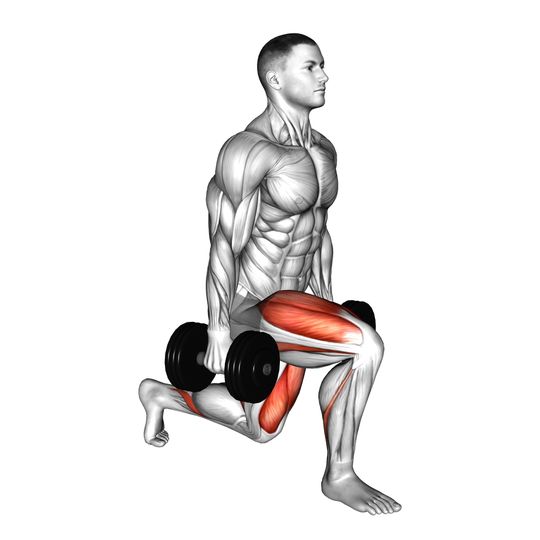
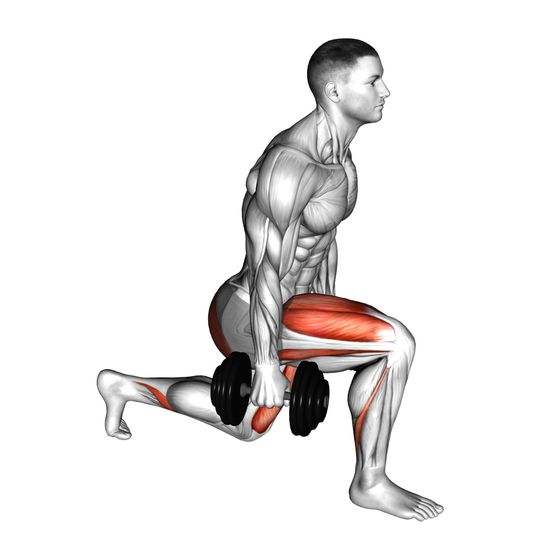
The split squat and the lunge look identical at the bottom: one foot forward, one back, the front knee bent to about ninety degrees, the rear knee near the floor. The difference is what happens between reps. In a split squat your feet stay planted and you squat up and down in place. In a lunge you step into the position, drive back out, and reset, so every rep includes a stride, a deceleration, and a push back to standing.
That step is the entire lunge vs split squat debate. It adds balance, coordination, and a braking demand the split squat does not have, and it costs you stability and load. The split squat lets you go heavier and focus on the working leg; the lunge trains more of the movement skill you use running and changing direction. Both are quad and glute exercises; which one you need depends on what the rest of your program covers.
| Factor | Dumbbell Split Squat | Dumbbell Lunge |
|---|---|---|
| Movement | Stationary — feet stay planted | Dynamic — step in, push out, reset each rep |
| Main target | Quads and glutes of the front leg | Quads and glutes, more hamstring on the step back |
| Balance demand | Low to moderate | Moderate to high |
| Knee stress | Moderate, knee angle stays constant | Higher on forward lunges from braking the step |
| How heavy it goes | Heavier — stable base, easy to load | Lighter — balance and stride limit the load |
| Best for | Leg size and strength one side at a time | Athletic carryover, coordination, conditioning |
| Common variations | Bulgarian (rear foot elevated), front foot elevated | Forward, reverse, walking, lateral |
Dumbbell Split Squat vs Dumbbell Lunge: muscles worked#
Dumbbell Split Squat
- Primary: Quads, Glutes
- Secondary: Hamstrings, Adductors, Calves, Abs
Dumbbell Lunge
- Primary: Quads, Glutes
- Secondary: Hamstrings, Adductors, Calves
Muscles worked#
Both are single-leg knee and hip extension exercises, and the front leg does most of the work. The quads straighten the knee, the glutes extend the hip, and the adductors and hamstrings assist, with the calves stabilising the ankle. Stance matters more than which exercise you pick: a long stance with the torso leaning slightly forward biases the glutes, a shorter stance with an upright torso biases the quads.
The lunge adds a deceleration phase. Stepping forward loads the front quad eccentrically as it stops your bodyweight, and driving back asks the glute and hamstring to reverse that momentum. Stepping backward, as in a reverse lunge, lands more on the front glute and hamstring and less on the knee. A split squat has no step, so the muscle demand is steadier over a fixed base.
Stability and loading#
The split squat is the stronger position. With both feet fixed, you can hold heavy dumbbells or a barbell and squat with confidence, and a Bulgarian split squat with the rear foot on a bench pushes the load almost entirely onto the front leg. Lifters routinely use 60–70 percent of their back squat weight on Bulgarians for sets of eight, more than any lunge variation allows.
The lunge trades load for skill. The stride, the landing, and the push back out mean you spend part of every rep balancing rather than lifting, so the weight comes down and the reps stay controlled. That is a feature for athletes and a limitation for pure hypertrophy: the lunge trains coordination that carries to sport, but the load ceiling means it builds less muscle per set than a heavy split squat.
Knee stress and variations#
Forward lunges are the harshest option on the knees. Landing on a bent front knee and stopping forward momentum is a large braking force through the patellar tendon, which is why they build athleticism and why knees that already hurt dislike them. Reverse lunges remove most of that by stepping back and driving forward, which keeps the front shin more vertical; a reverse lunge vs split squat comparison usually ends with the two feeling very similar on the joints.
Split squats sit in the middle. The knee angle is constant and there is no impact, so tolerance is high, though a Bulgarian split squat vs lunge at heavy loads puts more sustained tension through the front knee simply because there is more weight on it. If knees are the concern, reverse lunges and standard split squats are the safe defaults.
Programming and how to use both#
Program the split squat as a strength and hypertrophy movement: 3–4 sets of 6–10 per leg after your main squat or hinge, progressing dumbbell weight the same way you would on a bilateral lift. The Bulgarian version is the best choice when you want the front leg to do everything; the standard split squat is the better starting point for beginners.
Program lunges for movement quality, conditioning, and variety: 3 sets of 8–12 per leg with lighter dumbbells, or walking lunges for distance at the end of a session. Reverse lunges can also stand in for split squats as a heavier, knee-friendly option. A well-built leg day often has a split squat as the second lower-body movement and a lunge variation as a finisher.
The verdict#
Pick the split squat if you want to build muscle and strength one leg at a time with weights that actually challenge you, if balance is not what you are training, or if your knees prefer a fixed stance. The Bulgarian split squat in particular is the most effective single-leg exercise for quad and glute size, and it progresses like a barbell lift.
Pick the lunge if you play a sport, want the coordination and deceleration work a stationary lift cannot give you, or want a conditioning-friendly leg exercise that works with light dumbbells. Reverse lunges are the best default; forward and walking lunges add more knee and balance demand. Most programs benefit from a split squat for load and a lunge for movement.
Frequently asked questions#
Is a split squat the same as a lunge?
No. They share the bottom position, but a split squat is done with the feet planted, squatting up and down in place, while a lunge involves stepping into the position and back out on every rep. The step adds balance and deceleration demands and limits how heavy you can go.
Is the Bulgarian split squat better than lunges?
For building leg muscle and strength, yes. Elevating the rear foot on a bench pushes almost all the load onto the front leg, and the stable setup lets you use much heavier dumbbells than any lunge. Lunges win for athletic carryover, coordination, and conditioning.
Which is better for glutes, split squats or lunges?
Both hit the glutes when the stance is long and the torso leans slightly forward. The Bulgarian split squat with a longer stride is the strongest glute builder because it can be loaded heaviest. Reverse lunges are the most glute-biased lunge because the step back puts the work on the front hip rather than the knee.
Are reverse lunges or split squats better for bad knees?
They are close, and both are usually better than forward lunges. The reverse lunge keeps the front shin vertical and avoids the braking impact of a forward step; the split squat has no impact and a constant knee angle. Try both light and keep whichever lets you hit full depth without pain.
How many split squats or lunges should I do?
For split squats, 3–4 sets of 6–10 per leg with a load that makes the last reps slow. For lunges, 3 sets of 8–12 per leg with lighter weight, or walking lunges for 20–30 total steps as a finisher. Once or twice a week per exercise is plenty alongside a main squat or hinge.