
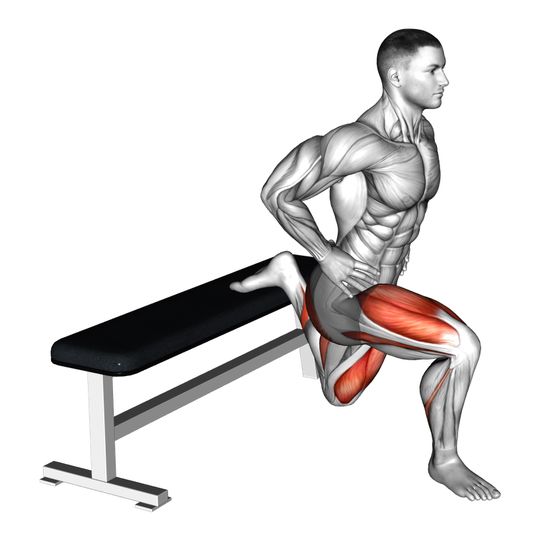
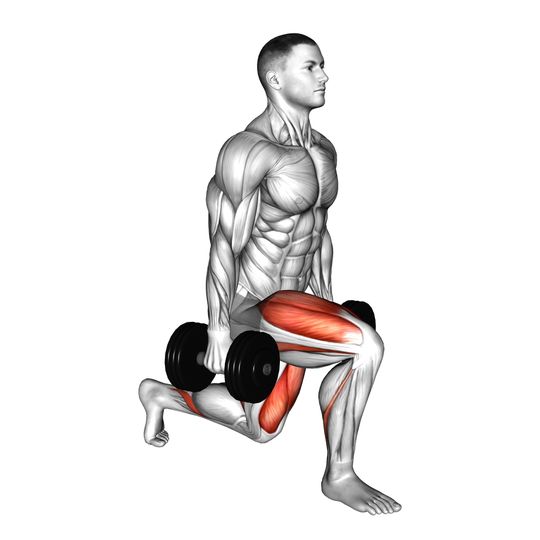
The split squat and the Bulgarian split squat are the same movement with one variable changed. In a split squat you stand in a long staggered stance with both feet on the floor and squat straight down, keeping the feet in place for the whole set. In a Bulgarian split squat — also called the rear foot elevated split squat — the back foot rests on a bench at roughly knee height, which tips almost all of the load onto the front leg.
That elevation is what people are really asking about when they search split squat vs bulgarian split squat. It changes how much of your bodyweight the front leg carries, how deep the hip goes, how much balance the set demands, and how heavy you can load it. Both are worth learning, and they belong at different points in a program rather than competing for one slot.
| Factor | Dumbbell Bulgarian Split Squat | Dumbbell Split Squat |
|---|---|---|
| Main target | Quads and glutes, glutes stretched hard at depth | Quads and glutes, more even split |
| Rear foot | On a bench or box, roughly knee height | Flat on the floor, carries 20–30% of the load |
| Load on front leg | Nearly all of it | Most of it, rear leg assists |
| Balance demand | High | Moderate |
| How heavy it goes | Limited by balance and grip, dumbbells | Heavier — works with a barbell on the back |
| Difficulty | Hard, advanced | Easier to learn, beginner-friendly |
| Best for | Glute and quad growth per leg, athletes | Learning single-leg work, heavier loading |
Dumbbell Bulgarian Split Squat vs Dumbbell Split Squat: muscles worked#
Dumbbell Bulgarian Split Squat
- Primary: Quads, Glutes
- Secondary: Hamstrings, Adductors, Abductors, Calves, Abs
Dumbbell Split Squat
- Primary: Quads, Glutes
- Secondary: Hamstrings, Adductors, Calves, Abs
Muscles worked#
Both exercises are quad and glute movements with the hamstrings, adductors and calves assisting and the trunk working to stay upright. In a split squat the rear leg is not passive: with the foot flat on the floor it carries somewhere around a fifth to a third of the load, and the rear hip flexor is stretched at the bottom. The front leg does most of the work, but the exercise feels closer to a stationary lunge than to a true single-leg squat.
Elevating the rear foot removes that help. In a Bulgarian split squat the back leg can only stabilise, so the front quad and glute carry nearly all of the bodyweight plus whatever you hold. The front hip also flexes deeper because the rear leg is raised behind you, which puts the glute and adductor of the working leg into a long stretch under load at the bottom of every rep. That is why the Bulgarian split squat is the stronger glute builder, and why the abductors on the outside of the hip work harder to keep the pelvis level.
Balance, stability and learning curve#
The split squat is the easier exercise to learn. Two feet on the floor give a stable base and the movement is a straight squat down and up. Most beginners get it right in a session, which makes it the starting point for anyone new to single-leg training or coming back from a knee or hip injury.
The Bulgarian split squat is genuinely awkward. Setting the rear foot at the right distance takes practice, the pelvis wants to tip toward the elevated side, and balance limits the load long before the muscles do. The instability is a feature for athletes who need single-leg stability, but for pure muscle growth it is a cost, which is why many lifters hold one dumbbell in the opposite hand and a light support with the other.
Loading, depth and joint stress#
The split squat goes heavier. Because both feet are on the floor it works with a barbell on the back, a safety squat bar, or heavy dumbbells, and lifters can load it for sets of 6–8 in a way the Bulgarian version rarely allows. Depth is limited by the rear knee approaching the floor, which usually leaves the front thigh at or just below parallel.
The Bulgarian split squat is limited by balance and grip, so most lifters stay with dumbbells at moderate loads, but the front leg still receives more work per rep because it is not sharing it. The range is deeper at the hip, which is the stimulus for the glutes and also the reason the front knee and the rear hip flexor take more strain. Lifters with a cranky front knee often prefer the split squat with a longer stance.
Programming and how to use both#
Use the split squat early in a training career, early in a session, or whenever you want to load single-leg work heavily. Program it for 3–4 sets of 6–10 per leg with a barbell or heavy dumbbells as a second lower-body movement, or with bodyweight as a warm-up before squats. It progresses in the same increments as any other squat.
Use the Bulgarian split squat once the split squat is comfortable and you want a harder stimulus per leg. Program it for 3 sets of 8–12 per leg with dumbbells, later in the session after a bilateral squat or hinge, and progress it by depth and control before load. Doing both in one session is redundant; alternate them across blocks, or keep the split squat as the heavy single-leg movement and the Bulgarian as a glute accessory on a different day. Train the weaker leg first and match its reps with the stronger side.
The verdict#
Pick the Bulgarian split squat if you already move well on one leg, want the biggest glute and quad stimulus per rep, or train for a sport where single-leg stability matters. The elevated rear foot removes the helping leg, deepens the hip, and stretches the glute under load in a way the floor version cannot.
Pick the split squat if you are new to single-leg training, want to load it heavier with a barbell, are managing a knee or hip issue, or simply want the training effect without the balance practice. It is the exercise to master first, and for many lifters it remains the better tool for heavy single-leg work.
Frequently asked questions#
What is the difference between a split squat and a Bulgarian split squat?
The rear foot. In a split squat both feet stay on the floor in a staggered stance; in a Bulgarian split squat the rear foot rests on a bench or box at about knee height. Elevating the foot removes the help the back leg gives, so the front leg carries nearly all of the load, the hip goes deeper, and balance becomes much harder.
Is the Bulgarian split squat better than the split squat?
For glute and quad stimulus per leg, yes, because the front leg is not sharing the work and the hip is stretched deeper at the bottom. For loading, learning and knee comfort, the split squat is better: it is stable enough for a barbell, easy to teach, and gentler on the front knee. Learn the split squat first and progress to the Bulgarian version.
Is a rear foot elevated split squat the same as a Bulgarian split squat?
Yes. Rear foot elevated split squat, often shortened to RFESS, is the descriptive name for the same exercise: a split squat with the back foot on a bench or box. Coaches tend to use the longer name and gyms say Bulgarian, but there is no difference.
Why are Bulgarian split squats so much harder than split squats?
The front leg carries almost all of the load instead of sharing it with the rear foot, the hip flexes deeper so the glute works through a longer range, and the elevated foot makes balance far harder, which drains effort before the muscles are even taxed. Expect to use noticeably lighter dumbbells for the same reps.
Should I do split squats or Bulgarian split squats for glutes?
The Bulgarian split squat, as long as you can do it with control. The elevated rear foot lets the front hip sink deeper and puts the glute of the working leg into a long stretch under load, which the flat split squat cannot match. Lean the torso slightly forward and take a longer stance to bias the glutes further; an upright torso and shorter stance keeps the work on the quads.