
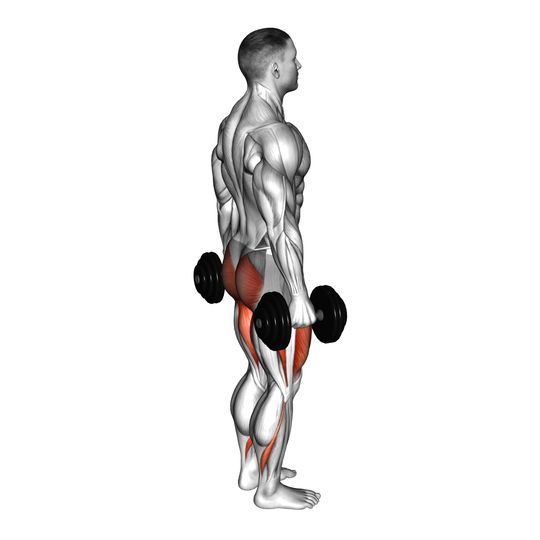
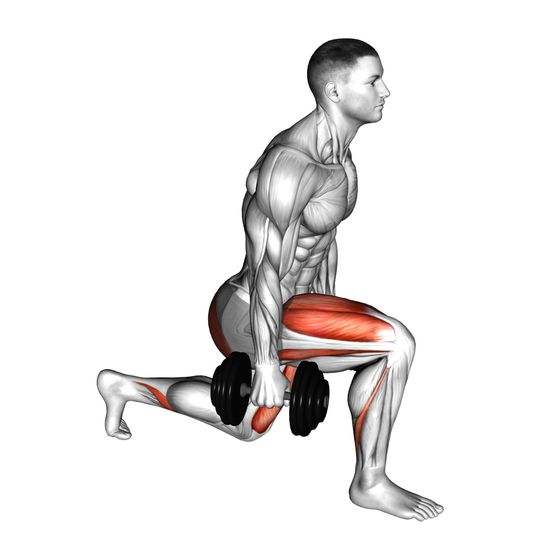
The reverse lunge and the forward lunge end in the same position: one foot in front, one behind, both knees bent, the back knee just off the floor. How you get there is the entire difference. Step forward and the front leg has to catch your body weight and slow it down; step back and the front leg stays planted while the rear foot does the moving.
That small change in direction shifts the load from the knee toward the hip, changes how much balance and control the exercise demands, and decides which one your joints will tolerate. Both are excellent single-leg exercises, and the reverse lunge vs forward lunge choice comes down to what you want the front leg to do and how your knees feel doing it.
| Factor | Dumbbell Reverse Lunge | Dumbbell Lunge |
|---|---|---|
| Direction of step | Backward — front foot stays planted | Forward — front foot lands and catches the weight |
| Main target | Glutes and quads, hips do more | Quads, with glutes assisting |
| Knee stress | Lower — shin stays close to vertical | Higher — knee travels forward and absorbs the landing |
| Balance demand | Moderate, stable front foot | Higher — deceleration on a moving base |
| Typical load | Heavier — easy to load | Lighter — form breaks down sooner |
| Soreness | Less, little braking on each rep | More, from decelerating every rep |
| Best for | Knee-friendly glute work, heavy single-leg strength | Athletic deceleration, quad focus, conditioning |
Dumbbell Reverse Lunge vs Dumbbell Lunge: muscles worked#
Dumbbell Reverse Lunge
- Primary: Quads, Glutes
- Secondary: Hamstrings, Adductors, Calves, Abs
Dumbbell Lunge
- Primary: Quads, Glutes
- Secondary: Hamstrings, Adductors, Calves
Muscles worked#
Both lunges are quad and glute exercises for the front leg, with the hamstrings and adductors assisting and the calves and abs stabilising. The reverse lunge biases the hips. Stepping back keeps the front shin close to vertical and puts the hips behind the front knee, so the glutes of the front leg carry a bigger share and the quads work mostly to control the knee and straighten it on the way up.
The forward lunge biases the quads. Stepping forward sends the knee out over the foot and asks the front leg to absorb your moving body weight before it can push back, which loads the quadriceps through a longer eccentric and increases the knee's share. The glutes still work to extend the hip, but the forward lunge is closer to a single-leg squat with a landing.
Knee stress and joint comfort#
The reverse lunge is the lunge most coaches teach first because the knee stays quiet. The front foot never moves, the shin stays near vertical, and there is no impact to absorb, so the patellar tendon and the front of the knee take much less strain. Lifters who find forward lunges uncomfortable almost always tolerate the reverse version without complaint.
The forward lunge puts the knee through more. The forward step lands with the knee travelling over the toes under a decelerating load, which is a real demand on the patellar tendon and on the quads' ability to brake. If forward lunges hurt, switch to reverse lunges rather than shortening the step, which usually makes the knee angle worse.
Balance, loading and fatigue#
Because the front foot is planted and the movement is slow, the reverse lunge is easier to load. Heavy dumbbells, a barbell on the back or a front rack all work, and lifters routinely reverse lunge with loads they could never control stepping forward. That makes it the better choice for building single-leg strength over months.
The forward lunge is harder to balance and harder to recover from. The landing and the push back to standing demand coordination that breaks down quickly under load, and the repeated braking produces more muscle damage and more soreness for the same sets and reps. That difficulty is the point when the goal is athleticism or conditioning, and a limitation when the goal is loading the legs heavily.
Programming and how to use both#
Use the reverse lunge as your main single-leg strength exercise: 3–4 sets of 6–10 per leg with dumbbells or a barbell, resting fully, doing all reps on one side before switching. It slots in after squats or deadlifts on a lower body day and can be trained twice a week without much recovery cost.
Use the forward lunge for athletic work and lighter volume: 2–3 sets of 10–15 per leg with body weight or light dumbbells, or as walking lunges for conditioning at the end of a session. Athletes who sprint, cut or land benefit from the deceleration it trains. A simple approach is reverse lunges heavy early in the week and forward or walking lunges light later in it, so the knees get one demanding day rather than two.
The verdict#
Pick the reverse lunge if you want a knee-friendly lunge, if glute development is the goal, or if you want to load a single-leg exercise heavily and progress it over time. The planted front foot and vertical shin make it the safer, stronger and more repeatable of the two.
Pick the forward lunge if you are an athlete who needs to decelerate and change direction, if quad work is the priority and your knees are healthy, or if you want a lunge that doubles as conditioning. It is the more demanding exercise, not the better one. Most lifters should treat the reverse lunge as the default and add forward or walking lunges as a lighter second option when the knees allow.
Frequently asked questions#
Is the reverse lunge better than the forward lunge?
For most people, yes. The reverse lunge is easier on the knees, easier to load, and hits the glutes harder, so it wins as a strength exercise. The forward lunge is better for training deceleration and is more quad focused, which matters for athletes. Neither is wrong; the reverse lunge is simply the safer default.
Are reverse lunges better for glutes or quads?
Glutes. Stepping back keeps the shin vertical and the hips behind the knee, which is a hip-dominant position, so the front glute does more of the work. The quads still contribute, especially on the way up. For a more quad-focused lunge, step forward or elevate the rear foot into a split squat.
Why do reverse lunges feel easier than forward lunges?
Because the front foot is planted and there is nothing to decelerate. Forward lunges require your front leg to catch your moving body weight, which demands balance and produces more muscle damage. Reverse lunges remove that braking phase, so they feel smoother and leave you less sore even with more weight.
Is a step back lunge the same as a reverse lunge?
Yes. Step back lunge, backward lunge, rear lunge and reverse lunge all describe the same movement: standing tall, stepping one foot behind you, lowering until the back knee is just off the floor, and driving through the front foot to return.
Which lunge is best for bad knees?
The reverse lunge. It keeps the front shin close to vertical and has no landing to absorb, which takes strain off the patellar tendon and the front of the knee. If even that is uncomfortable, shorten the range, hold onto something for balance, and build up gradually before adding weight.