
The goblet squat is the squat most people learn first, and the barbell back squat is the one most people want to graduate to. Both are the same movement, but a dumbbell held at the chest and a barbell across the upper back load the body in very different ways.
The goblet squat vs regular squat question usually comes from someone wondering whether the dumbbell version is enough or whether they need the bar. The short answer is that the goblet squat teaches the pattern and builds quads for as long as you can hoist a heavy enough dumbbell, and the back squat takes over when strength becomes the limit rather than technique.
| Factor | Goblet Squat | Barbell Squat |
|---|---|---|
| Load position | Dumbbell or kettlebell held at the chest | Barbell across the upper back |
| Main target | Quads, with upper back and abs bracing | Quads and glutes, lower back and whole-body bracing |
| Torso angle | Upright, counterbalanced by the front load | More forward lean, especially low bar |
| How heavy it goes | Limited by what you can lift to the chest | Your heaviest lower body lift |
| Skill and setup | Learned in one session, no rack | Needs a rack, safeties and technique work |
| Spinal loading | Low | High — the bar compresses the spine directly |
| Best for | Beginners, technique, high-rep quad work | Maximal strength, muscle mass, long-term progression |
Goblet Squat vs Barbell Squat: muscles worked#
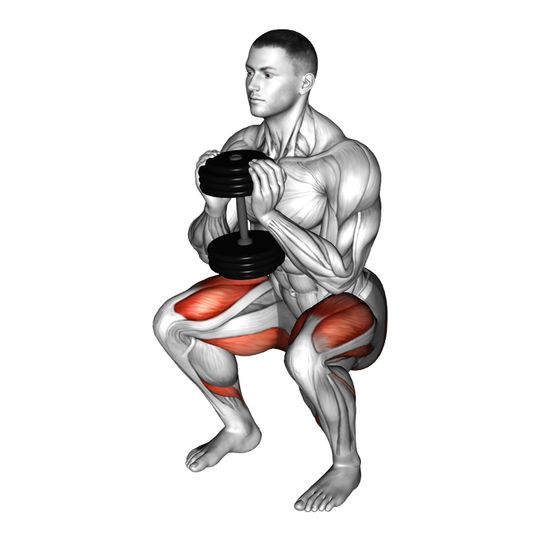
Goblet Squat
- Primary: Quads, Glutes
- Secondary: Hamstrings, Adductors, Abs, Upper back
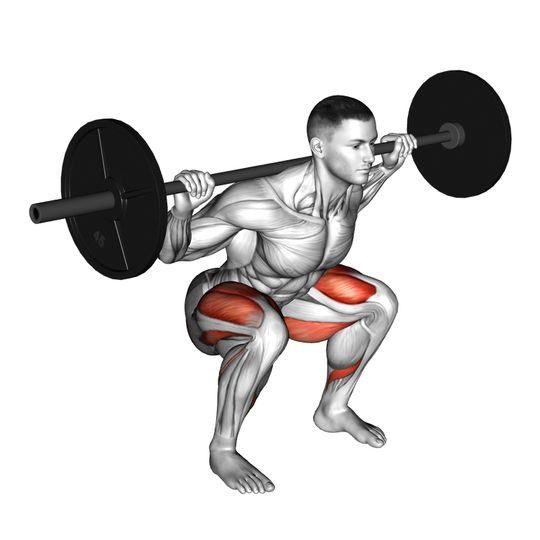
Barbell Squat
- Primary: Quads, Glutes
- Secondary: Hamstrings, Adductors, Lower back, Abs, Calves
Muscles worked#
The goblet squat is quad dominant. The weight held in front shifts your centre of mass forward, which lets you sit upright and push the knees far over the toes, so the quadriceps take most of the load through the descent while the glutes finish the rep. The upper back and abs work hard to keep the dumbbell from pulling the chest down, which is why a heavy set leaves the rhomboids as tired as the legs.
The back squat spreads the work across more muscle. The bar on the back forces some forward lean, which gives the glutes, adductors and hamstrings a larger share and loads the spinal erectors heavily. The quads still do most of the knee extension, but the back squat is a whole lower body exercise in a way the goblet squat is not.
Loading and the ceiling#
The goblet squat has a hard ceiling. Most gyms stop their dumbbells around 50 kilograms, and long before that the problem is getting the weight to your chest, not squatting it. A fit lifter outgrows the goblet squat as a strength exercise within a few months; after that it only keeps producing growth with higher reps, slower tempos or paused bottoms.
The back squat has no practical ceiling. You can add weight for years in small increments, which is the most reliable way to build leg muscle and strength. The barbell squat also allows loads heavy enough to drive whole-body adaptations — bone density, trunk strength, connective tissue — that a 30 kilogram dumbbell never will.
Technique, safety and who it suits#
The goblet squat is nearly self-correcting. The dumbbell acts as a counterweight so beginners can sit deep without falling backward, a collapsing chest is obvious immediately, and the elbows tracking inside the knees at the bottom cue the knees to stay out. It is safe to take to failure without a rack, and there is no way to get stuck under it.
The back squat is a skill. Bar position, bracing, stance, depth and bailing all have to be learned, and errors are expensive because the load is large and sits on the spine. It is not dangerous with sensible loading and safeties, but a beginner should build the pattern with a goblet squat for a few weeks first.
Programming and how to use both#
Use the goblet squat as the main squat for the first month or two of training, in 3–4 sets of 8–15, going as deep as possible every rep. Once you can do 10 clean reps with a dumbbell around a third of your body weight, the pattern is learned and the barbell is the next step. Afterwards, keep the goblet squat as a warm-up, a high-rep finisher, or a home gym option.
Use the back squat as the main lower body lift once technique is in place: 3–5 sets of 3–6 for strength, 6–10 for size, once or twice a week, adding weight when every rep is clean. A lower body day that opens with back squats and finishes with goblet squats for 15–20 reps covers heavy work and quad volume.
The verdict#
Pick the goblet squat if you are new to squatting, if you have no rack or barbell, if your back needs a break from spinal loading, or if you want a high-rep quad exercise that is hard to do badly. It teaches the squat better than anything else and stays useful as an accessory long after you have moved on.
Pick the back squat if you want to get strong, build serious leg muscle, or progress for more than a few months. The goblet squat vs barbell squat debate ends where the dumbbell rack does: once you can hoist the heaviest dumbbell to your chest and squat it for ten, the only way to keep growing is a bar on your back. Learn with the goblet, build with the barbell, and keep both.
Frequently asked questions#
Is the goblet squat as good as a regular squat?
For learning the movement and for the first few months of training, yes. For long-term strength and muscle, no — the goblet squat runs out of weight quickly and the barbell back squat does not. It is a superb teaching tool and accessory rather than a permanent replacement.
Can goblet squats replace back squats?
For beginners, people training at home with dumbbells, or anyone who needs to keep load off the spine, yes for a time. For lifters who want to keep adding strength and size, no. If goblet squats are your only option, push the reps to 15–20, slow the tempo, and pause at the bottom to keep the stimulus high.
How heavy should a goblet squat be compared to a back squat?
Most lifters can goblet squat roughly 25–35 percent of their back squat for the same reps, and the number is capped by what they can lift to their chest. A goblet squat with a dumbbell around a third of your body weight for 10 clean reps is a reasonable sign you are ready for the barbell.
Are goblet squats better for glutes or quads?
Quads. The front load keeps the torso upright and drives the knees forward, which is a quad position. The glutes still work at the bottom and to stand up, but a back squat loads them harder because the forward lean adds hip work.
Should beginners start with goblet squats or barbell squats?
Goblet squats. Spend two to six weeks on them, learn to sit deep with the chest up and the knees tracking over the feet, then move to an empty barbell and add weight gradually. Beginners who start on the bar spend those same weeks fixing faults the goblet squat would have prevented.