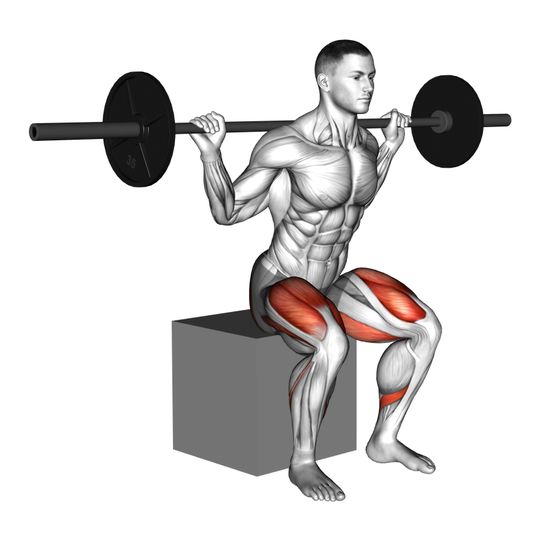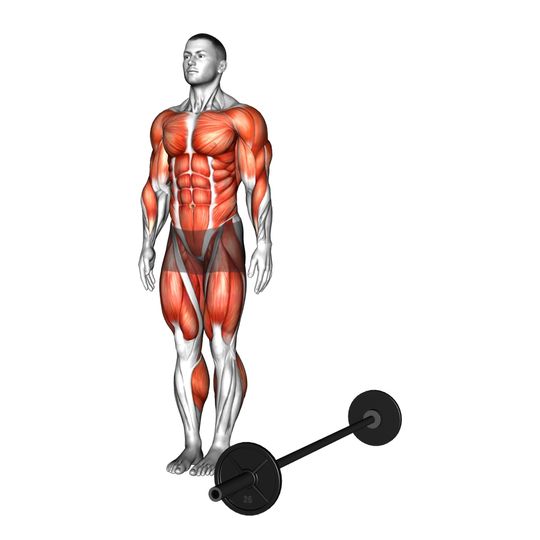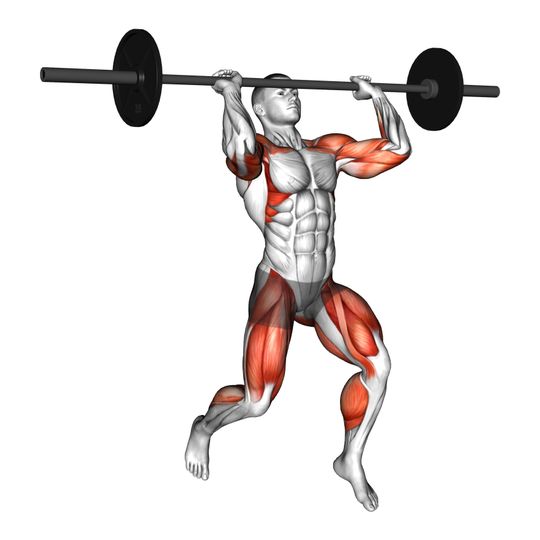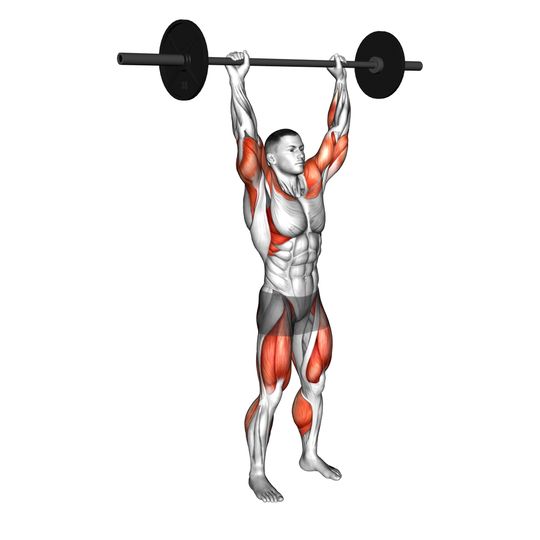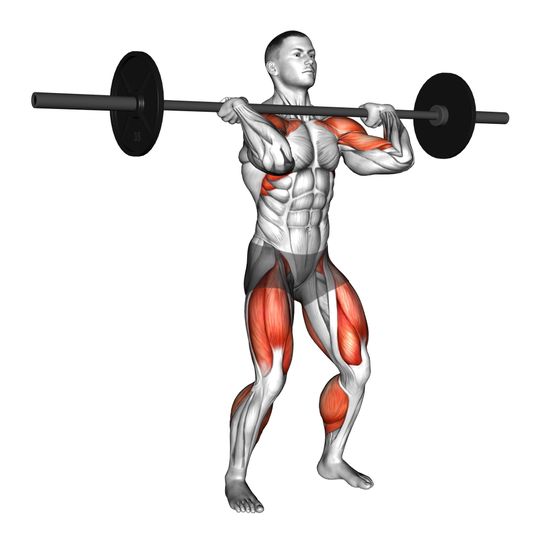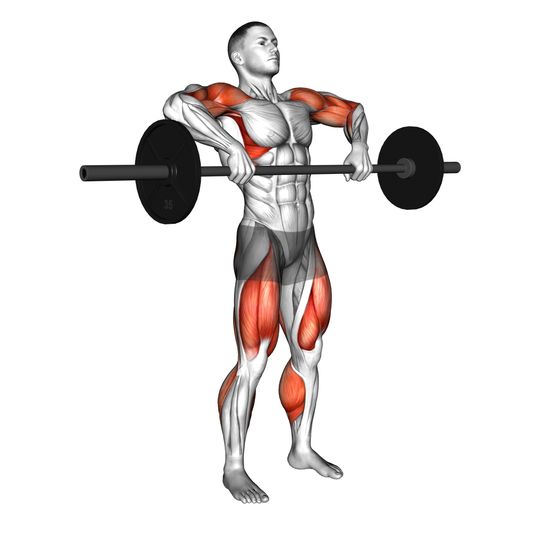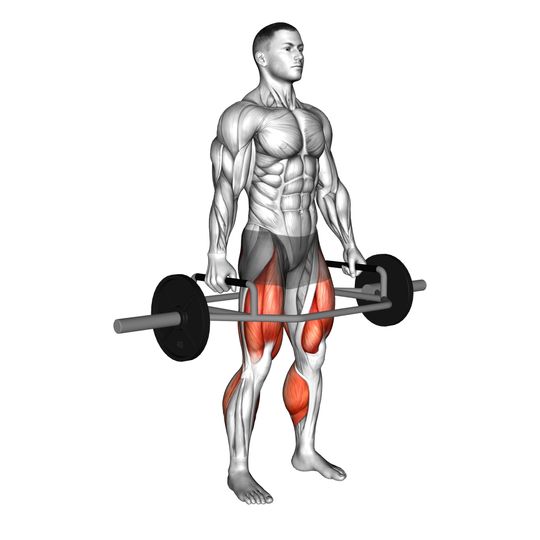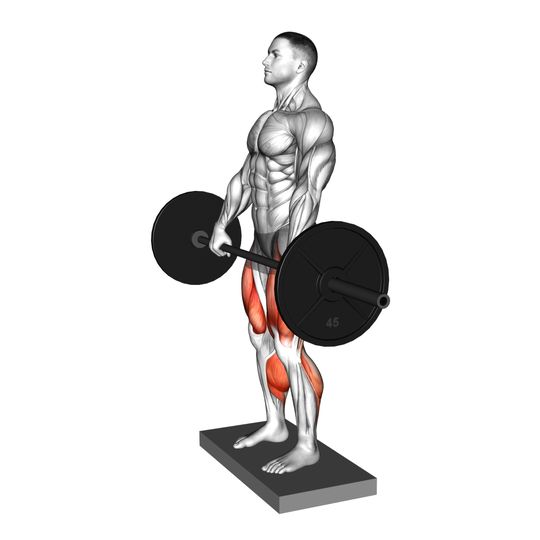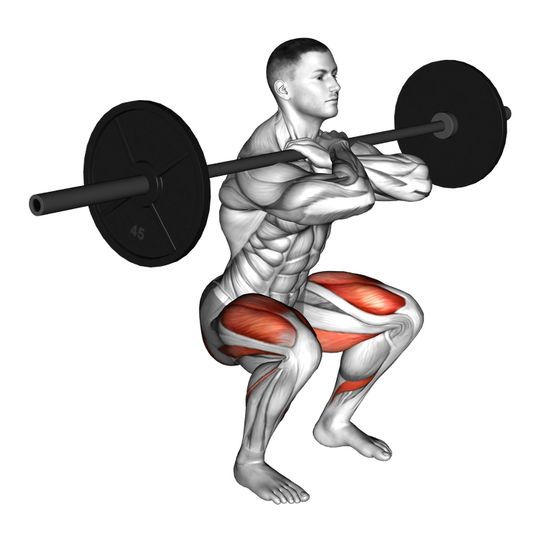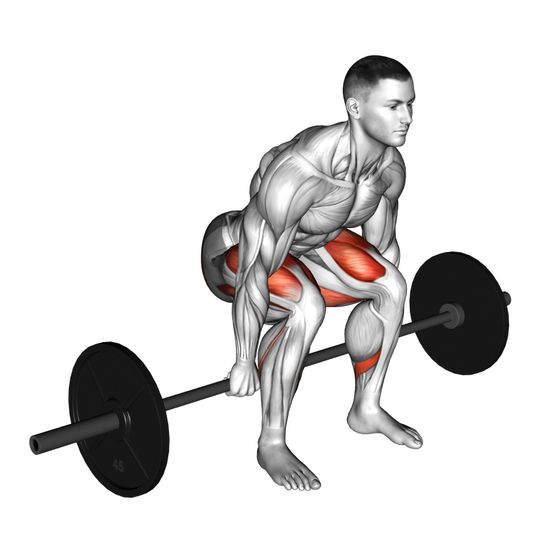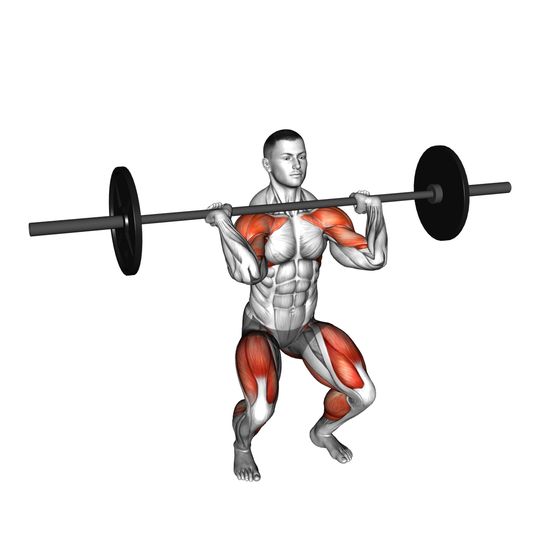


Stand with a loaded barbell on your upper back and lower your hips by bending at the hips and knees, using primarily the quadriceps to control the movement. Rise back to standing by driving through the heels and mid-foot.
How to do the Barbell Squat#
- Rest the bar on your upper back, grip it roughly shoulder-width, and stand with feet about shoulder-width apart.
- Brace your core and keep your spine neutral with your head in line with your torso.
- Begin the squat by sending your hips back and bending your knees, sitting down between your feet.
- Continue lowering until your thighs are about parallel to the floor.
- Drive through your heels and mid-foot to return to the starting standing position and repeat.
Muscles worked#
- Primary: Quads (Quadriceps Femoris), Glutes (Gluteus Maximus)
- Secondary: Hamstrings (Biceps Femoris, Semitendinosus & Semimembranosus), Adductors (Adductor Magnus, Longus & Brevis (Hip Adductors)), Lower back (Erector Spinae), Abs (Rectus Abdominis), Calves (Gastrocnemius & Soleus)
Common mistakes#
- Allowing the heels to lift off the floor.
- Rounding the lower back instead of keeping a neutral spine.
- Letting the knees collapse inward during the descent.
- Stopping well above parallel and not reaching a full depth.
- Placing the bar too high on the neck rather than on the upper back.
How much should you squat?#
What the average squat actually is, and what counts as beginner, intermediate, advanced, or elite at your bodyweight — for men and women, in kg and lbs.
See squat strength standards →
Barbell Squat vs other exercises#
Head-to-head breakdowns of muscles worked, loading, joint stress, and which one to pick for your goal.
- Hack Squat vs Back Squat →
- Front Squat vs Back Squat →
- Leg Press vs Squat →
- Deadlift vs Squat →
- Goblet Squat vs Back Squat →
Why it works#
The back squat loads the quads and glutes under more weight than any other lower-body movement, and it does it through a deep, stretched bottom position that drives most of the growth.
It also trains everything holding you upright under the bar: spinal erectors, adductors and abs work every rep. That is why squat strength shows up in sprinting, jumping and the rest of your leg training.
Sets, reps and setup#
Three to four sets of 5-8 reps builds size; for strength, run 3-5 sets of 3-5 reps and rest 3-5 minutes. Squatting twice a week, with one lighter session, works well.
- Setup
- Bar on the upper traps for high bar or across the rear delts for low bar, feet about shoulder width with toes turned out 15-30 degrees. Descend until the hip crease passes below the knee.
- Progression
- Add 5-10 lb a week while depth and bar speed hold. When they slip, keep the weight and add a set instead.
Variations#
- Front Squat (Barbell) Bar on the front delts. More upright, more quad, less load.
- Goblet Squat One dumbbell or kettlebell at the chest. The simplest way to learn depth and bracing.
- Pause Squat (Barbell) Two seconds in the hole removes the bounce and hardens the bottom position.
- Bulgarian Split Squat (Dumbbell) Single-leg work that loads the quad hard with far less spinal load.
High-bar vs low-bar squat#
High bar keeps the torso more upright and biases the quads. Low bar tips you forward, shortens the hip moment arm and usually lets you lift more.
If you squat to build legs, high bar through a full range is the simpler choice. If you compete in powerlifting, low bar generally puts more weight on the bar.
Common questions#
How deep should I squat?
At least until your hip crease drops below the top of the knee. Deeper squats load the glutes and adductors more, so go as deep as you can with your heels down and your pelvis untucked.
How many sets and reps should I squat?
Three to four sets of 5-8 reps for size, three to five sets of 3-5 for strength, resting 3-5 minutes between heavy sets.
Should my knees travel past my toes?
For most people, yes. Letting the knees travel forward is how you stay upright and load the quads; forcing them back shifts work onto your lower back.
Why do my heels come up?
Usually ankle mobility or a stance that is too narrow. Widen the stance, turn the toes out more, or squat in shoes with a raised heel.
What can I squat at home without a rack?
Goblet squats for 10-20 reps cover most of the same ground, and Bulgarian split squats add real load per leg.