
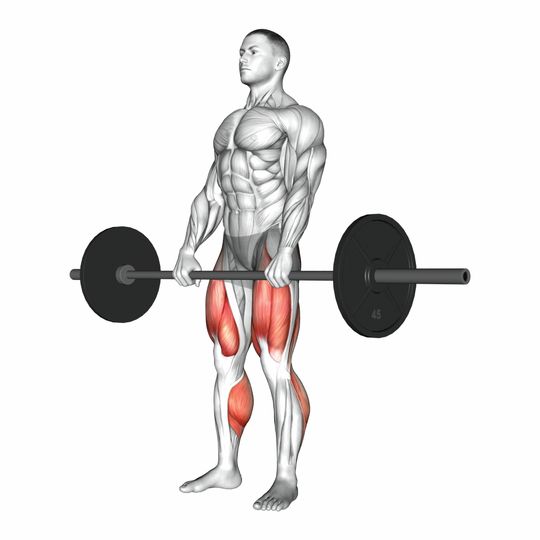
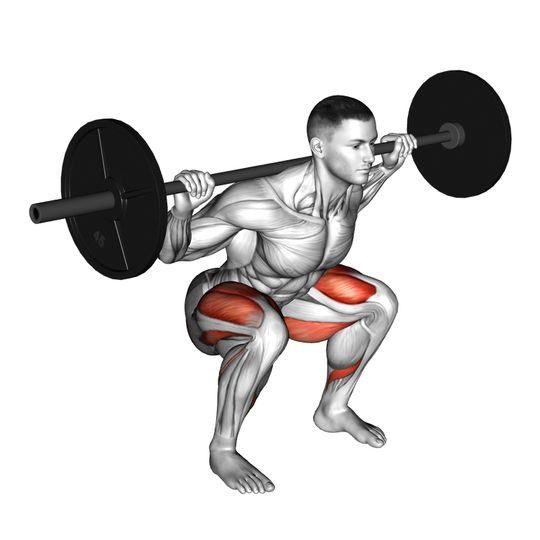
The deadlift and the squat are the two heaviest lifts in the gym, and people often talk about them as if they were interchangeable. They are not. The squat is a knee-dominant movement: you sit down under a bar on your back and stand up with it, and the quads do most of the work. The deadlift is a hip hinge: the bar starts on the floor, you pick it up by extending the hips and knees together, and the posterior chain does most of the work.
That squat vs deadlift difference in mechanics decides everything else — the muscles built, the weight you can lift, how much it costs you to recover, and how often you can train each one. Neither replaces the other, but knowing what each does makes it easier to decide how many sets each deserves and which comes first.
| Factor | Barbell Deadlift | Barbell Squat |
|---|---|---|
| Main target | Glutes, hamstrings and spinal erectors | Quads and glutes |
| Movement pattern | Hip hinge, bar in the hands | Knee-dominant squat, bar on the back |
| Starts from | A dead stop on the floor | Standing, out of a rack |
| Typical load | Most lifters pull 10–20% more than they squat | Heaviest lift for very quad-dominant lifters |
| Recovery cost | High — hardest lift to recover from | High, but easier to train twice a week |
| Grip and back | Grip and upper back heavily involved | Grip irrelevant, back braces isometrically |
| Best for | Posterior chain, back thickness, total strength | Leg size, quads, athletic carryover |
Barbell Deadlift vs Barbell Squat: muscles worked#
Barbell Deadlift
- Primary: Glutes, Hamstrings, Lower back
- Secondary: Quads, Traps, Upper back, Forearms, Abs
Barbell Squat
- Primary: Quads, Glutes
- Secondary: Hamstrings, Adductors, Lower back, Abs, Calves
Muscles worked#
The deadlift trains the whole back of the body. The glutes and hamstrings extend the hips, the spinal erectors hold the back rigid from the floor to lockout, the lats keep the bar against the legs, and the traps and forearms hold it all together at the top. The quads contribute at the start to break the bar off the floor, but once the bar passes the knees the lift belongs to the posterior chain.
The squat trains the front of the legs first. The quads control the descent and drive the knees straight, the glutes and adductors extend the hips out of the bottom, and the erectors work hard but isometrically to keep the torso from folding. Hamstring involvement is modest because the knees and hips flex together, so the muscle barely changes length. If you want big quads, you squat; if you want a thick back and glutes, you pull.
Mechanics and how heavy they go#
A deadlift rep begins at its hardest point. The bar is on the floor, there is no stretch reflex to help, and you have to build tension from nothing, which is why the lift builds so much strength and why it is so fatiguing. A squat rep begins at its easiest point, standing, and the bottom is where it gets hard — but you arrive there with a stretch reflex to bounce off.
Most lifters deadlift 10–20 percent more than they squat, because the range is shorter, the back is more upright at the finish and the grip and hips are strong levers. Lifters with long arms often pull far more; lifters with long femurs or a squat background sometimes squat more than they pull. Both patterns are normal.
Fatigue, back stress and safety#
The deadlift is the most expensive lift in the gym. A heavy pull loads the spine, the grip and the nervous system all at once, and most lifters can only handle one heavy deadlift session a week. The squat is also hard on recovery but is easier to train twice a week, because the bar sits on the back and the load is shared across more joints.
Both lifts are safe with a braced, neutral spine and a load you can control, and both punish rounding under a maximal weight. Deadlifts are more often blamed for lower back tweaks because the spinal erectors are a prime mover rather than a stabiliser, and because the bar is furthest from the hips at the start. Squats are more often blamed for knees, usually when depth outruns mobility or the weight gets ahead of technique.
Programming both in one week#
Train both, and give each its own day. The classic layout is a squat-focused lower day early in the week and a deadlift-focused day later: deadlift 3–5 sets of 3–5 once a week, squat twice — once heavy for 3–6 and once lighter for 6–10. Beginner programs like a 5x5 pair squats every session with one set of five deadlifts, which works because the loads are still light.
If you have to put them in the same session, squat first and deadlift second at reduced volume, or the other way round depending on which one you are prioritising that block. The second lift will always be compromised; accept it and treat those sets as practice rather than progress.
The verdict#
Pick the deadlift if you want the biggest return in total-body strength per set, if your back, glutes and hamstrings are the priority, or if you can only recover from one heavy lower-body lift a week. Nothing else builds a thick back and a strong grip while training the legs at the same time.
Pick the squat if leg size and quad development are the goal, if you play a sport that rewards jumping and sprinting, or if you want a lift you can train hard more than once a week. In practice the answer is both: squat twice a week, deadlift once, and let each take the lead in alternating blocks.
Frequently asked questions#
What is the difference between a squat and a deadlift?
The squat is a knee-dominant movement with the bar on your back: you sit down and stand up, and the quads and glutes do most of the work. The deadlift is a hip hinge with the bar in your hands: you lift it from the floor by extending the hips, and the glutes, hamstrings and back do most of the work. Different patterns, different muscles, different jobs.
Is the deadlift or squat better for glutes?
Both train the glutes hard. The squat loads them most in the bottom position, when the hips are deeply flexed; the deadlift loads them most at lockout, when the hips finish extending. Squatting deep and pulling heavy covers both ends of the range.
Should I squat or deadlift first?
Whichever you are prioritising, and preferably on different days. If they share a session, squat first if you want your squat to grow and deadlift first if you want your pull to grow, then accept a lighter second lift.
Why can I deadlift more than I squat?
Because it is normal. The deadlift has a shorter range, finishes with a more upright back and lets the hips and grip act as strong levers, so most people pull 10–20 percent more than they squat. A squat higher than your deadlift usually means long femurs or a squat background, and it is not a problem.
Can I do deadlifts and squats on the same day?
Yes, and beginners often do. Keep the total low: one heavy lift with normal volume, the other for a few sets at 70–80 percent of what you would usually use. Once your working weights are heavy enough that a deadlift session leaves you flat for two days, split them onto separate days.