

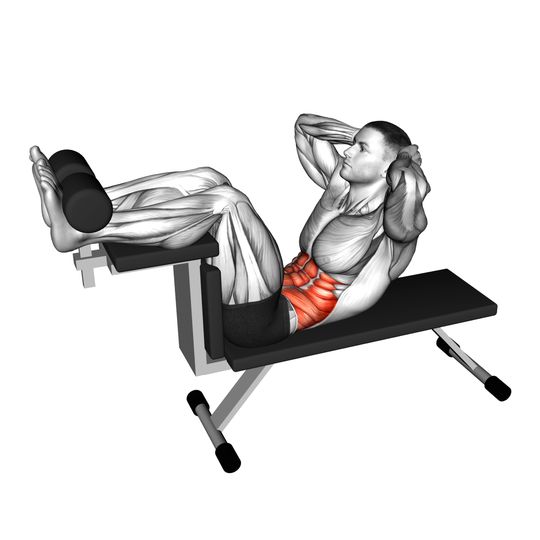
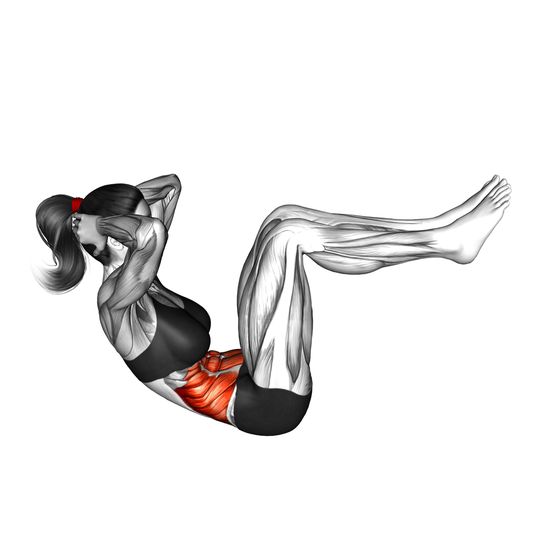
The crunch and the sit-up look like the same exercise cut off at different points, and in a sense they are. The crunch lifts the shoulder blades a few centimetres off the floor and stops; the sit-up keeps going until the torso is upright. Everything about the crunch vs sit up debate comes from what happens in that extra range.
For the first few degrees of movement the abs are the only thing working, curling the ribs toward the pelvis. Past that point the spine has flexed as far as it usefully can and the hip flexors take over to pull the torso upright. That is why the sit-up feels harder, trains more than just the abs, and why fitness tests have started dropping it over lower back concerns.
| Factor | Crunch | Sit Up |
|---|---|---|
| Main target | Rectus abdominis, obliques assist | Rectus abdominis and hip flexors |
| Range of motion | Shoulder blades off the floor, lower back stays down | Torso all the way to upright |
| Hip flexor involvement | Minimal — hips do not move | Heavy, especially past the halfway point |
| Lower back stress | Low, lumbar spine supported | Higher, repeated full flexion under hip flexor pull |
| Typical reps | 15–25 slow, or 10–15 with a plate | 10–20, often for time in fitness tests |
| Best for | Isolating the abs, back-friendly ab work | Fitness tests, hip flexor endurance |
Crunch vs Sit Up: muscles worked#
Muscles worked#
The crunch is spinal flexion and almost nothing else. The rectus abdominis shortens to pull the ribcage toward the pelvis, the obliques assist and stop the torso twisting, and the deep transversus abdominis braces on the exhale. Because the lower back stays on the floor and the hips never move, the hip flexors barely contribute. It is the most direct bodyweight exercise for the muscle people mean when they say abs.
The sit-up does everything the crunch does in the first part of the movement, then hands the rest of the rep to the hip flexors — the iliopsoas and rectus femoris — which pull the pelvis and torso up over the thighs. The abs stay contracted isometrically to hold the trunk stiff, but they are no longer the prime mover. That is why sit up vs crunch is really a question of whether you want hip flexor work alongside your ab work.
Range of motion and where the abs stop#
The rectus abdominis can only shorten so far. Once the shoulder blades are clear of the floor and the ribs have curled toward the pelvis, the abs have done their full range, which is roughly 30 degrees of trunk flexion. The crunch stops there on purpose. A two-second lift, one-second squeeze and two-second lower makes those few centimetres surprisingly hard.
The sit-up continues for another 60 degrees or more, and none of that movement comes from the spine. Anchoring the feet makes it worse: the hip flexors get a fixed point to pull against and take over even earlier. If your sit-ups get easier when someone holds your feet, that is the hip flexors, not stronger abs, doing the extra work.
Lower back and safety#
The crunch keeps the lumbar spine on the floor and moves it through a small range under very light load. For healthy backs that is about as safe as ab training gets. The main complaint is neck strain, which comes from pulling on the head rather than lifting the ribs, and is fixed by keeping the hands on the chest and a fist of space between chin and chest.
The sit-up loads the lower back more, because the hip flexors pull the lumbar spine into a stronger arch while the abs are trying to flex it, and because the full range is repeated for dozens of reps. That combination is why spine researchers have argued against high-volume sit-ups for years and why the US Army replaced the sit-up with the plank in its fitness test. Occasional sets are fine for a healthy back; hundreds a week are not a good idea.
Programming and how to use both#
For ab development, build around the crunch. Three sets of 15–25 slow reps two or three times a week is plenty, and once tempo alone is not enough, hold a plate on the chest and drop to 10–15 reps, or move to a cable or decline crunch where the load can keep rising.
Keep the sit-up for what it is actually good at: a fitness test movement and hip flexor endurance. If you have to pass a timed sit-up test, train it — one or two sessions a week of 2–3 sets close to test conditions — but do not treat those reps as ab training. Athletes who want strong hip flexors can also justify it, ideally with the feet unanchored.
The verdict#
Pick the crunch if the goal is stronger, more visible abs and you want to keep your lower back out of the conversation. It isolates the rectus abdominis, loads easily with tempo or a plate, and can be done almost daily without cost. Whether the abs show is a body fat question, but the crunch is what builds the muscle underneath.
Pick the sit-up if you are training for a test that scores it, or if you specifically want hip flexor strength and endurance alongside ab work. For everyone else it adds lower back stress and hip flexor fatigue without giving the abs anything a slow crunch does not.
Frequently asked questions#
Are crunches or sit ups better for abs?
Crunches. The rectus abdominis only works through the first part of the movement, and the crunch stops exactly where that range ends, so every rep is ab work. The sit-up continues into hip flexion, which trains the hip flexors rather than the abs. For visible abs the crunch is the better exercise; body fat decides whether you see them.
What is the difference between a curl up and a sit up?
A curl up is a crunch by another name, usually the physiotherapy version where one hand supports the lower back and the head and shoulders lift only a few centimetres. Curl ups vs sit ups is the same comparison as crunch vs sit up: a short range that stays in the abs versus a full range that brings the hip flexors in.
Are sit ups bad for your back?
Not for a healthy back in small doses, but they are the harder of the two on the lumbar spine because the hip flexors pull it into an arch while it is repeatedly flexing. If you have a history of disc problems, choose crunches, planks and dead bugs instead.
Do crunches or sit ups burn more calories?
Sit-ups burn slightly more per rep because they move more of your body through a larger range, but neither burns enough to matter. Twenty minutes of either is a fraction of what a brisk walk uses. Do them to build the muscle and manage body fat through diet.
How many crunches or sit ups should I do a day?
You do not need them daily. Three sets of 15–25 slow crunches, two or three times a week, builds the abs as well as anything, and sit-ups follow similar volumes if you are training for a test. Hundreds of fast reps train endurance rather than muscle and mostly produce a sore neck.