

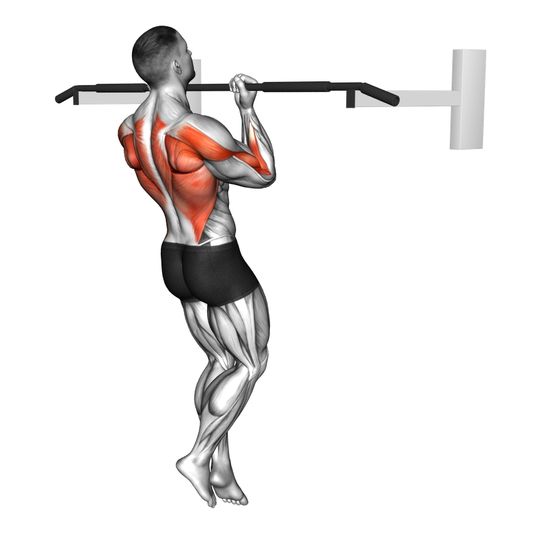
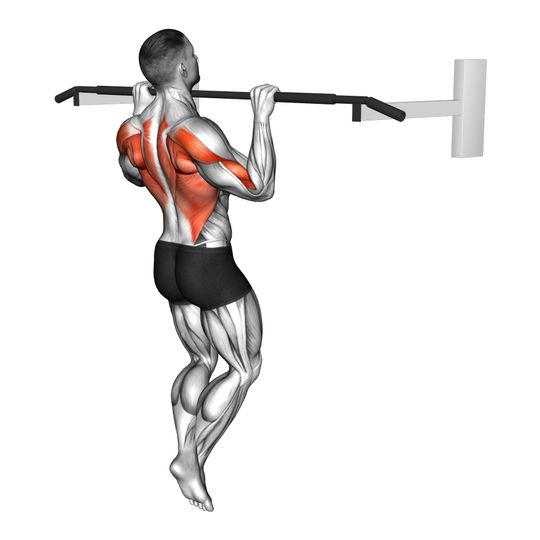
The chin up and the pull up are the same movement with the hands turned the other way. Palms facing you is a chin up; palms facing away is a pull up. Both are dominated by the lats and both are hard. The grip change looks trivial, but it shifts how the shoulder and elbow move, and that decides which muscles carry the load and how many reps you get.
Most people can do two or three more chin ups than pull ups, feel their biceps more on chin ups, and feel their upper back more on pull ups. Neither is a beginner or advanced version of the other. Pull up vs chin up is a question of emphasis, and the answer depends on whether you are chasing back width, arm size, or your first clean rep.
| Factor | Chin Up | Pull Up |
|---|---|---|
| Grip | Underhand, shoulder width or closer | Overhand, shoulder width or wider |
| Main target | Lats and biceps | Lats and upper back |
| Biceps involvement | High — biceps in their strongest position | Moderate — brachialis and forearms do more |
| Range of motion | Slightly longer, elbows travel in front | Slightly shorter, elbows travel out to the sides |
| Difficulty | Easier, usually 2–3 more reps | Harder, the standard strength test |
| Joint stress | Inner elbow and wrist | Shoulder, especially with a wide grip |
| Best for | Arm and lat growth, first reps | Back width, upper back, relative strength |
Chin Up vs Pull Up: muscles worked#
Chin Up
- Primary: Lats, Biceps
- Secondary: Upper back, Forearms, Abs
Pull Up
- Primary: Lats, Upper back
- Secondary: Biceps, Forearms, Abs
Muscles worked#
Both are lat-dominant vertical pulls. The latissimus dorsi pulls the elbows down and toward the ribs, which is what lifts you to the bar, and it does most of the work on either grip. EMG research finds the lats work about equally hard in both; the real difference in chin up vs pull up muscle activation lives in the muscles that assist.
The chin up puts the biceps in a supinated, shortened position where they are strongest, so they contribute far more, and the pecs help draw the elbows down. The pull up puts the biceps at a disadvantage; the brachialis and forearms take over elbow flexion, and the lower traps, rhomboids, and rear delts work harder to pull the shoulder blades down and together at the top. That makes the pull up the better upper back exercise and the chin up the better arm exercise.
Difficulty and range of motion#
The chin up is easier for almost everyone. With the biceps able to pull hard, more total muscle is bending the elbow, and the elbows travel in front of the body so the lats work through a slightly longer, more natural arc. Two to three extra reps on chin ups is a normal gap; if yours is much larger, your upper back is the weak link.
The pull up takes the biceps partly out of the equation and asks the lats and upper back to do more of the lifting, so it is the harder rep and the one used as a strength standard. A wide grip makes it harder still by shortening the range and reducing the lats' leverage; a grip just outside shoulder width is the strongest position for most people.
Joint stress and grip comfort#
The chin up loads the inner elbow. The supinated grip runs tension through the biceps tendon and the common flexor origin, and heavy or high-volume chin ups are a common cause of medial elbow pain. A straight bar that forces full supination can also bother the wrists; an angled or neutral handle fixes most of that.
The pull up is friendlier to the elbows but harder on the shoulders, especially with a wide grip and a dead hang that lets the shoulder ride up toward the ear. Keep the grip around shoulder width and pull the shoulder blades down before the elbows bend. If neither grip feels good, a neutral grip on parallel handles is usually the most comfortable.
Programming and how to use both#
If you can do fewer than five pull ups, start with chin ups. The extra reps let you accumulate the volume that actually builds a back, and the strength carries over: most people who reach ten chin ups can do six to eight pull ups without training them. Use bands or slow negatives until three sets of five is possible, then build to ten reps before adding weight.
Once both are available, treat them as two exercises. Run pull ups as the main vertical pull for 3–4 sets of 5–10, and chin ups as the second pull for 3 sets of 6–12. Alternate which one leads each block to keep the elbows and shoulders healthy, and load either with a dip belt in the 5–8 range once bodyweight reps get high.
The verdict#
Pick the chin up if you want the biceps to grow alongside the lats, if you are still working toward your first few reps, or if your shoulders dislike the overhand grip. It is the more forgiving lift, and for building arm and lat size at the same time nothing you can do with bodyweight beats it.
Pick the pull up if back width and upper back thickness are the goal, if you want the honest strength standard, or if your elbows flare up with underhand work. It trains the lats, lower traps, and rhomboids with less help from the arms. Most good pull programs use both — pull ups first while fresh, chin ups second for arm and lat volume.
Frequently asked questions#
Are chin ups or pull ups better for biceps?
Chin ups, clearly. The underhand grip puts the biceps in their strongest, most shortened position, and EMG studies consistently show higher biceps activation than in pull ups. Pull ups still train the arms through the brachialis and forearms, but for bigger biceps, chin ups do more per rep and let you do more reps.
What muscles does a pull up work compared to a chin up?
Both work the lats first. The pull up adds more upper back — lower traps, rhomboids, rear delts — and more forearm and brachialis. The chin up adds more biceps and some chest. Everything else, including the abs holding the body still, is roughly the same.
Why can I do more chin ups than pull ups?
Because the biceps help more with an underhand grip and the elbows travel a path where the lats have better leverage. Two to three more chin ups than pull ups is normal. If the gap is five or more, your upper back is lagging, and pull ups will fix that faster than more chin ups will.
Are pull ups or chin ups better for a wider back?
Pull ups, slightly. The overhand grip puts the lats and upper back in charge with less help from the arms, and it tends to build the upper lats and lower traps that make a back look wide. Chin ups still build lats, so width really comes from doing plenty of both with a full hang and a full pull.
Should I do pull ups and chin ups in the same workout?
You can, and it is a good way to get enough vertical pulling volume. Do pull ups first while fresh for 3–4 sets of 5–10, then chin ups for 2–3 sets of 6–12 to load the biceps and lats with an easier grip. If your elbows or shoulders get irritable, alternate them by session instead.