

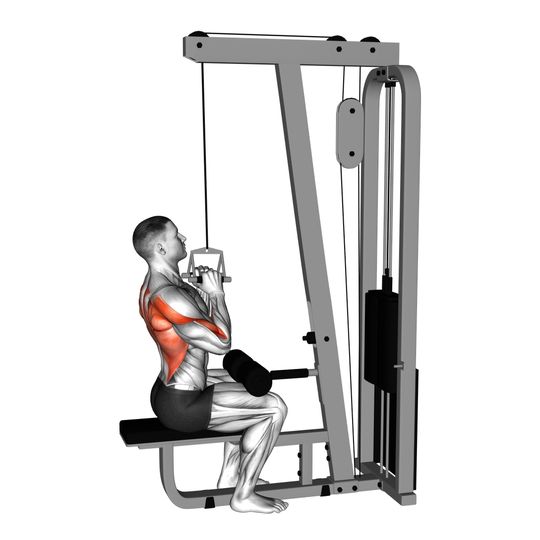
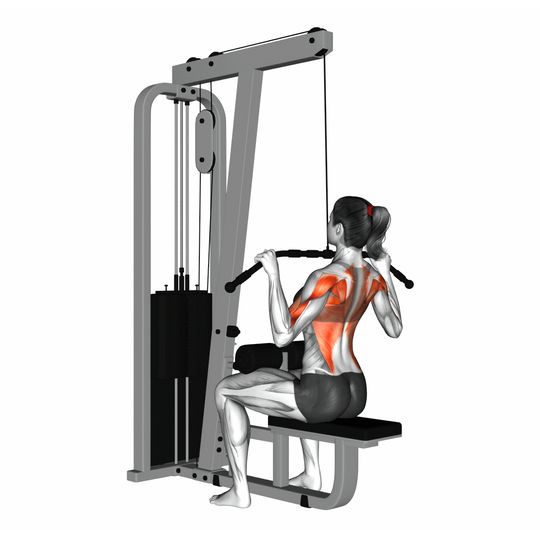
Every lat pulldown station has a long bar for a wide grip and a V-bar for a narrow one, and most lifters pick whichever is attached. The grip does change the exercise, though not in the way gym folklore claims: a wide grip does not build a wider back, and a close grip is not just a biceps exercise.
A wide grip lat pulldown sends the elbows out to the sides and shortens the range of motion; a close grip pulldown brings the elbows down in front of the body through a longer path with the biceps in a stronger position. Both train the lats first; the difference is which muscles assist, how much you can load, and how far the lats travel.
| Factor | Close Grip Lat Pulldown | Wide Grip Lat Pulldown |
|---|---|---|
| Main target | Lats, through a long range | Lats, with more upper back and rear delt |
| Elbow path | Down and forward, in front of the torso | Out to the sides, in line with the shoulders |
| Range of motion | Longer — bar reaches the upper chest | Shorter — bar stops near the collarbone |
| Biceps involvement | High, especially with a neutral grip | Lower, wide pronated grip weakens the arms |
| Typical load | Heavier by roughly 10–15% | Lighter |
| Shoulder comfort | Easier on most shoulders | Can pinch at the bottom for tight shoulders |
| Best for | Progressive overload, chin up carryover | Upper back and rear delt work, a second angle |
Close Grip Lat Pulldown vs Wide Grip Lat Pulldown: muscles worked#
Close Grip Lat Pulldown
- Primary: Lats
- Secondary: Biceps, Forearms, Upper back, Rear delts
Wide Grip Lat Pulldown
- Primary: Lats
- Secondary: Biceps, Forearms, Upper back, Rear delts
Muscles worked#
The lats are the prime mover in both pulldowns. Research comparing grip widths finds no meaningful difference in lat activation; what shifts is the supporting cast. The close grip lat pulldown, usually done with a neutral V-bar, puts the biceps and brachialis in their strongest position and takes the shoulder through more extension, so the lower lat fibres get a longer contraction as the elbows finish against the ribs.
The wide grip lat pulldown pulls the elbows out to the sides, which gives the teres major, rear delts and the upper lat fibres near the armpit a bigger share of the work, and takes the biceps out because a wide pronated grip is a weak position for the arm. The mid traps and rhomboids assist in both, but the wide grip's outward elbow line makes the upper back feel more involved.
Range of motion and grip#
Grip width sets the bar path. With a close grip, the arms travel from a full overhead reach down until the elbows tuck against the sides and the bar touches the upper chest: a long range with the lats stretched at the top and fully shortened at the bottom.
With a wide grip, the hands are already partly out to the sides at the top, so the arms cover less distance before the bar reaches the collarbone. The range difference between wide vs narrow grip lat pulldowns is real: the wide version cuts the top of the movement short and finishes with the elbows flared. Neither grip changes how wide your back grows; that is decided by lat volume and progressive loading, not hand spacing.
Loading and shoulder stress#
Most lifters pull 10–15 percent more on a close grip handle than on a wide bar. The biceps contribute more, the elbow path is more efficient, and the shoulder is in a stronger position. More load through a longer range is more total work for the lats, which is why the close grip pulldown is the better default for long-term progress.
The wide grip trades load for a different feel and more shoulder stress. The flared position at the bottom is where cranky shoulders complain, and pulling behind the neck makes that worse with no extra lat benefit. Kept in front of the body with the hands just outside shoulder width, the wide grip pulldown is safe for most people.
Programming and how to use both#
Make the close grip lat pulldown your heavy vertical pull if you cannot yet do pull ups or want a pulldown to load progressively: 3–4 sets of 8–12, full stretch at the top, elbows to the ribs at the bottom, adding weight when every rep is clean. It also carries over directly to chin ups and neutral grip pull ups, since the arm path is nearly identical.
Use the wide grip pulldown as the second vertical pull, in the 10–15 range, where the lighter load makes it easy to chase a hard contraction. A pull day with one heavy close grip pulldown and one lighter wide grip pulldown covers both elbow paths, or rotate grips every training block. If you only have room for one, close grip does more.
The verdict#
Pick the close grip lat pulldown if you want the strongest, most loadable pulldown, if your shoulders dislike a wide flared position, or if your goal is a bigger back built through progressive overload. The longer range, heavier load and stronger arm position make it the better single choice for most lifters.
Pick the wide grip lat pulldown if you want more upper back and rear delt involvement, or if you already have a heavy close grip pulldown or chin up in your program. It will not make your back wider on its own — no grip does — but it is a good second angle. Most well-built back programs use both, with the close grip taken heavy and the wide grip for volume.
Frequently asked questions#
Is close grip or wide grip lat pulldown better for lats?
They are close to equal in lat activation, and the close grip version usually wins on total work because you can use more weight through a longer range. The wide grip brings in more upper back and rear delt. For lat size, either works; for progressive loading, close grip is easier to build over time.
Does a wide grip lat pulldown make your back wider?
No. Back width comes from lat growth, and lat growth comes from progressively loaded volume regardless of hand spacing. The wide grip changes the elbow path, which is a different feel rather than a different result. A heavy close grip pulldown builds width just as well.
What are the close grip vs wide grip lat pulldown muscles worked?
Both train the lats as the main muscle. The close grip adds more biceps and brachialis and takes the lats through a longer range; the wide grip adds more rear delt, teres major and upper back while using less arm. The mid traps and rhomboids assist in both.
Is a neutral grip lat pulldown the same as close grip?
Usually, yes. Most close grip pulldowns use a neutral V-bar with the palms facing each other, which is the strongest and most shoulder-friendly position. A close underhand grip on a straight bar shifts a little more onto the biceps.
Should I do wide and narrow grip lat pulldowns in the same workout?
You can, and it is a sensible way to cover both angles. Do the close grip pulldown first and heavier, in the 8–12 range, then the wide grip for 10–15 with a lighter load. If time is short, one heavy pulldown plus a row does more for the back than two pulldowns.