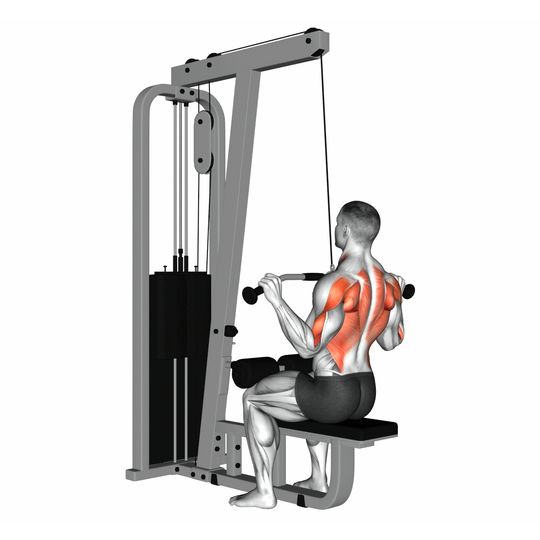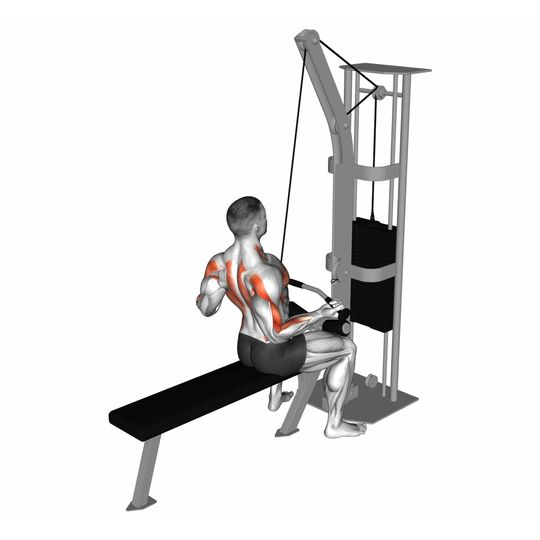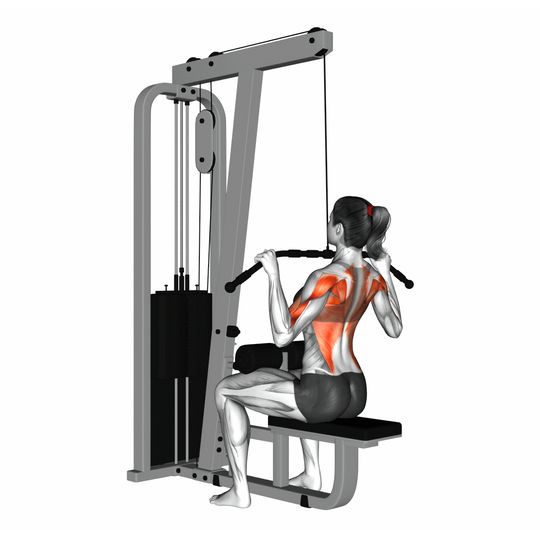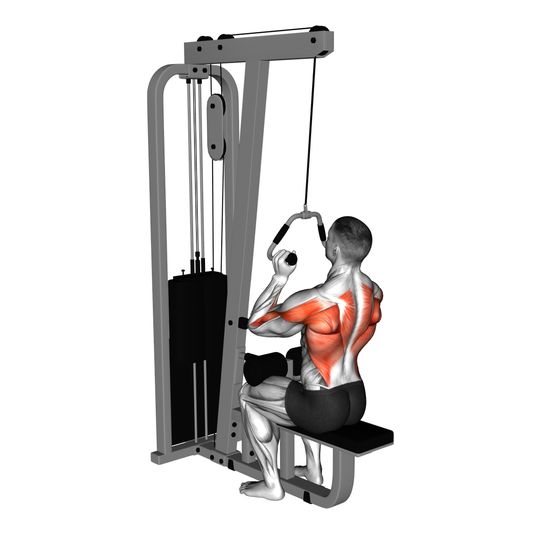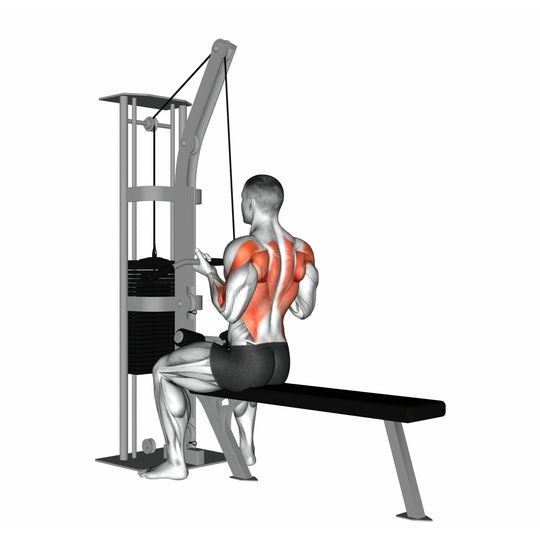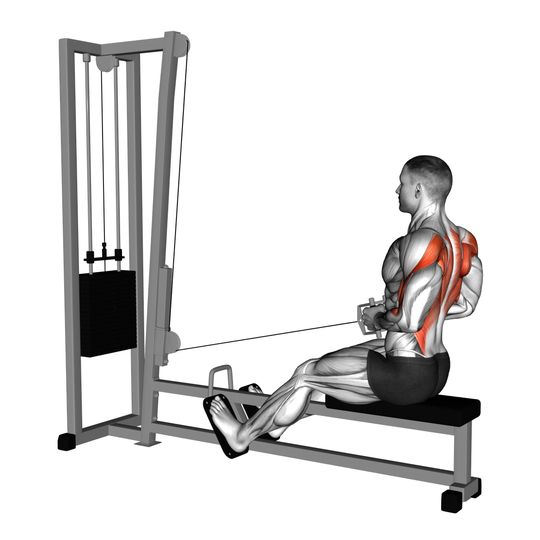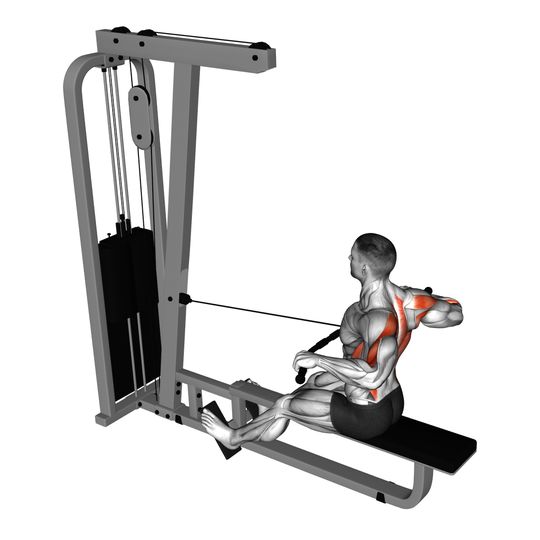


Pull a close-grip cable handle down toward your upper chest to load the latissimus dorsi. Maintain an upright torso and move through a controlled concentric and eccentric phase.
How to do the Close Grip Lat Pulldown#
- Sit at the cable pulldown station and grasp the close-grip attachment with both hands, arms extended overhead.
- Plant your feet and sit upright with a neutral spine and chest slightly lifted.
- Drive your elbows down and back to pull the handle toward your upper chest, focusing on contracting the lats.
- Hold the bottom position briefly while keeping your torso still and shoulders down.
- Slowly return the handle to the start with control, fully extending the arms.
Muscles worked#
The close grip lat pulldown is built to train the lats. With the hands close and usually neutral on a V-bar, the elbows travel down and forward in front of the body rather than out to the sides, which puts the latissimus dorsi through a longer range than a wide grip and lets you load it heavier. You should feel the pull start at the armpit and finish low on the ribs as the elbows reach the sides of the torso.
The biceps and brachialis work hard because the neutral grip puts them in a strong position, and the forearms hold the handle throughout. The mid traps, rhomboids, and rear delts pull the shoulder blades down and together at the bottom, and the lower part of the traps keeps the shoulders from shrugging up. If you feel it mostly in the arms, the elbows are stopping short of the torso and the lats are not finishing the rep.
- Primary: Lats (Latissimus Dorsi)
- Secondary: Biceps (Biceps Brachii), Forearms (Forearm Flexors & Extensors (incl. Brachioradialis)), Upper back (Rhomboids & Middle Trapezius), Rear delts (Posterior Deltoid)
Common mistakes#
- Leaning back excessively and turning the move into a torso row.
- Using momentum or jerking the weight down.
- Pulling mainly with the forearms or biceps instead of the lats.
- Allowing the shoulders to shrug up toward the ears.
Close Grip Lat Pulldown vs other exercises#
Head-to-head breakdowns of muscles worked, loading, joint stress, and which one to pick for your goal.
Why it works#
The close grip pulldown is the strongest pulldown variation for most lifters, because the neutral hand position lets the biceps contribute fully and the long elbow path keeps the lats loaded through more range. That makes it the best choice when the goal is progressive overload on a vertical pull: you can add weight to it steadily for years, which is harder to do with wide-grip or single-arm versions.
It also builds the specific strength that carries over to chin ups and neutral grip pull ups, since the arm path and grip are nearly identical. Lifters who cannot yet do bodyweight pull ups get the most out of it by treating it as their main back exercise, while stronger lifters use it to accumulate volume once their pull ups are done.
Sets, reps and setup#
Three to four sets of 8-12 reps with 90 seconds to two minutes of rest, once or twice a week. Use it as the heavy pulldown in a session and keep at least one or two reps in reserve on the early sets. Pushing every set to failure turns the movement into a shrug and arm pull.
- Setup
- Lock the thighs under the pad, grab the V-bar with a neutral grip, and sit tall with a slight lean back of ten to fifteen degrees. Start by pulling the shoulder blades down, then drive the elbows toward the hips until the handle touches the upper chest. Hold for a beat, then let the arms straighten fully and the shoulder blades rise before the next rep.
- Progression
- Add reps to twelve, then add a plate and drop back to eight. When the weight stalls, slow the lowering to three seconds or add a pause at the top of the stretch. If you can pull more than your bodyweight for eight clean reps, start doing weighted pull ups and keep this as a second back exercise.
Variations#
- Lat Pulldown The standard shoulder-width overhand version, which puts the elbows slightly wider and reduces the biceps contribution.
- Wide Grip Lat Pulldown Pulls with the elbows out to the sides through a shorter range, shifting more emphasis to the upper back and teres.
- Underhand Lat Pulldown A supinated grip that loads the biceps even more and mirrors the chin up path.
- Neutral Grip Pull Up The bodyweight version of the same pull, once your pulldown strength approaches your bodyweight.
- Single Arm Lat Pulldown One side at a time with more freedom to reach and rotate, useful for fixing a lat that lags behind the other.
Close grip vs wide grip lat pulldown#
The wide grip forces the elbows out to the sides, which shortens the range of motion and reduces the biceps contribution, so it feels harder on the lats even though you lift less weight. Much of the extra difficulty is simply leverage, and the shorter range means fewer total degrees of lat work per rep.
The close grip lets the elbows travel further, allows more load, and works the lats through a longer range while bringing the biceps in as a helper. For back size and strength it is the more productive default. Use the wide grip as a secondary movement to hit the upper back and outer lats from a different angle.
Common questions#
What muscles does the close grip lat pulldown work?
The lats are the main target, working through a long range as the elbows drive down in front of the body. The biceps and forearms assist strongly with the neutral grip, and the mid traps, rhomboids, and rear delts pull the shoulder blades together at the bottom.
Is a close grip lat pulldown better than a wide grip?
It allows more weight and a longer range, so it is better for overall lat development and strength. The wide grip hits the upper back and outer lats through a shorter range. Most lifters benefit from making the close grip their main pulldown and adding wide grip as a second angle.
Should I lean back during lat pulldowns?
A slight lean of about ten to fifteen degrees is fine and helps the handle clear your chin. Rocking further back on each rep turns it into a row and lets momentum do the work; if you need to lean to move the weight, it is too heavy.
Where should the bar touch on a close grip pulldown?
The upper chest, just below the collarbones. Pulling lower than that means leaning back excessively, and stopping at chin height means the elbows have not finished driving down to the sides.
How much should I be able to lat pulldown?
Pulling roughly your bodyweight for eight to ten reps with a controlled tempo is a good intermediate benchmark and usually lines up with being able to do several strict pull ups. Beginners often start at 40 to 60 percent of bodyweight.