

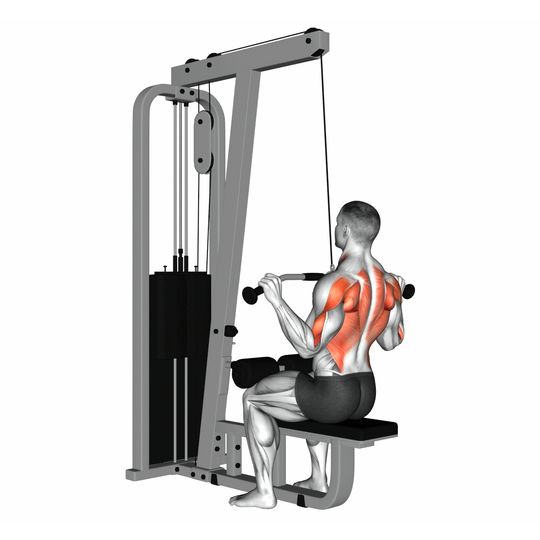
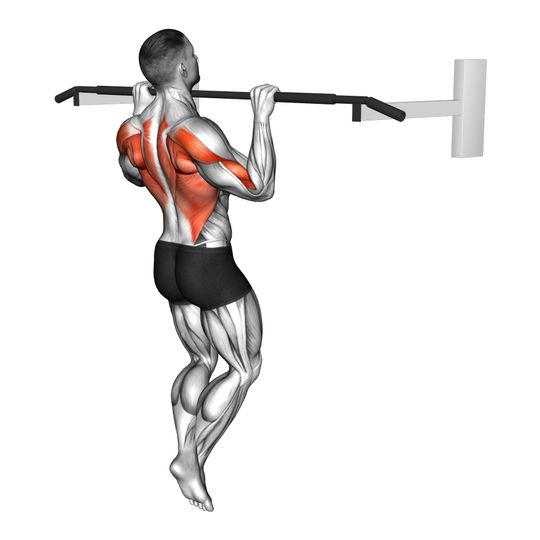
The pull up and the lat pulldown are the same vertical pull performed two ways. On the pull up your body is the load and you move it toward a fixed bar; on the pulldown you are fixed and pull a loaded bar toward you. The muscles are nearly identical, but the loading, the stability demand, and how you progress could hardly be more different.
The pull up is the harder, more complete exercise and a benchmark of relative strength. The lat pulldown is the more adjustable one: any load, any grip, any rep range, on demand. Which belongs in your program depends on what you can do today and what you are trying to build.
| Factor | Lat Pulldown | Pull Up |
|---|---|---|
| Main target | Lats, upper back, biceps | Lats, upper back, biceps, core |
| Load | Any — set the pin | Bodyweight, or more with a belt |
| Stability demand | Low, seated and braced | High — the whole body hangs and swings |
| Progression | Smooth, small increments | Stepped: reps, then added weight |
| Beginner-friendly | Yes | No — most beginners cannot do one |
| Best for | Volume, isolation, all levels | Relative strength, full-body pulling, advanced lifters |
Lat Pulldown vs Pull Up: muscles worked#
Lat Pulldown
- Primary: Lats
- Secondary: Biceps, Forearms, Upper back, Rear delts
Pull Up
- Primary: Lats, Upper back
- Secondary: Biceps, Forearms, Abs
Muscles worked#
Both exercises train the latissimus dorsi as the main mover, with the teres major, rhomboids, lower traps, rear delts, and biceps assisting. Electromyography comparisons show similar lat activation between the two when the load is matched, which makes sense — it is the same joint action.
The pull up adds the core and the whole body to the equation. Hanging from a bar and keeping the body still while pulling recruits the abs, the hip flexors, and the grip far more than sitting on a pulldown seat does. That is extra training effect, and also extra fatigue and extra ways for form to break down.
Loading and progression#
The lat pulldown lets you pick the exact load. Beginners can start with a weight they can pull for 10 clean reps, and advanced lifters can go heavier than bodyweight without a belt. Progress is smooth: add a plate, add a rep, done. It is also easy to change the grip and the handle to hit the back from a different angle.
The pull up starts at bodyweight and most beginners cannot do one. Progress comes in steps: assisted versions or band assistance, then negatives, then singles, then reps, then added weight on a belt. That staircase is slower and less forgiving, and it is also why a set of weighted pull ups is a bigger achievement than any pulldown number.
Strength carryover and stability#
A big pull up carries over to everything: it is relative strength, grip strength, core control, and lat strength in one number. Athletes, climbers, and anyone who cares about what their body can do should train it.
The pulldown trains the lats just as well but does not build the same whole-body coordination — you can be strong on the machine and still struggle to hang from a bar. Conversely, the seat and the fixed path make the pulldown far easier to take close to failure safely, which is exactly what you want from a volume exercise.
Programming both#
If you can do 8 or more clean pull ups, make them the first vertical pull of the session and add weight when you can do more than 10–12. Follow with pulldowns for 10–15 reps to add lat volume without the fatigue of hanging and swinging.
If you cannot do pull ups yet, build toward them with pulldowns as your main vertical pull — heavy, in the 6–10 range, with a grip that mirrors the pull up you want — plus assisted pull ups or negatives twice a week. A pulldown at roughly 80 percent of bodyweight for 8 reps usually predicts a first pull up.
The verdict#
The pull up is the better exercise if you can do it well: more muscle, more carryover, and a benchmark you can measure yourself against for years. Weighted pull ups are the gold standard for vertical pulling strength.
The lat pulldown is the better tool for building lats at any level, because you can load it precisely, isolate the movement, and take it to failure safely. Beginners should use it to earn their first pull up; everyone else should use it after pull ups for volume. The back grows fastest when both are in the program.
Frequently asked questions#
Are lat pulldowns as good as pull ups?
For lat growth, yes — activation is similar at matched load, and the pulldown is easier to load and progress precisely. For total-body strength, grip, and core, no; the pull up trains far more than the lats. Which is “better” depends on whether you are training a muscle or a skill.
Can lat pulldowns help me do pull ups?
Yes, especially heavy ones. Train pulldowns in the 6–10 rep range with a grip that matches the pull up you want, and add assisted pull ups or negatives twice a week. When you can pulldown around 80 percent of your bodyweight for 8 reps, a first pull up is usually close.
How much should I be able to lat pulldown?
A pulldown at around 70–80 percent of bodyweight for 8–10 reps is a solid intermediate level and roughly the point where pull ups become possible. Advanced lifters pull more than bodyweight on the machine. Note that the machine and the pulley design change the numbers, so compare against yourself rather than the internet.
Should I do pull ups or lat pulldowns first?
Pull ups first if you can do them, because they need the most freshness and strength. Then pulldowns for volume. If you cannot do pull ups yet, do heavy pulldowns first and finish with assisted pull ups or negatives.
Which grip is best for lat pulldown or pull up?
A shoulder-width or slightly wider overhand grip is the standard for lats. Underhand (chin up) brings more biceps in and lets most people pull more. Neutral grip is the friendliest for the shoulders and elbows. Rotating grips over a program builds the back more completely than sticking to one.