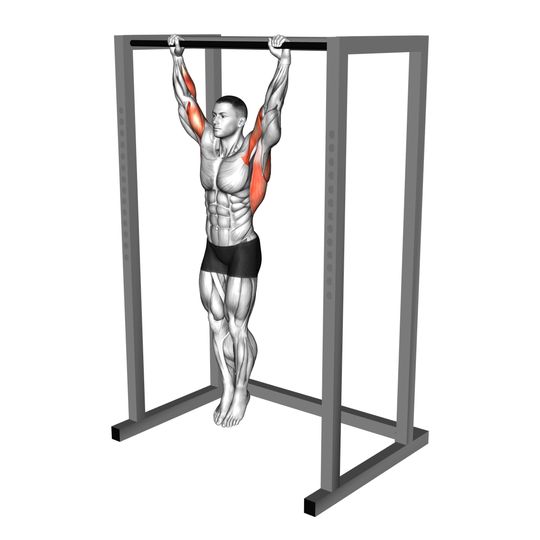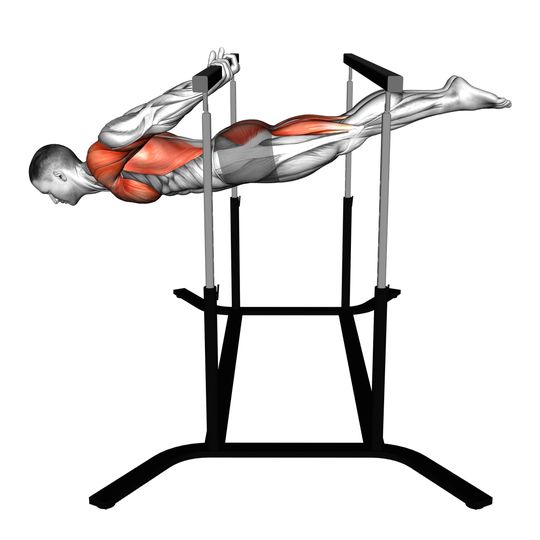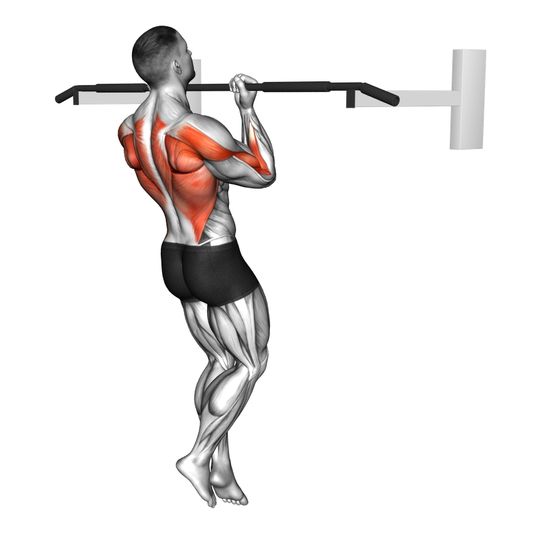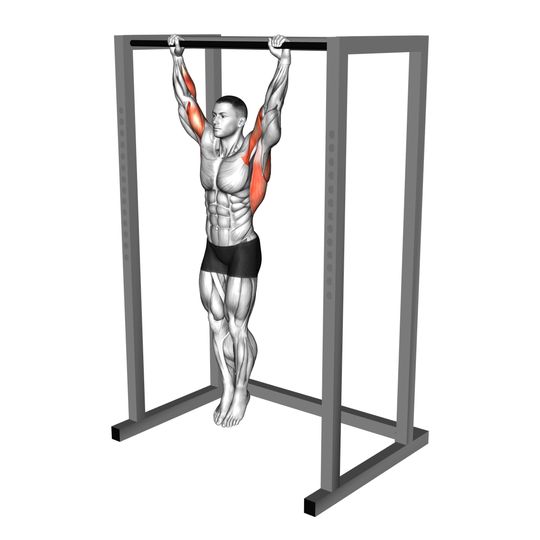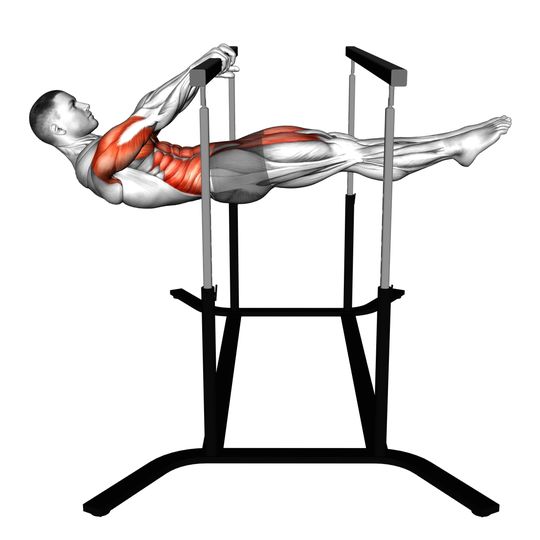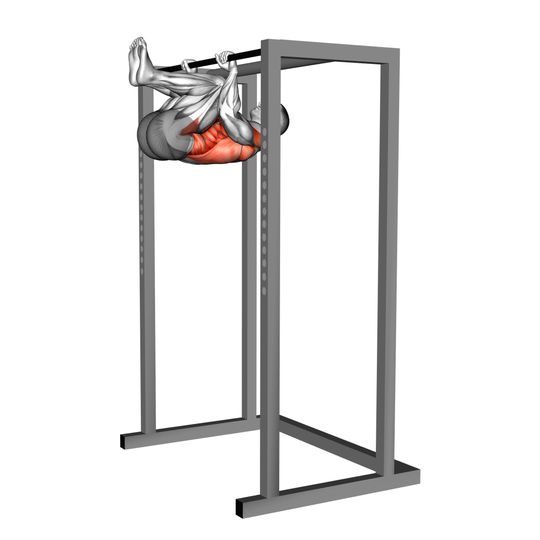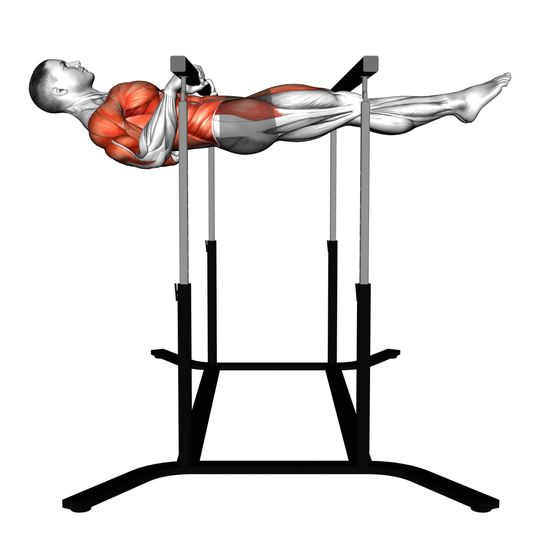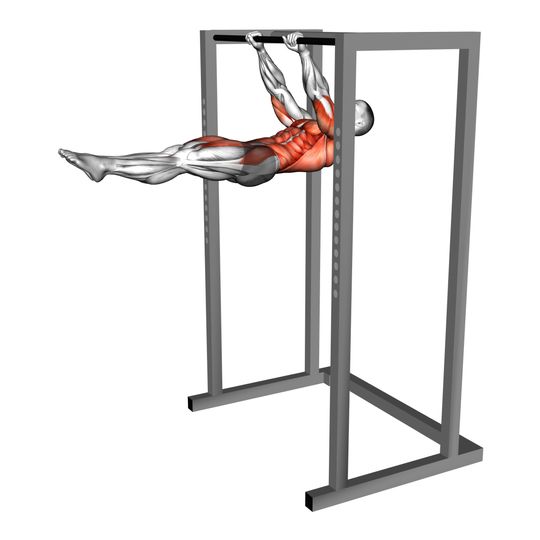


A vertical pulling exercise that lifts your body toward the bar and primarily works the lats and upper back.
How to do the Pull Up#
- Grab the bar with a neutral grip (palms facing each other) and hang with your arms fully extended.
- Set your shoulder blades by drawing them down and back before initiating the pull.
- Drive your elbows down and pull your chest upward until your chin clears the bar or your chest approaches it.
- Hold briefly at the top while contracting the lats, then lower yourself slowly back to a dead hang.
- Repeat for the desired number of repetitions with controlled, even tempo.
Muscles worked#
The pull up is the most complete upper-back exercise you can do with your bodyweight. The lats (latissimus dorsi) pull the elbows down and toward the ribs, which is the movement that lifts you to the bar, and they do the most work in the first half of each rep. Higher up, the lower traps and rhomboids of the upper back take over to pull the shoulder blades down and together, and the rear delts help the arms finish behind the line of the body.
The biceps and brachialis bend the elbows on every rep, which is why pull ups can build arms as well as a back, and the forearms and grip decide how many reps you can do before the hands give out. The abs work harder than most people expect to keep the legs still and the ribs down, and the serratus and rotator cuff stabilise the shoulder throughout.
- Primary: Lats (Latissimus Dorsi), Upper back (Rhomboids & Middle Trapezius)
- Secondary: Biceps (Biceps Brachii), Forearms (Forearm Flexors & Extensors (incl. Brachioradialis)), Abs (Rectus Abdominis)
Common mistakes#
- Using momentum or kicking the legs to propel the body upward.
- Shrugging the shoulders instead of starting the pull from scapular engagement.
- Stopping short and not fully extending the arms at the bottom.
- Relying mainly on the arms and not engaging the back muscles.
Pull Up vs other exercises#
Head-to-head breakdowns of muscles worked, loading, joint stress, and which one to pick for your goal.
Why it works#
Nothing builds relative upper-body strength like the pull up. Your bodyweight is a fixed and honest load, so getting from zero to ten reps is a direct measurement of how much stronger your back, arms, and grip have become. Because the shoulder moves through a full overhead range under load, it also maintains shoulder mobility and scapular control that machine rows never touch.
The pull up is also easy to progress in either direction. Bands and negatives make it accessible to beginners, and a dipping belt with plates turns it into a heavy compound lift for advanced trainees. A bar is all you need, so it fits any program, any gym, and most parks.
Sets, reps and setup#
Beginners who cannot yet do a rep should do three to five sets of 3-5 negatives or band-assisted reps three times a week. Once you can do eight clean reps, train three or four sets of 5-10 reps, stopping one or two short of failure, twice a week. When you reach 12-15 reps, add weight and work in the 5-8 range.
- Setup
- Take the bar just outside shoulder width with a full grip, hang with straight arms, and pull the shoulder blades down before the elbows bend. Drive the elbows toward the hips and bring the chest to the bar, hold for a beat, then lower under control to a full hang. Keep the legs still and the ribs down.
- Progression
- Add one rep per set each week until you hit the top of your range, then add load in 2.5 kg steps. If reps are stuck, finish sets with negatives using a five-second lowering phase to build strength at the sticking point.
Variations#
- Chin Up Palms facing you, which brings the biceps in more and is a little easier for most people.
- Neutral Grip Pull Up Palms facing each other on parallel handles, the most shoulder-friendly grip and a good middle ground.
- Band Assisted Pull Up A band under the feet takes some bodyweight off so you can practise the full range before you can do a rep.
- Negative Pull Up Jump to the top and lower slowly, the fastest way to build the strength for your first rep.
- Lat Pulldown The same pulling pattern on a machine with an adjustable load for volume work and beginners.
Pull up vs chin up#
The pull up uses an overhand grip, which puts the forearms in pronation and slightly reduces how much the biceps can contribute. That leaves the lats and upper back doing a bigger share, and it is the version that most people find harder. It also allows a wider grip if you want more emphasis on the lats and upper back.
The chin up uses an underhand grip, which lets the biceps work through a stronger position, so most people can do a rep or two more. It builds the arms more and is the better starting point for beginners. Both train the lats hard, so run whichever you can progress and switch every couple of months.
Common questions#
What muscles does the pull up work?
The lats and upper back are the main movers, with the biceps and brachialis bending the elbows and the forearms holding the grip. The rear delts, lower traps, rhomboids, and abs all work hard to stabilise the body.
How many pull ups should I be able to do?
A reasonable target for a trained man is 10-15 clean reps and for a trained woman 5-8. Anyone who can do 20 unbroken reps is strong by any standard. If you cannot do one yet, that is common and fixable in a couple of months with negatives and band assistance.
Why can't I do a pull up?
Usually a combination of bodyweight relative to back strength and a lack of practice at the specific movement. Train negatives, band-assisted reps, and heavy lat pulldowns two or three times a week, and if you are carrying extra weight, losing some of it makes every rep easier.
Are pull ups better than lat pulldowns?
They train the same muscles. Pull ups demand more core and grip work and build relative strength, while pulldowns let you set the exact load and are easier to take to failure safely. Most good programs use both.
Should I do pull ups every day?
Not to failure. Daily sub-maximal sets, sometimes called greasing the groove, can work well for building rep counts, but hard sets every day will beat up your elbows and shoulders. Two to three focused sessions a week is the standard approach.