

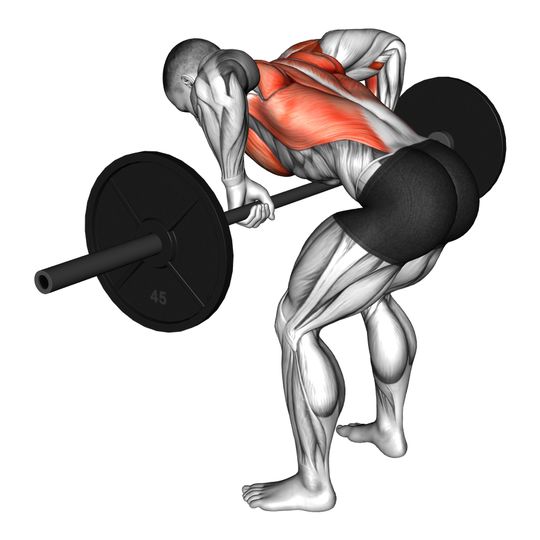
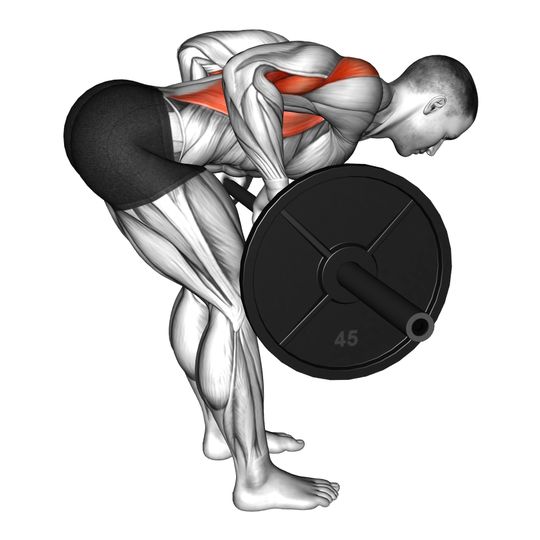
The Pendlay row and the bent over barbell row look like the same exercise until you watch a set of each. Both are heavy barbell pulls for the lats and upper back that live in the same slot of a pull day. The difference is where the bar goes between reps and what your torso does while it gets there.
In a Pendlay row the bar starts and finishes on the floor, the torso stays parallel to the ground, and every rep is a strict, explosive pull from a dead stop. In a bent over row the bar never touches down: you hold it with the torso between 45 degrees and parallel and row continuously. That one change alters the emphasis, the load, and what the exercise is for.
| Factor | Pendlay Row | Barbell Bent Over Row |
|---|---|---|
| Bar between reps | Rests on the floor, dead stop | Held off the floor the whole set |
| Torso angle | Parallel to the floor, fixed | About 45 degrees, drifts up under fatigue |
| Main target | Upper back and lats | Lats and upper back, more lower back and hamstrings |
| Tempo | Explosive pull, bar returned to the floor | Continuous, controlled up and down |
| Typical load | Lighter, limited by strict form | Heavier, 10–20% more for most lifters |
| Lower back fatigue | Lower — spine unloads every rep | Higher — held isometric for the whole set |
| Best for | Strict upper back strength, explosive pulling | Back size, heavy volume, general strength |
Pendlay Row vs Barbell Bent Over Row: muscles worked#
Pendlay Row
- Primary: Upper back, Lats
- Secondary: Biceps, Rear delts, Lower back, Forearms
Barbell Bent Over Row
- Primary: Upper back, Lats
- Secondary: Biceps, Rear delts, Lower back, Forearms, Hamstrings
Muscles worked#
Both rows train the same muscles: the lats pull the elbows back toward the hips, the rhomboids, mid traps and rear delts squeeze the shoulder blades together, the biceps and forearms bend the arms and hold the bar, and the spinal erectors keep the torso from folding. Where they differ is in the share each muscle gets.
The Pendlay row's parallel torso means the bar travels straight up against gravity into the lower chest, which puts the upper back under the most direct load of any barbell row. The bent over row's higher torso angle and continuous tension shift the emphasis toward the lats and add a long isometric for the lower back, glutes and hamstrings, which hold the hinge for the entire set.
Dead stop vs continuous tension#
Starting every rep from the floor removes the stretch reflex and any momentum carried over from the previous rep. That makes the Pendlay row hard to cheat: if the bar does not reach the chest with a flat back, the rep did not happen, and there is no way to gradually stand up as the set gets hard.
The bent over row keeps the muscles loaded through the whole set, including the lowering phase, which is a bigger hypertrophy stimulus per set and lets you accumulate more time under tension. The cost is that the movement is easy to degrade. The torso rises, the hips start to help, and the last reps of a heavy set stop being rows.
Loading and lower back#
Most lifters bent over row 10–20 percent more than they Pendlay row. The higher torso angle shortens the bar path, the stretch reflex helps at the bottom, and the hips can contribute. That heavier number is real work for the back, but the spinal erectors hold a heavier isometric and usually end the set before the lats do.
The Pendlay row unloads the spine every rep. The bar rests between pulls, so the lower back gets a brief reset and the limiting factor is the upper back rather than how long you can hold a hinge. That makes it the easier row to recover from when squats and deadlifts already tax the lower back in the same week.
Programming and how to use both#
Program the Pendlay row like a strength lift: 3–5 sets of 5–8 reps, full rest, bar to the chest every rep, bar to the floor every rep. Keep reps under ten, because the explosive dead-stop pull loses its point once the set turns into a grind. It is the row of choice for lifters building the back strength that keeps a deadlift or a clean close to the body.
Program the bent over row like a size and general strength exercise: 3–4 sets of 6–12 reps, controlled lowering, a slight torso rise acceptable on the last reps. Many lifters alternate: Pendlay rows in a strength block and bent over rows in a hypertrophy block, or one of each in the same week.
The verdict#
Pick the Pendlay row if you want strict, honest upper back strength, if your lower back is already taxed by squats and deadlifts, or if you train for a sport where explosive pulling matters. The dead stop and the parallel torso build the rhomboids and mid traps harder per rep than any other barbell row.
Pick the bent over row if back size is the goal, if you want to move more weight, or if your program calls for a row in the 8–12 range. The continuous tension and heavier load produce more total work for the lats. Both are barbell rows; the Pendlay row is the stricter version and the bent over row the bigger one.
Frequently asked questions#
Is the Pendlay row better than the barbell row?
Better for strict upper back strength and for keeping the lower back fresh, yes. Better for lat size and total volume, no — the bent over barbell row lets you use more weight and keep tension on the muscle through the whole set.
What is the difference between a Pendlay row and a bent over row?
The Pendlay row starts and finishes every rep on the floor with the torso parallel to the ground and a fast, strict pull. The bent over row holds the bar off the floor throughout, uses a torso angle closer to 45 degrees, and moves the bar continuously. The Pendlay row is a stricter, lighter, more upper back focused version of the same movement.
Should I Pendlay row or bent over row for a bigger back?
For pure size, the bent over row edges ahead: heavier loads, continuous tension and a longer eccentric all favour hypertrophy. The Pendlay row still builds a thick upper back, and its strictness makes progress easier to measure. Running Pendlay rows for a block and then switching to bent over rows usually beats choosing one forever.
Can Pendlay rows replace bent over rows?
Yes, for a block or permanently. Expect the weight on the bar to drop by 10–20 percent and the lower back to feel fresher. Add a rep or a set to keep total back volume similar, since each Pendlay rep spends less time under tension.
Why is my Pendlay row so much weaker than my bent over row?
Because it is meant to be. The parallel torso lengthens the bar path, the dead stop removes the stretch reflex, and the strict form takes the hips and lower back out of the movement. A gap of 10–20 percent is normal. If the two match, your Pendlay row is probably drifting upright.