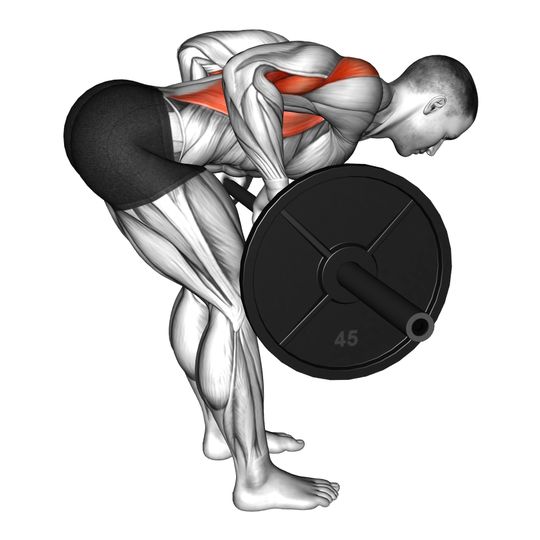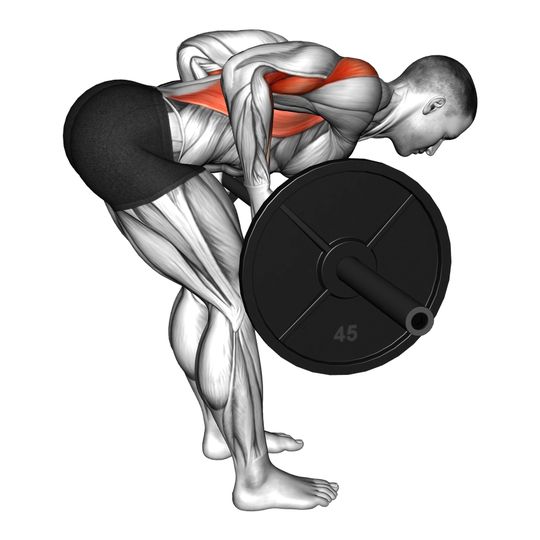


Perform a strict bent-over barbell row from a dead stop, hinging at the hips and pulling the bar to the upper chest to load the upper back muscles.
How to do the Pendlay Row#
- Stand with feet about hip-width and grip the barbell with an overhand grip just outside shoulder width.
- Hinge at the hips until your torso is roughly parallel to the floor, keep a neutral spine and bend the knees slightly.
- Brace your core, then drive your elbows back to pull the barbell toward your upper chest, contracting the upper back.
- Lower the bar under control until it returns to the floor and allow it to fully rest between reps.
- Reset your position and breathing before performing the next rep.
Muscles worked#
The Pendlay row is a strict, explosive barbell row from a dead stop on the floor, and the upper back is what it builds. With the torso parallel to the ground, the rhomboids, mid traps, and rear delts pull the shoulder blades together directly against gravity, and the lats drive the elbows up and back to bring the bar to the lower chest. Every rep starts from zero, so there is no stretch reflex or bounce; the back produces all the force.
The spinal erectors and lower back hold a parallel torso under load, a heavy isometric even though the bar rests between reps. The hamstrings and glutes fix the hip hinge. The biceps and forearms bend the elbows and grip a bar being moved fast, and grip often fails first when the weight gets serious. Compared to a normal bent-over row, more of the work lands on the upper back.
- Primary: Upper back (Rhomboids & Middle Trapezius), Lats (Latissimus Dorsi)
- Secondary: Biceps (Biceps Brachii), Rear delts (Posterior Deltoid), Lower back (Erector Spinae), Forearms (Forearm Flexors & Extensors (incl. Brachioradialis))
Common mistakes#
- Using torso momentum instead of pulling with the upper back.
- Rounding the lower back during the hinge.
- Failing to let the bar rest on the floor between reps.
- Pulling with the forearms rather than driving the elbows toward the hips.
Pendlay Row vs other exercises#
Head-to-head breakdowns of muscles worked, loading, joint stress, and which one to pick for your goal.
Why it works#
The Pendlay row is the most honest row in the gym. Because the bar returns to the floor every rep, you cannot shorten the range, use the rebound from the previous rep, or gradually stand up as fatigue sets in. What you can row from a dead stop with a flat back to the chest is what your upper back can actually do, which makes it easy to track and hard to cheat.
It also trains the back explosively, which few exercises do. Named after weightlifting coach Glenn Pendlay, it was designed to build the upper back strength that keeps a bar close in the clean and the deadlift, and it still does that better than slower rows. Bodybuilders use it for the thickness heavy horizontal pulling brings.
Sets, reps and setup#
Three to five sets of 5-8 reps with two to three minutes of rest, once a week as the main row, or twice for lifters prioritising the back. Keep reps below ten: the dead stop and explosive pull are lost when fatigue turns the movement into a slow grind. Each rep is a separate effort with a brief reset on the floor.
- Setup
- Bar on the floor, feet hip-width, overhand grip a little outside the legs. Hinge until the torso is parallel to the floor with the knees slightly bent and the back flat. Brace, pull the bar hard to the lower chest with the elbows driving back, and lower it to the floor under control. Shorter lifters may need blocks to reach a true parallel torso.
- Progression
- Add 2.5 kilos when all sets reach the target reps with the bar touching the chest and the torso parallel. The torso angle is the first thing to break as weight rises, so film a set from the side occasionally. Rising to 45 degrees to finish a set is a bent-over row, not a heavier Pendlay row.
Variations#
- Barbell Bent Over Row Held off the floor between reps at a higher torso angle, more weight and more lower back involvement.
- Underhand Barbell Row Supinated grip that brings the biceps in more and tucks the elbows for the lats.
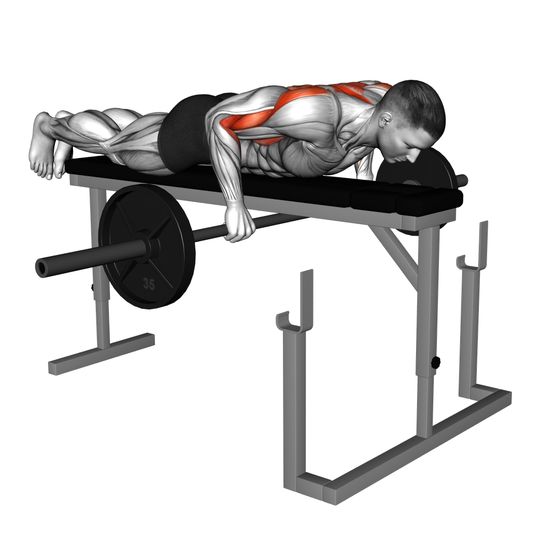
- Barbell Seal Row Lying face down on a high bench, so the lower back is out entirely and only the upper back works.
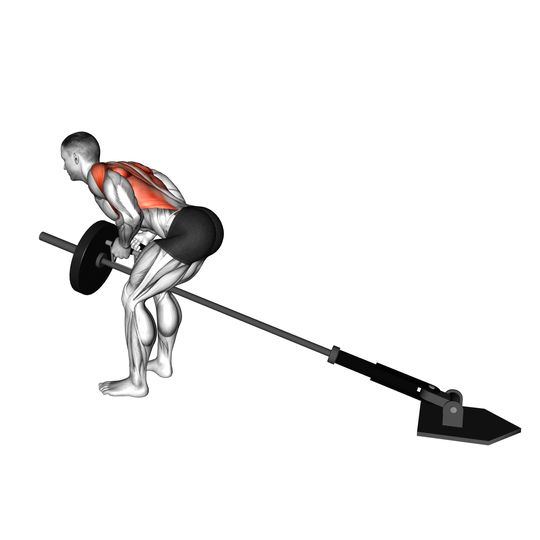
- T Bar Row Pivoting bar with neutral handles, an easier way to row heavy with less lower back demand.
Pendlay row vs bent over row#
The bent over row holds the bar off the floor for the whole set, usually with the torso between 45 degrees and parallel. That lets you use the stretch reflex and a little body English to move heavier weights for more reps, and the lower back works the entire set. It is the better exercise for total pulling volume and a fine choice when the goal is size.
The Pendlay row resets on the floor each rep with the torso locked at parallel, so the weight and reps are lower and the upper back does a larger share of the work. It is the better choice for strength, explosiveness, and for lifters whose bent over rows have drifted into upright shrugs. Many programs use the Pendlay row on heavy days and the bent over row for volume.
Common questions#
What muscles does the Pendlay row work?
The upper back, meaning the rhomboids, mid traps, and rear delts, along with the lats. The biceps and forearms assist the pull, and the lower back, glutes, and hamstrings hold the parallel torso.
What is the difference between a Pendlay row and a barbell row?
The Pendlay row starts and finishes every rep on the floor with the torso parallel and the pull explosive. The standard barbell row keeps the bar in the air between reps at a higher torso angle, usually for more reps.
Should the bar touch the floor between reps?
Yes, that is the defining feature. Each rep starts from a complete stop, which removes momentum and forces the upper back to produce all the force. If the bar hovers, it is a bent over row.
How much should you be able to Pendlay row?
Considerably less than you bent over row, often 15-25 percent less, because there is no rebound and the torso is lower. Around 60-70 percent of your bench press for five clean reps is a respectable intermediate level.