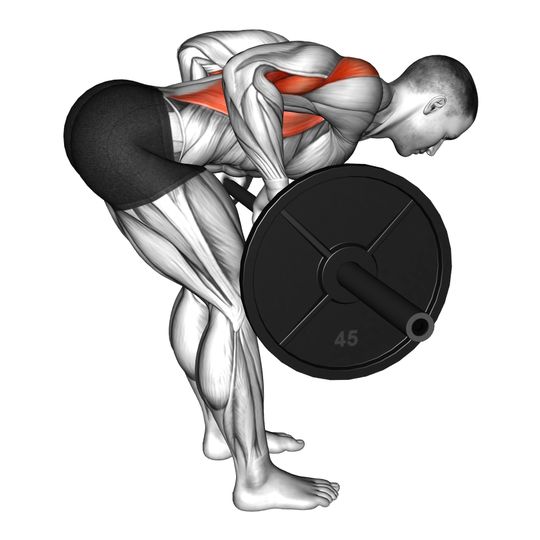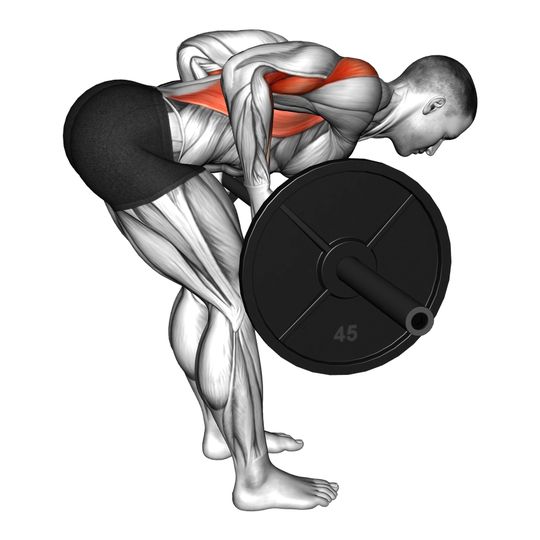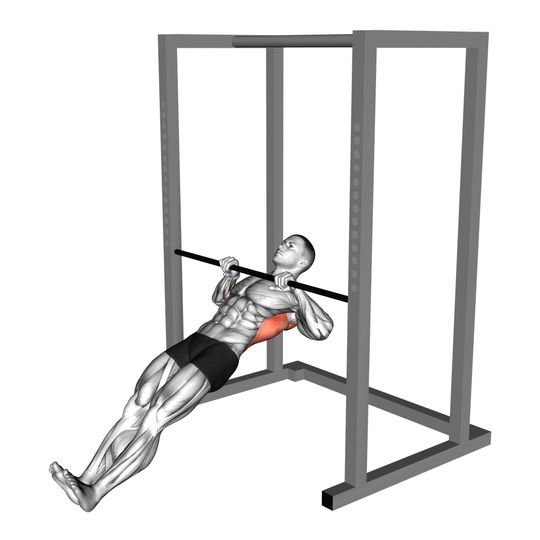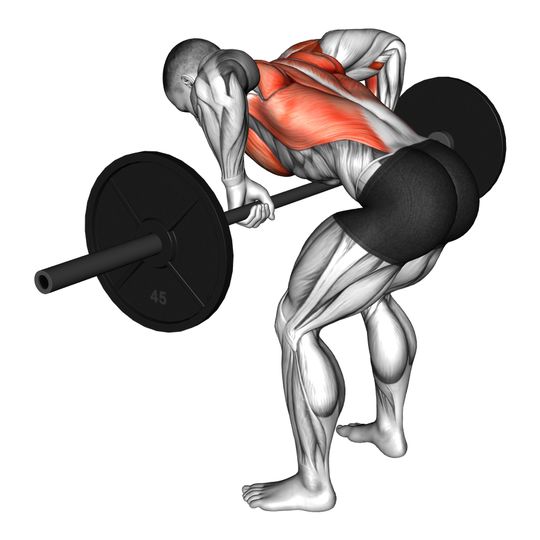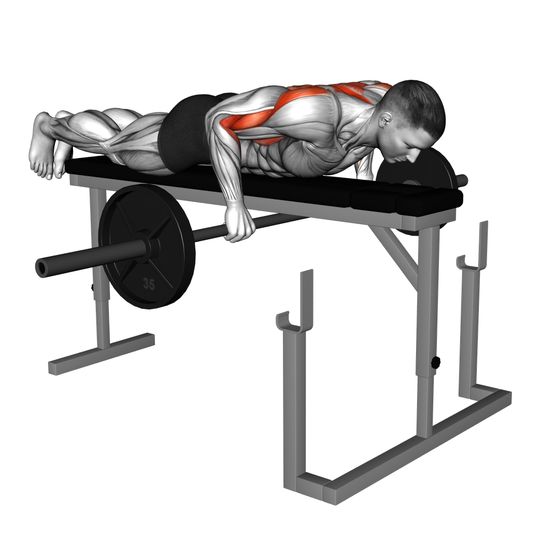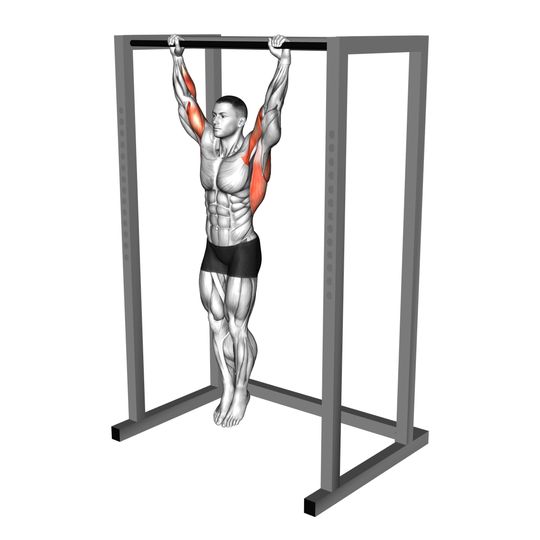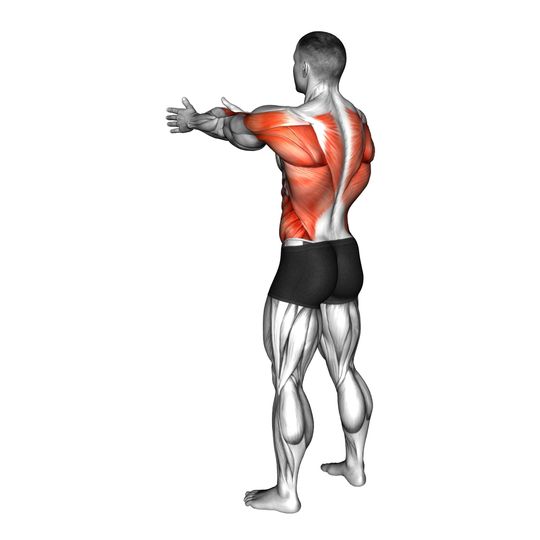


A horizontal pulling exercise performed with a barbell that emphasizes the upper back and lats. You hinge at the hips and row the barbell toward your torso using elbow-driven pulling.
How to do the Landmine Row#
- Stand with feet about hip-width apart and grasp the barbell near one end with one hand.
- Hinge at the hips with a slight knee bend and keep a neutral spine so your torso leans forward.
- Drive your elbow up and back to pull the barbell toward your lower ribs, focusing on the upper back and lats.
- Pause briefly at the top and squeeze your shoulder blades together.
- Lower the barbell under control until your arm is extended and reset before the next rep.
Muscles worked#
The landmine row is a lat and upper back exercise first. Because the bar arcs toward your hip rather than straight up, the elbow finishes behind the torso, which is exactly the line of pull the latissimus dorsi prefers. The rhomboids and mid traps take over near the top as the shoulder blade slides back toward the spine, so a well-done rep is felt low on the ribcage and between the blades, not in the hand.
The biceps and forearms flex the elbow and hold a thick, awkward bar end, so grip usually tires before the back does. The rear delts help drag the upper arm back, and the lower back and hamstrings work isometrically to hold the hinge for the whole set. Standing beside the bar also asks the obliques to resist the twist the offset load tries to create.
- Primary: Upper back (Rhomboids & Middle Trapezius), Lats (Latissimus Dorsi)
- Secondary: Biceps (Biceps Brachii), Rear delts (Posterior Deltoid), Traps (Trapezius), Lower back (Erector Spinae), Forearms (Forearm Flexors & Extensors (incl. Brachioradialis))
Common mistakes#
- Rounding the lower back instead of maintaining a neutral spine.
- Using torso rotation or a jerk to lift the weight rather than pulling with the elbow.
- Letting the hand or wrist do the work instead of driving with the elbow.
Cannot do this one today?#
Machine taken, gym closed, or the movement just not agreeing with you? Here is what to run instead, and what each substitute changes.
9 best landmine row alternatives →
Why it works#
The landmine fixes one end of the bar to the floor, so the path is an arc you cannot really get wrong. That makes it the most forgiving heavy row in the gym: you can load it aggressively, drive the elbow hard, and the pivot keeps the bar tracking toward your hip without the drift you get on a dumbbell. Lifters who never feel their lats on a barbell row usually feel them here inside a set.
Working one side at a time exposes strength gaps between arms and lets the torso rotate slightly into the stretch at the bottom, which gives the lat a longer range than a two-handed row. It is also cheap on the lower back compared with a bent over barbell row because the free hand can brace on your thigh or a bench.
Sets, reps and setup#
Three to four sets of 8-12 reps per arm with 60-90 seconds between arms. Rows respond well to moderate loads and full range, so pick a weight where the last two reps are hard but the elbow still finishes behind the ribcage.
- Setup
- Load the free end and stand square to it with the bar between your feet or just outside the working side. Hinge until your torso is roughly 45 degrees, brace the free hand on your thigh, and grip the bar behind the collar. Pull the elbow up and back toward your hip, pause, then lower until the arm is long and the shoulder blade slides forward.
- Progression
- Add a rep per set each week until you hit 12 across the board, then add a small plate and drop back to 8. When the load gets heavy enough that your torso rotates to help, either lower the weight or switch to the two-handed version with a V handle for a few weeks.
Variations#
- Meadows Row Stand perpendicular to the bar with an overhand grip on the sleeve, which shifts more work onto the upper back and rear delt.
- Barbell Bent Over Row Both hands, free bar path, and heavier loading at the cost of much more lower back demand.
- Pendlay Row Each rep starts dead from the floor, so it trains explosive pulling rather than a controlled stretch.
- Barbell Seal Row Chest supported on a raised bench, which removes the lower back entirely and isolates the lats and mid back.
- Dumbbell Bent Over Row Free path with the same single-arm setup, harder to stabilise but easier to find in any gym.
Landmine row vs dumbbell row#
The dumbbell row lets you move the weight in any direction, which is its strength and its problem. Beginners tend to row toward the shoulder and shrug, turning it into a trap exercise. The landmine forces the arc toward the hip, so the lat takes the load whether you are thinking about it or not.
The dumbbell wins on range and on availability: you can reach further toward the floor and every gym has a rack of them. If your rows already feel right, the dumbbell is fine. If you struggle to find your lats, run the landmine version for a block and the dumbbell row will feel different afterwards.
Common questions#
What muscles does the landmine row work?
Primarily the lats and upper back, with the rhomboids and mid traps squeezing the shoulder blade at the top. The biceps, forearms and rear delts assist, and the lower back and obliques hold the hinge steady against an offset load.
Is the landmine row good for building a bigger back?
Yes. It combines a long lat stretch at the bottom with a hard contraction at the top and lets you load it heavily without your lower back giving out first. Two to three sessions a week of 8-12 reps is enough to see visible thickness within a few months.
Where should I grip the landmine bar?
On the sleeve just behind the collar for a thick neutral grip, or on the bar itself for a thinner grip. The thicker grip trains the forearms harder; if grip fails before your back, use straps or move your hand onto the bar.
How heavy should a landmine row be?
Start with the empty bar plus a 10-20 kg plate and add weight until 8-12 reps per arm is hard but your torso stays still. Most intermediate lifters land between 40 and 70 kg on the sleeve. Jerking or twisting means the load is too high.
Can I do the landmine row without a landmine attachment?
Yes. Wedge one end of the bar into a corner with a folded towel, or set it inside a heavy plate lying flat on the floor. The bar pivots the same way and the movement is unchanged.