
The hack squat and the leg press are the two heaviest quad exercises most gyms offer that do not load your spine with a barbell. Both are sled machines, both keep your back supported, and both let you push far more weight than you could squat. That is where the similarity ends.
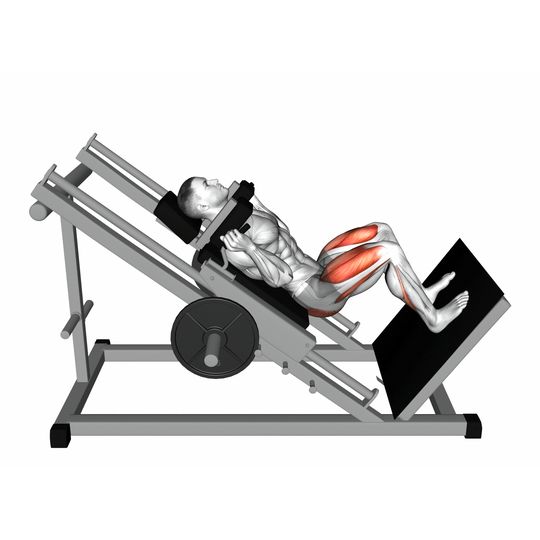
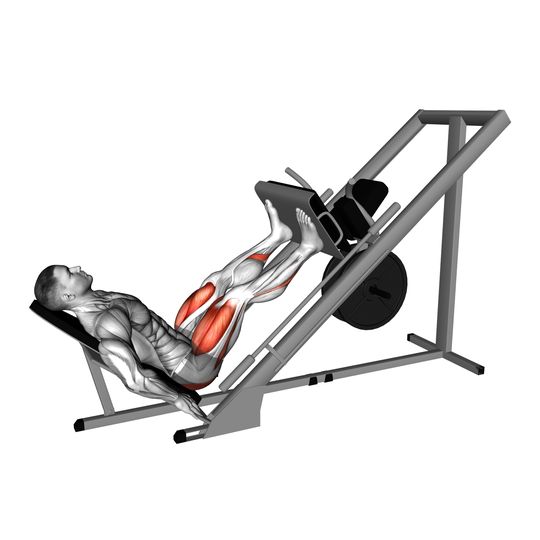
On the hack squat you move and the sled stays angled behind you, so your torso stays upright and the knees travel forward over the feet. On the leg press you stay put and push the sled away, with your hips folded to ninety degrees or more. Those two differences decide which muscles do the work, how deep you can go, and which joints take the strain.
| Factor | Hack Squat | Leg Press |
|---|---|---|
| Main target | Quads, with glutes at depth | Quads and glutes, adductors with wide feet |
| Range of motion | Deep — mimics a full squat | Limited by hip flexion and lower back |
| Spinal loading | Low, shoulders carry the pad | Very low, back is flat on the pad |
| Knee stress | Higher — knees travel forward | Moderate, adjustable with foot height |
| How heavy it goes | Heavy | Heaviest machine in the gym |
| Best for | Quad growth, squat carryover | Volume with minimal fatigue, beginners |
Hack Squat vs Leg Press: muscles worked#
Hack Squat
- Primary: Quads
- Secondary: Glutes, Adductors
Leg Press
- Primary: Quads, Glutes
- Secondary: Hamstrings, Adductors, Calves
Muscles worked#
Both machines are quad-dominant knee extension exercises with the glutes and adductors assisting. The hack squat biases the quads harder because the upright torso and forward knee travel keep the hips relatively extended, so the glutes contribute less and the quads — especially the rectus femoris and vastus lateralis — carry more of the load through the full range.
The leg press recruits more glute and adductor the lower you place your feet and the wider you set them, because the hips flex deeper at the bottom. High and narrow feet turn it into a quad exercise close to the hack squat; low and wide feet make it a glute and inner-thigh press that the hack squat cannot replicate.
Range of motion and depth#
The hack squat wins on depth. Because your torso is upright and supported, you can sink to a full squat position with the hamstrings covering the calves, which stretches the quads under load — the stimulus most associated with quad growth. The bottom position is also where the exercise gets hard, and where most lifters cut it short.
The leg press is limited by how far your hips can flex before your lower back peels off the pad. Once the tailbone lifts, the lumbar spine is rounding under a heavy sled, which is the one genuinely risky moment on the machine. Most lifters get a solid but shorter range than on the hack squat.
Joint stress and safety#
The hack squat asks more of the knees. Forward knee travel with a heavy sled is exactly what makes it grow quads and exactly what irritates knees that are already unhappy. Lifters with patellar tendon complaints usually tolerate the leg press better, especially with the feet set higher on the platform.
The leg press asks more of the lower back at depth and lets you load far beyond what your connective tissue is ready for, because nothing about it feels heavy until it is. Set the safety stops, do not let the hips lift, and treat the number on the sled as a fraction of your squat rather than a replacement for it.
Programming and carryover#
The hack squat carries over to the barbell squat better than the leg press does: same upright torso, same knee travel, same deep bottom position. Use it as a second heavy quad movement in the 6–10 rep range, or as a squat substitute when your back needs a week off.
The leg press is the better volume tool. It costs almost nothing in stability or recovery, so it is easy to take to failure safely and to run for 10–20 reps late in a session. Beginners also learn it in one attempt, which makes it the right first quad machine before graduating to the hack squat.
The verdict#
Pick the hack squat if quad size is the priority and your knees are healthy. The depth, the upright torso, and the forward knee travel make it the closest machine there is to a heavy squat, and the stretched bottom position is the stimulus the leg press cannot match.
Pick the leg press if you want heavy volume with minimal fatigue, if your knees complain on deep knee travel, or if you are new to leg training. Most well-designed leg days use both: hack squat or squat first in the 6–10 range, leg press second in the 10–15 range for volume that does not wreck recovery.
Frequently asked questions#
Is the hack squat better than the leg press for quads?
Slightly, yes. The hack squat lets you reach a deeper knee bend with an upright torso, which stretches the quads under load more than the leg press does. The leg press is close when the feet are set high and narrow, and it lets you push more total weight, so the difference is about emphasis rather than one being useless.
Which is safer, hack squat or leg press?
Neither is dangerous with sane loading. The hack squat is harder on the knees because they travel forward under load; the leg press is harder on the lower back if you let your hips lift off the pad at the bottom. If you have a knee issue, favour the leg press; if you have a lower back issue, favour the hack squat with a slightly shorter range.
Can I do both hack squats and leg presses in the same workout?
Yes, and it is a common pairing. Do the hack squat first while you are fresh, in the 6–10 rep range, and follow with the leg press for 10–15 reps to add quad and glute volume without much extra fatigue. Together they usually replace the need for a third quad exercise.
Why can I leg press so much more than I hack squat?
The leg press removes almost every stabilising demand and shortens the range of motion, and on a 45-degree sled you are only lifting part of the plate weight against gravity. The number is not comparable to a hack squat or a barbell squat — treat it as a training load for that machine only.
Does the leg press or hack squat replace barbell squats?
For quad growth, a hack squat can. For overall strength, balance, and carryover to sport or the barbell, neither fully replaces a free squat. Many lifters run a barbell squat as the main movement and use one of these machines as the second quad exercise, or swap in the hack squat during a block when the spine needs a break.