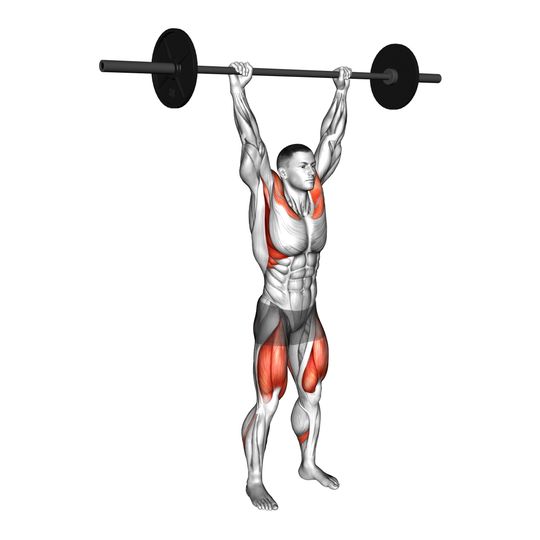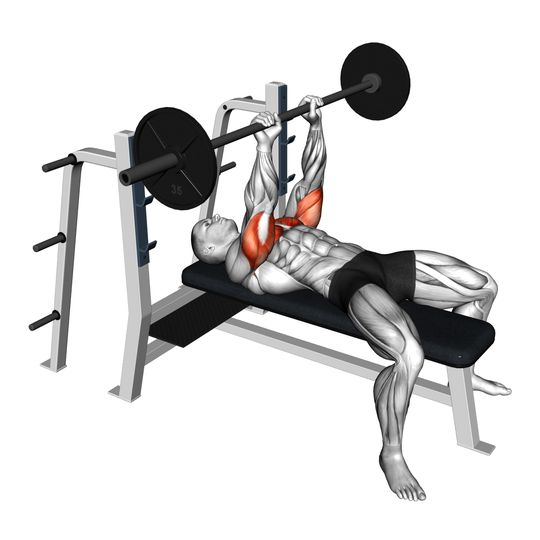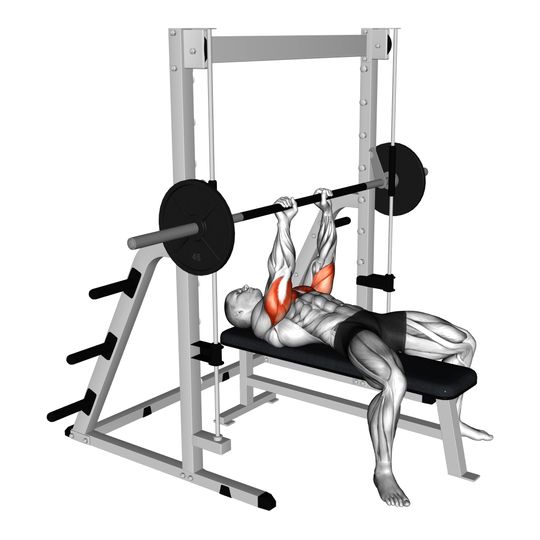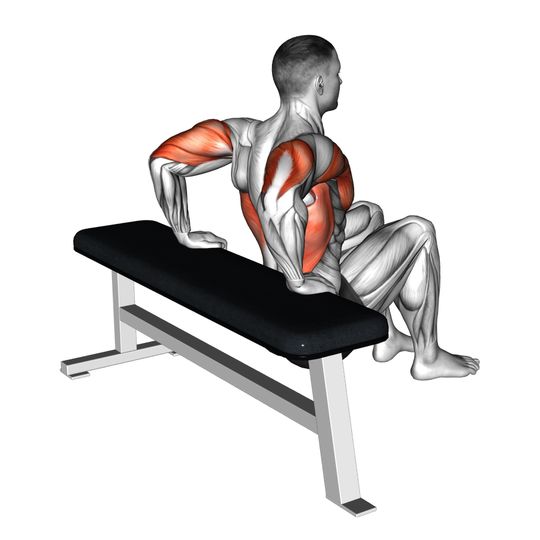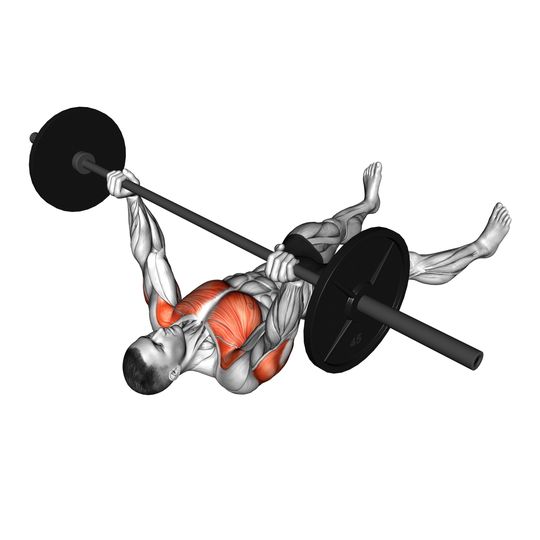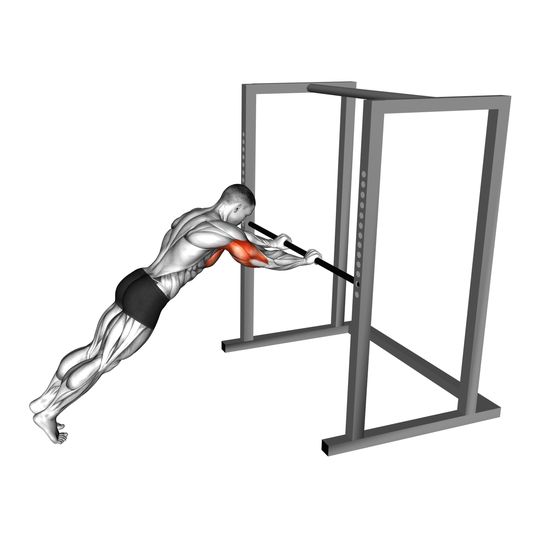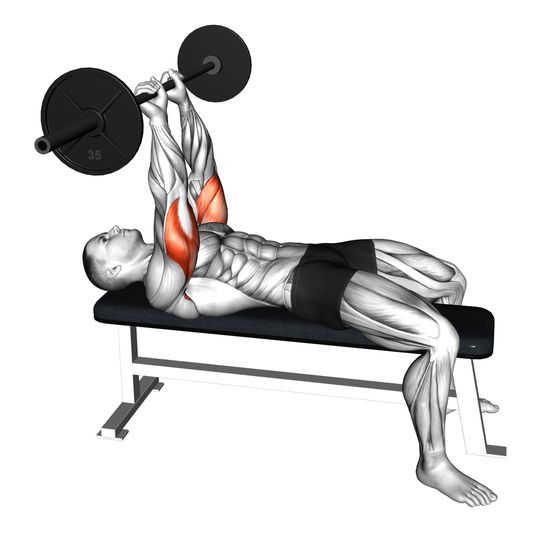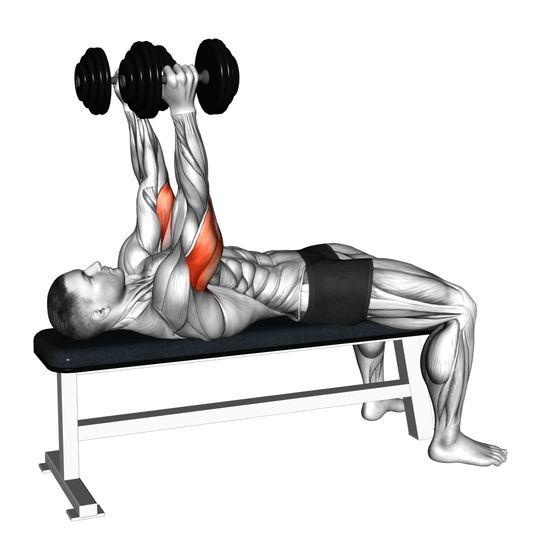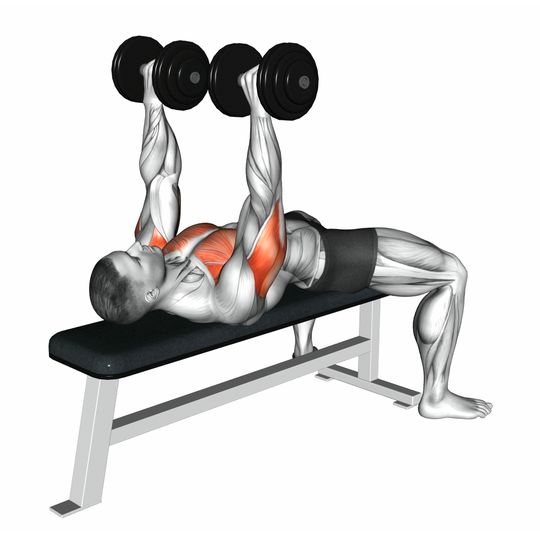


A barbell pressing movement that emphasizes elbow extension to train the triceps. You lower the bar in a controlled path near the forehead and press it back up using the triceps.
How to do the JM Press#
- Lie flat on a bench and grasp the barbell with a close grip (about shoulder-width or slightly narrower).
- Unrack the bar and hold it directly over your chest with your arms extended and wrists neutral.
- Bend your elbows to lower the bar in a controlled line toward your forehead or upper face, keeping your elbows close to your sides.
- Pause briefly at the bottom without bouncing, then extend the elbows to press the bar back to the start position.
- Maintain a steady tempo, keep the wrists stable, and control both descent and ascent with the triceps.
Muscles worked#
The JM press is a triceps exercise disguised as a bench press. The bar travels toward the upper chest and throat rather than the lower chest, and the elbows fold forward so the forearms nearly touch the biceps at the bottom, which means the triceps extend the elbow from a deep, stretched position on every rep. All three heads work, and because the upper arm stays roughly fixed rather than swinging, the long and lateral heads are loaded harder than in a normal close grip bench.
The chest and front delts help press the bar off the bottom, but far less than in a bench press, because the elbows stay high and forward rather than tucking toward the ribs. The forearms keep the wrists stacked under a bar that wants to roll backward, and the upper back holds the bench position. Next-day soreness is almost entirely in the triceps, a good sign the movement was done correctly.
- Primary: Triceps (Triceps Brachii)
- Secondary: Chest (Pectoralis Major), Front delts (Anterior Deltoid)
Common mistakes#
- Using too wide a grip, which reduces triceps emphasis.
- Allowing the elbows to flare outward during the descent.
- Letting the bar drift too far back or bouncing it off the face.
- Using momentum or excessive torso drive to complete the rep.
Why it works#
The JM press loads the triceps heavier than any isolation exercise. Skullcrushers and pushdowns are limited by the elbow joint working alone; the JM press keeps a small amount of shoulder involvement so the bar can be heavy, but the path puts the triceps in charge. Lifters who bench regularly can usually JM press around half of their bench for reps, far more than any pushdown will ever hold.
It was developed by powerlifter JM Blakley to fix the top half of the bench press, and that is still its main job. The lockout of a heavy bench and the second half of an overhead press both depend on the triceps extending the elbow under load with the upper arm in front of the body, which is exactly what the JM press trains. It also builds arm size faster than most lifters expect.
Sets, reps and setup#
Three to four sets of 6-10 reps with two to three minutes of rest, once a week after your main press. This is a heavy accessory, not a pump exercise; keep the reps under ten and the tempo controlled. Start around 40 percent of your bench press and build over several weeks.
- Setup
- Lie on a flat bench with a grip about shoulder-width or slightly narrower, wrists straight, bar over the upper chest. Lower by bending the elbows and letting them travel forward, so the bar moves toward the throat and the forearms fold onto the biceps, upper arms roughly 45 degrees from the torso. Press back up and slightly forward along the same line.
- Progression
- Add 2.5 kilos when all sets hit the target reps without the bar drifting toward the lower chest. If the elbows flare wide or the path turns into a normal bench press as the set goes on, the weight is too heavy for the triceps. Train it in a rack with the safeties just above the throat so you can go close to failure.
Variations#
- Close Grip Bench Press Normal bar path to the lower chest with a narrow grip, more weight and more chest involvement.
- Barbell Skullcrusher Upper arms fixed vertically and only the elbows moving, stricter triceps isolation with lighter loads.
- Barbell Floor Press Pressing from the floor so the elbows stop at the ground, removing the stretch and training the lockout.
- Dumbbell Skullcrusher Independent arms and a neutral grip, easier on the elbows and exposes side-to-side differences.
JM press vs close grip bench press#
The close grip bench press is still a bench press: the bar comes down to the lower chest, the elbows tuck toward the ribs, and the chest and shoulders do a large share of the work. It is the better choice for raw pressing strength and the safer lift to load heavily, and it should be the first triceps-focused barbell press most lifters add.
The JM press changes the bar path to the throat and folds the elbows forward, which strips out most of the chest and forces the triceps to handle the load from a stretched position. It is harder on the elbows and uses less weight, but it isolates the triceps in a way the close grip bench cannot. Use the close grip bench as your heavy press and the JM press as the accessory behind it.
Common questions#
What muscles does the JM press work?
The triceps do the large majority of the work, with all three heads extending the elbow from a stretched position. The chest and front delts assist off the bottom, and the forearms hold the wrists stacked under the bar.
What is the difference between a JM press and a close grip bench press?
The bar path. A close grip bench comes down to the lower chest with the elbows tucked; a JM press comes down to the throat with the elbows folding forward so the forearms touch the biceps. The JM press uses less weight and isolates the triceps far more.
How much should you JM press?
Around 40-60 percent of your bench press for sets of six to ten once the movement is learned. Start at the low end; the elbow tendons need time to adapt to the deep stretch.
Is the JM press good for the bench press?
It was created for exactly that purpose, and it remains one of the best exercises for a bench that stalls in the top half. Stronger triceps in this position mean a faster lockout and less reliance on the chest to finish the lift.