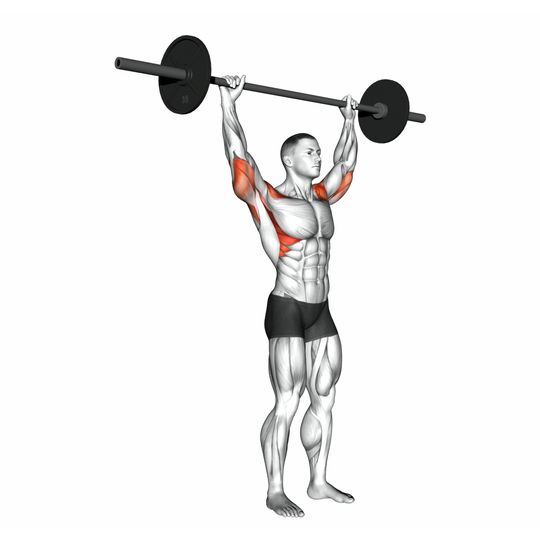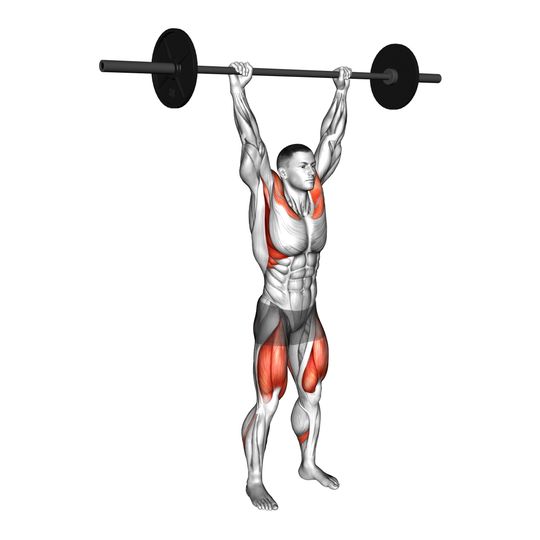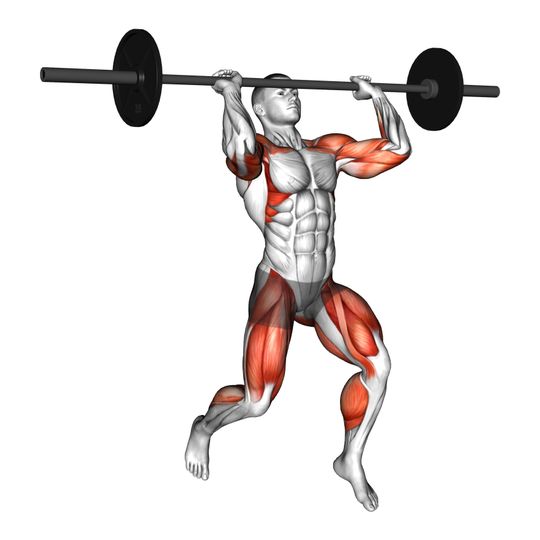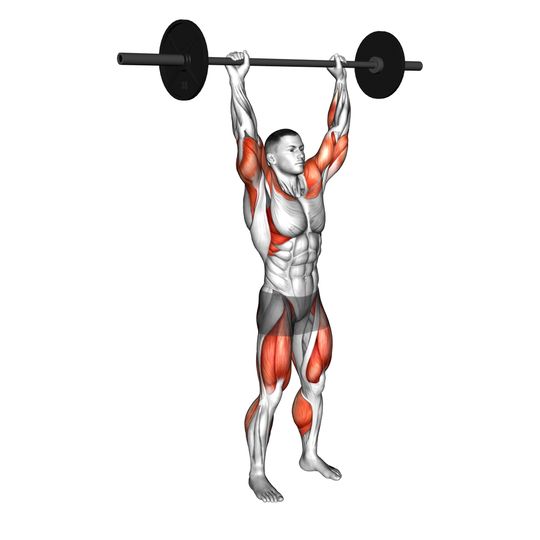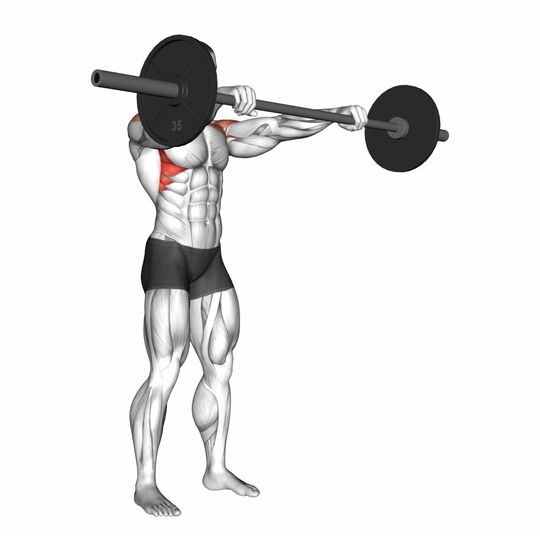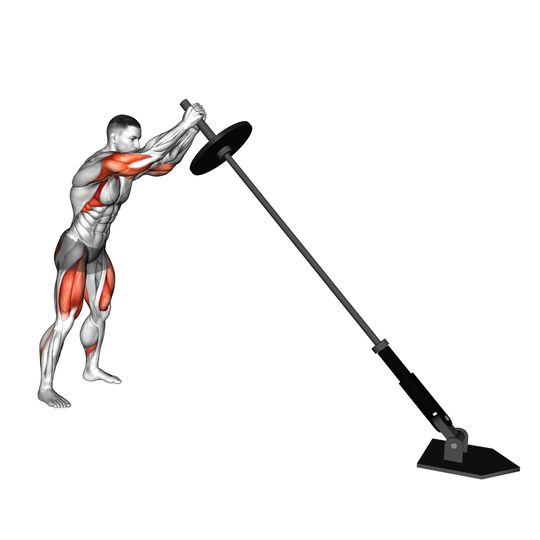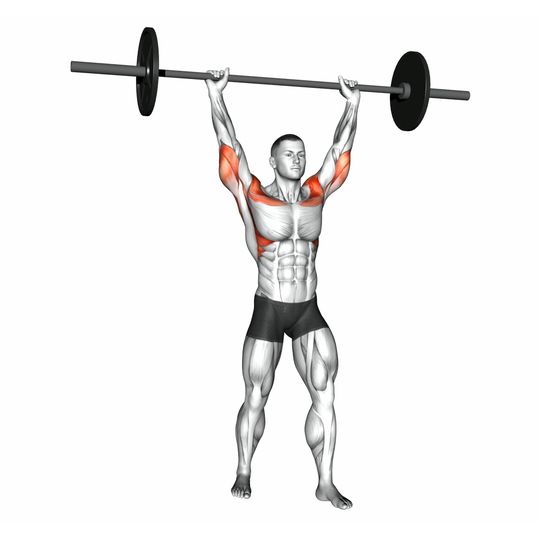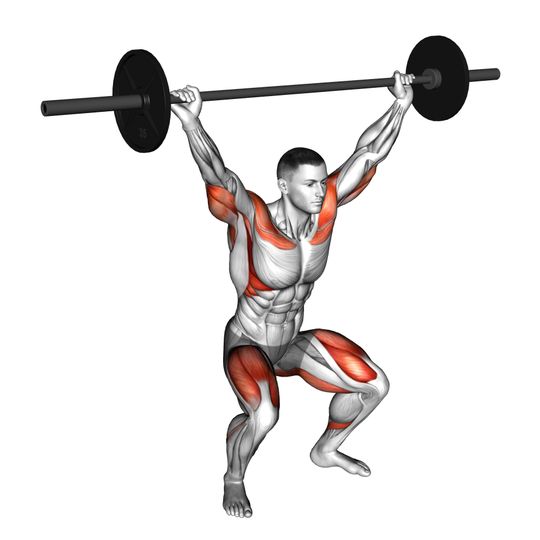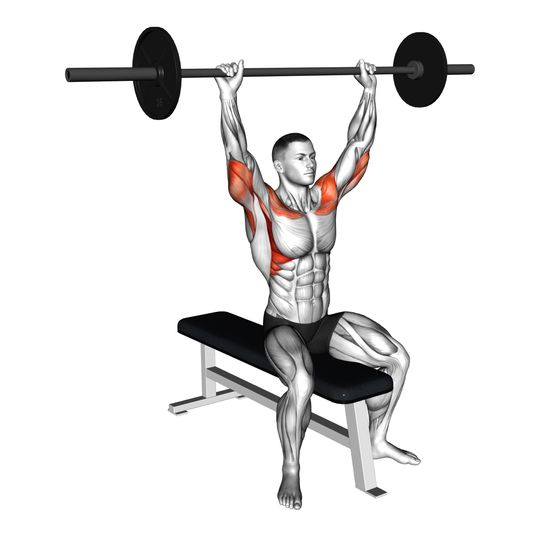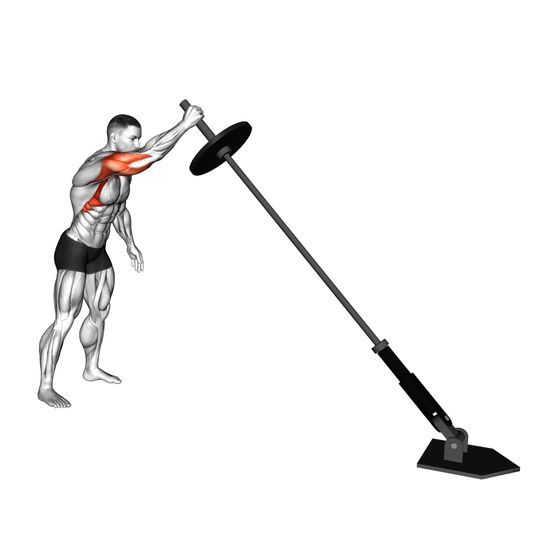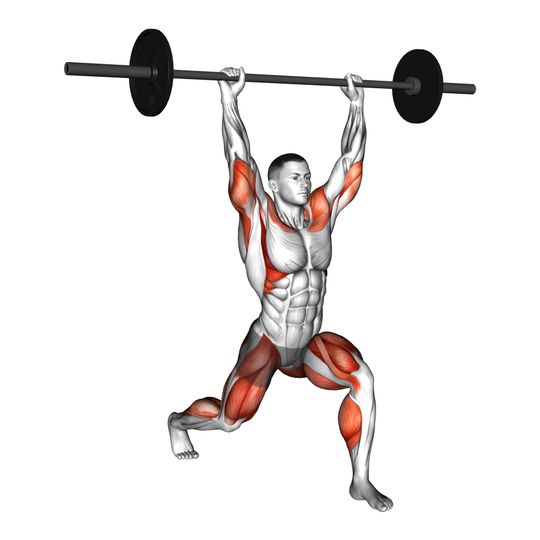


Use a short leg dip to drive a barbell from shoulder height to overhead, primarily working the shoulder muscles (deltoids).
How to do the Push Press#
- Stand with feet about hip-width, grip the barbell overhand at shoulder width and rest it on the front of your shoulders with elbows under the bar.
- Bend your knees briefly into a shallow dip to load the legs while keeping your torso upright.
- Explosively extend your hips and knees and use that upward drive to help push the barbell overhead until your arms are locked.
- Lower the bar back to the front-rack position under control and reset before the next rep.
Muscles worked#
The push press is a shoulder exercise that borrows power from the legs. The front delts and side delts drive the bar from the shoulders to overhead and the triceps finish the lockout. Because the leg drive gets the bar past the hardest part of the press, the delts and triceps work against loads you could not strict press, and the upper half of the movement is loaded harder than in any other pressing variation.
The quads and glutes generate the dip and drive, a short, sharp knee and hip extension rather than a squat. The upper traps rise to support the bar at lockout, and the abs and obliques brace hard to stop the lower back arching when the bar goes overhead. After a heavy set you feel it in the shoulders, but the legs and torso have done a lot of the work.
- Primary: Front delts (Anterior Deltoid), Side delts (Lateral Deltoid), Triceps (Triceps Brachii)
- Secondary: Quads (Quadriceps Femoris), Glutes (Gluteus Maximus), Traps (Trapezius), Abs (Rectus Abdominis)
Common mistakes#
- Using the arms alone instead of combining leg drive with the press.
- Overarching the lower back at the top of the movement.
- Dropping into a deep squat instead of a quick, shallow dip.
- Allowing the knees to collapse inward during the dip.
How much should you overhead press?#
What the average overhead press actually is, and what counts as beginner, intermediate, advanced, or elite at your bodyweight — for men and women, in kg and lbs.
See overhead press strength standards →
Why it works#
The push press lets you handle more weight overhead than a strict press, often 15-30 percent more, and that extra load lands on the delts and triceps during the second half of the press and the entire lowering phase. It is the best way to overload the top of the overhead press and to train the shoulders eccentrically with weights that would otherwise be impossible.
It also teaches the timing between legs and arms that carries into jerks, thrusters, and any sport that involves throwing or pushing. The dip and drive is fast, so a few heavy sets build rate of force development in a way slow pressing does not, without the technical demands of a full Olympic lift.
Sets, reps and setup#
Four to five sets of 3-6 reps with two to three minutes of rest, once or twice a week. Above eight reps the leg drive gets sloppy and the shoulders stop being the limiting factor. For hypertrophy, use heavy sets of five and follow with a strict press or lateral raises for volume.
- Setup
- Take the bar from a rack at chest height with a grip just outside the shoulders, elbows slightly in front of the bar, feet under the hips. Dip straight down 10-15 centimetres by bending the knees only, torso vertical, then reverse hard and let the bar leave the shoulders as the legs finish extending. Press to lockout with the head through and the bar over the mid-foot.
- Progression
- Add 2.5 kilos when all sets hit the target reps with a clean lockout. If the bar drifts forward or the heels leave the floor, the dip has become a forward lean; fix that before adding weight. Stalled lifters can pause in the dip to remove the bounce, then reintroduce it.
Variations#
- Barbell Overhead Press No leg drive, so lighter loads and a harder start from the shoulders.
- Push Jerk Adds a second dip to catch the bar with bent knees, allowing heavier weights overhead.
- Split Jerk Catches in a split stance, the heaviest and most technical way to get a bar overhead.
- Dumbbell Overhead Press Independent arms and a freer path, better for volume and for finding imbalances.
Push press vs strict overhead press#
The strict press is the pure test of shoulder and triceps strength: nothing helps the bar off the shoulders except the delts. It is the better choice for building pressing strength from a dead stop, but the weight is limited by the weakest point, which is the first few inches.
The push press skips that weak point with the legs, so the shoulders and triceps handle heavier loads through the top half and the lowering. Think of it as an overload tool, not a replacement. Most lifters do best with the strict press as the main movement and the push press as a heavy accessory, or the reverse for athletes who care about power more than pressing strength.
Common questions#
What muscles does the push press work?
The front and side delts and the triceps press the bar overhead, while the quads and glutes provide the leg drive. The traps support the bar at lockout and the abs and obliques brace the torso.
How much more can you push press than strict press?
Most lifters push press roughly 15-30 percent more than they strict press once the dip and drive is timed well. A much bigger gap usually means the strict press is undertrained; a much smaller one means the legs are not being used.
How deep should the dip be on a push press?
About 10-15 centimetres, roughly a quarter squat. Dipping deeper slows the drive and turns the movement into a thruster; the goal is a quick, shallow bend with the torso vertical.
Push press or push jerk, which should I do?
Push press to train the shoulders and triceps; push jerk to move the most weight overhead or if you train weightlifting or CrossFit. The jerk catches the bar with bent knees, so the arms do less work.