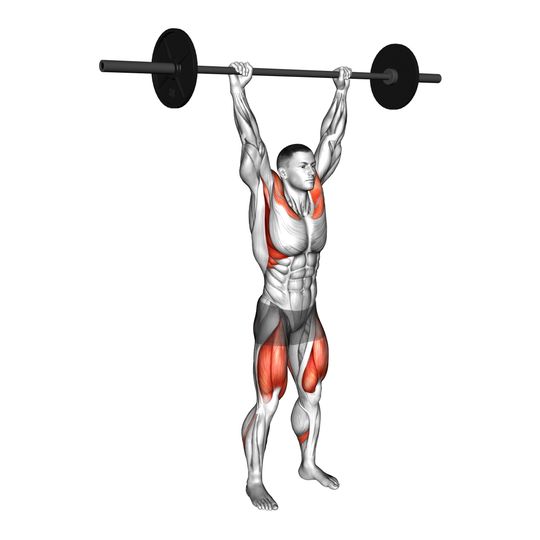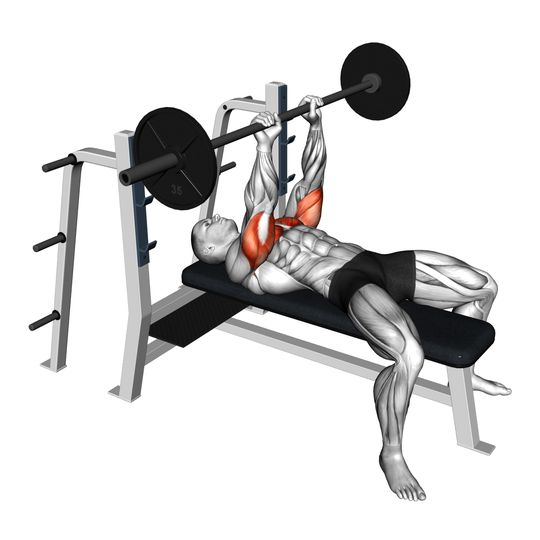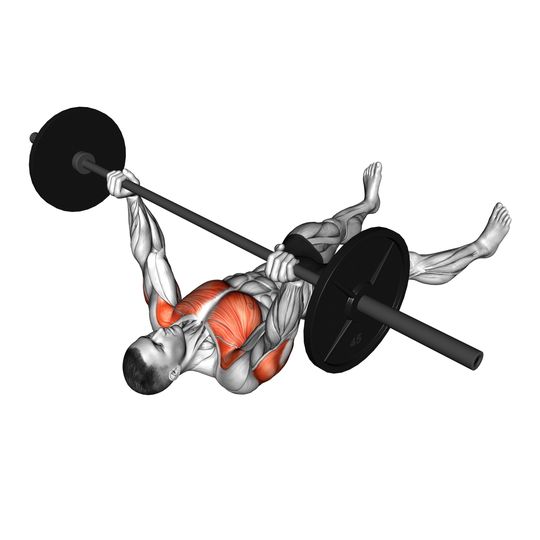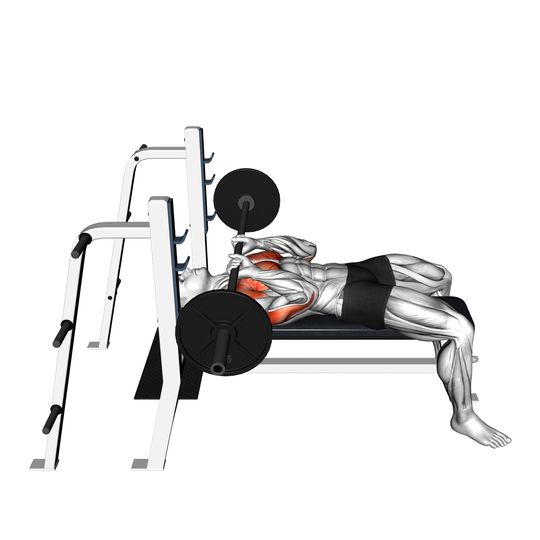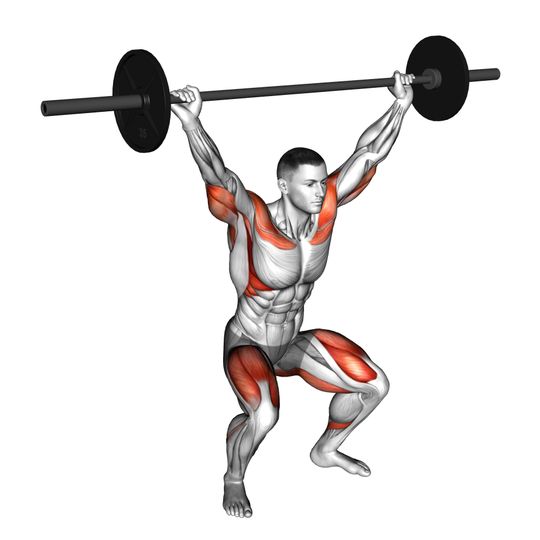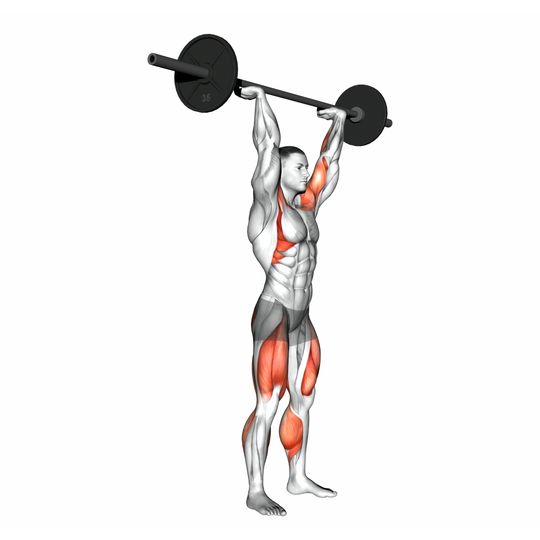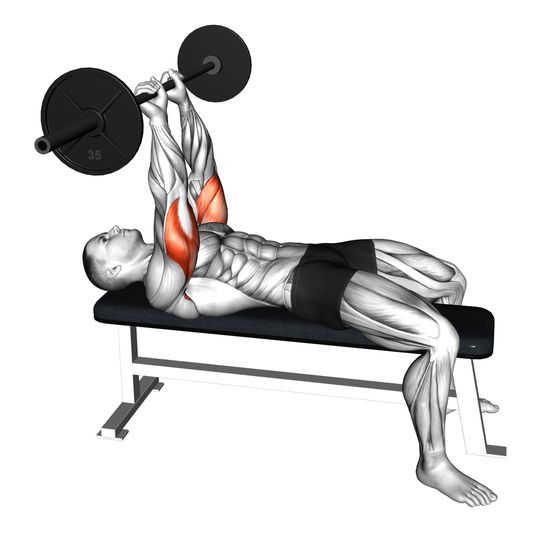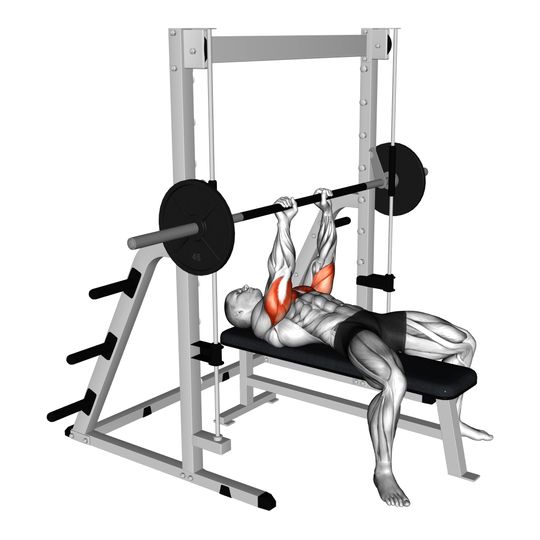


Perform controlled elbow extensions to lower a barbell behind the head and press it back overhead, working the triceps.
How to do the Barbell Triceps Extension#
- Choose to stand with feet hip-width apart or lie flat on a bench, and grasp the barbell with both hands overhead, arms straight.
- Keep your upper arms stationary and hinge only at the elbows as you lower the barbell in a smooth arc toward the back of your head.
- Pause when the forearms approach the rear of the upper arms or a comfortable end range of motion.
- Contract the triceps to extend the elbows and return the barbell to the starting position with arms straight.
- Control the movement on both lowering and lifting and avoid swinging the bar with your shoulders or torso.
Muscles worked#
The barbell triceps extension is a long head exercise. With the arms raised overhead and the bar lowered behind the head, the long head of the triceps brachii, which attaches to the shoulder blade, is put on full stretch before it has to contract. That stretched position is where the long head is trained hardest, and it is the reason overhead extensions are the best movement for the mass at the back of the upper arm.
The lateral and medial heads work alongside it to straighten the elbow, so the whole triceps is involved even though the emphasis shifts. The front delts and upper traps hold the arms overhead throughout the set, which is why the shoulders feel it on long sets. The forearms grip the bar and the abs brace to stop the lower back arching when the weight is behind the head, particularly when standing.
- Primary: Triceps (Triceps Brachii)
Common mistakes#
- Allowing the elbows to flare outward during the movement.
- Using shoulder or torso momentum instead of elbow extension.
- Letting the upper arms move forward or backward instead of staying fixed.
- Arching the lower back excessively when standing.
Why it works#
Pushdowns and close grip presses train the triceps with the arm by the side, where the long head is slack and does relatively little. Raising the arm overhead puts the long head on stretch, and training a muscle in its lengthened position is one of the more reliable ways to make it grow. If the back of your arms lags, this is the exercise that fixes it.
The barbell version is also easy to load and progress. Unlike a single dumbbell, where the jump between sizes gets large and the grip becomes awkward, a bar can be increased in small increments and held with both hands comfortably. An EZ bar does the same job with a more forgiving wrist angle for lifters who find a straight bar uncomfortable.
Sets, reps and setup#
Three to four sets of 10-15 reps with 60-90 seconds of rest, once or twice a week. The long head responds to the stretch, so use a load that lets you lower the bar fully behind the head under control rather than one that stops the range short.
- Setup
- Sit on a bench with back support or stand with a soft knee and the ribs pulled down. Press the bar overhead with a shoulder width grip, then lower it behind the head by bending only the elbows until the forearms touch or nearly touch the upper arms. Drive the bar back up to a full lockout without letting the elbows flare wide or the upper arms drift forward.
- Progression
- Add 2.5 kg when you can hit 15 reps with a full stretch on all sets, then drop back to 10. If the elbows start flaring or the lower back arches to help, hold the weight and slow the lowering phase to three seconds. Elbow discomfort is the signal to swap to an EZ bar or reduce the range for a few weeks.
Variations#
- Barbell Skullcrusher Lying on a bench with the bar lowered to the forehead, less shoulder involvement and heavier loads.
- Dumbbell Triceps Extension A single dumbbell held in both hands, more comfortable for the wrists but harder to progress in small steps.
- Cable Triceps Extension Constant tension from a cable that stays loaded even at the bottom of the stretch.
- JM Press A hybrid of a close grip press and a skullcrusher that allows much heavier loading.
- Close Grip Bench Press The compound triceps builder, with the chest and shoulders sharing the work.
Barbell triceps extension vs skullcrusher#
The skullcrusher is performed lying down, with the upper arms roughly vertical and the bar lowered toward the forehead. That position is stable, lets you use more weight, and takes the shoulders and lower back out of it. The trade-off is less long head stretch, because the arms are not fully overhead.
The overhead extension puts the arm at or past vertical and lowers the bar behind the head, which loads the long head in its longest position. It is the better exercise for filling out the back of the arm and the worse one for moving heavy weight. Run the skullcrusher when you want load and the overhead extension when you want stretch; many programs include both.
Common questions#
What muscles does the barbell triceps extension work?
All three heads of the triceps, with the long head taking the most work because the overhead position puts it on stretch. The front delts and upper traps hold the arms overhead, the forearms grip the bar, and the abs brace to keep the lower back from arching.
Is the overhead triceps extension better than pushdowns?
For the long head, yes. Pushdowns train the triceps with the arm by the side where the long head is slack; the overhead extension stretches it. Pushdowns are easier on the shoulders and better for the lateral head, so the two complement each other rather than compete.
Should I do barbell triceps extensions seated or standing?
Seated with back support is stricter and protects the lower back, which is the main thing that suffers when the weight is behind the head. Standing works if you keep a soft knee and the ribs down, but it is easier to arch and use momentum. Most lifters should sit.
How far should I lower the bar behind my head?
Until the forearms touch or nearly touch the upper arms, as long as the shoulders and elbows are comfortable. That full stretch is where the long head is trained, so cutting the range short defeats the purpose. Lower under control over two seconds rather than dropping into the bottom.
Why do my elbows hurt during overhead triceps extensions?
The long lever and deep stretch put more stress on the elbow tendons than most triceps exercises. Warm up with two light sets, keep the elbows from flaring, avoid full lockout if it is painful, and switch to an EZ bar or a cable for a few weeks. If pain persists, reduce the range and frequency rather than pushing through.