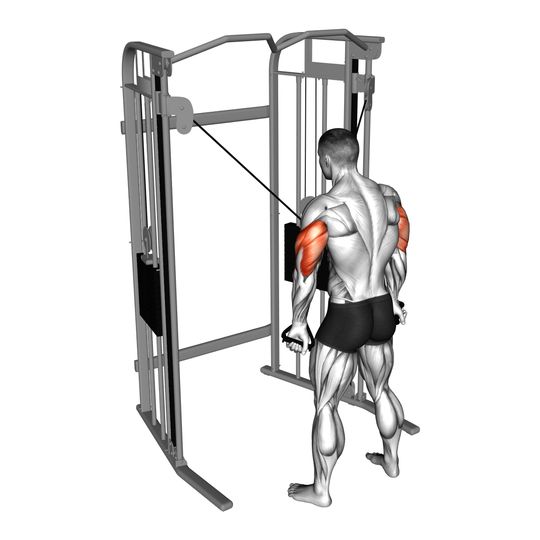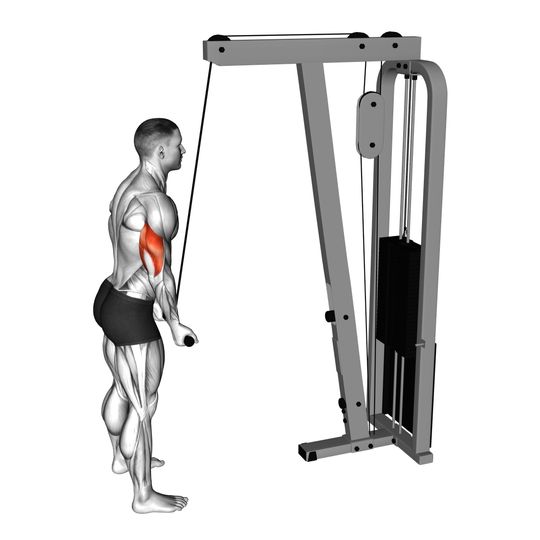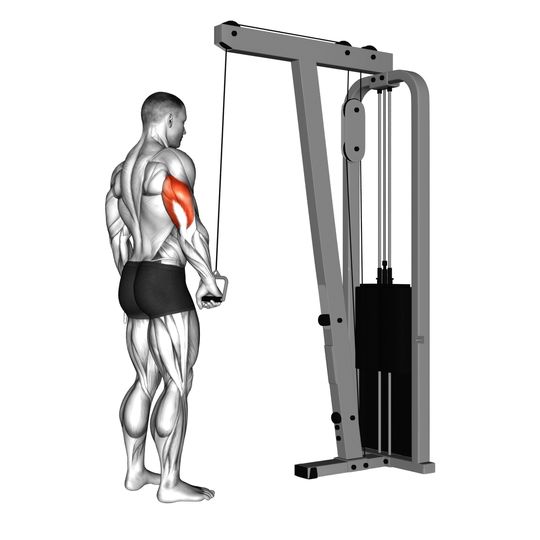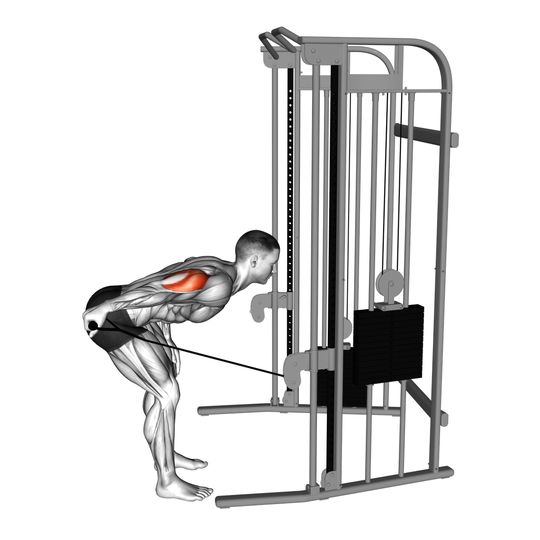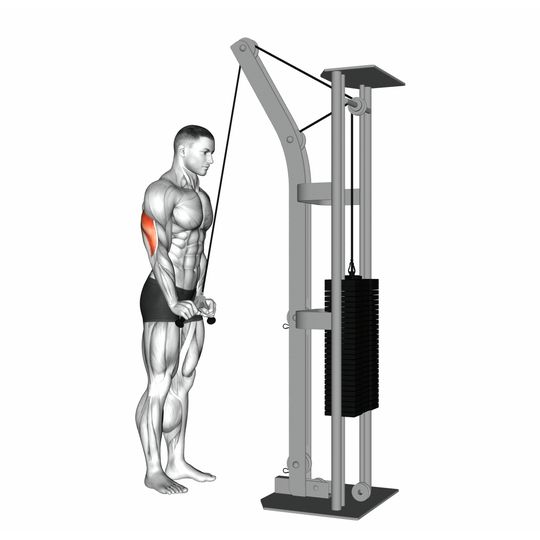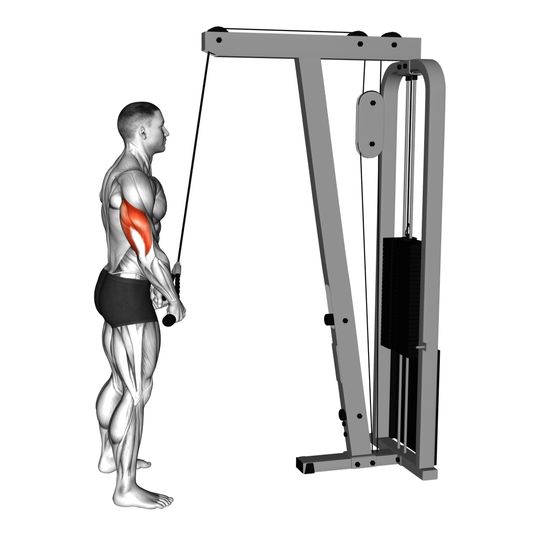


A cable elbow-extension performed with a straight bar that loads the triceps by driving the forearms downward. The movement emphasizes the triceps through controlled elbow extension.
How to do the Straight Bar Triceps Pushdown#
- Set the pulley to about chest height and attach the straight bar.
- Stand facing the machine and grip the bar with a narrow overhand grip, keeping your elbows pinned to your sides.
- Hold an upright torso and maintain a firm core while your upper arms stay stationary.
- Extend your forearms down by straightening the elbows until your arms are fully extended and the triceps contract.
- Return the bar under control to the starting position, keeping the elbows fixed at your sides.
Muscles worked#
The straight bar triceps pushdown works all three heads of the triceps brachii, with the emphasis on the lateral and medial heads. Because the upper arm stays by the side, the long head, which also crosses the shoulder, is not put on stretch and contributes less than it would in an overhead extension. The lateral head, the one that forms the visible outer sweep of the arm, is loaded hardest as you approach full extension.
The pronated grip on a straight bar keeps the wrists slightly extended and the forearms working to hold that position, so the wrist extensors get a share of the load. The anconeus, a small muscle at the back of the elbow, assists in the final degrees of lockout. The lats and abs contract to pin the elbows to the ribs and stop the torso from folding forward to push the bar down.
- Primary: Triceps (Triceps Brachii)
Common mistakes#
- Leaning the torso or using body momentum to push the weight down.
- Allowing the elbows to drift away from the sides.
- Bending or flexing the wrists during the movement.
- Stopping short of full elbow extension so the triceps never fully contract.
Why it works#
The straight bar is the pushdown for loading. The bar cannot rotate or spread, so both arms work in a fixed position, the movement is easy to repeat identically from set to set, and progress is straightforward to track by pin. Lifters who want their triceps work to follow a linear progression get more out of the straight bar than the rope, where the freedom of the hands makes each set slightly different.
A pushdown is also the most joint-friendly way to train the triceps hard. The cable keeps tension on the muscle through the whole range without the elbow stress of a skull crusher, there is nothing to balance, and recovery is quick. It fits at the end of any push or arm session and can be run twice a week without complaint from the elbows.
Sets, reps and setup#
Three to four sets of 8-12 reps with 60-90 seconds of rest, twice a week after pressing. The straight bar tolerates heavier loads than the rope, so this is where to place your lower-rep triceps work. Pause for a second at lockout on every rep.
- Setup
- Set the pulley high and grip the bar with the hands about shoulder width apart, palms down. Step back so the cable runs at a slight angle, lean forward a few degrees, and pin the elbows to the ribs with the forearms parallel to the floor. Extend until the arms are straight and the bar touches the thighs, then return only until the forearms reach parallel.
- Progression
- Add a plate when you hit 12 reps with a full lockout on every set. If the elbows drift forward on the way up or the shoulders round to push down, the load is too heavy. When you stall, add a two-second pause at the bottom for a few weeks rather than reaching for the next pin.
Variations#
- Triceps Rope Pushdown Free hands that can spread at the bottom for a fuller contraction and easier wrists.
- V Bar Triceps Pushdown Angled grips that reduce wrist strain while keeping the stability of a fixed bar.
- Reverse Grip Triceps Pushdown Palms up on the same bar, a lighter variation that shifts sensation toward the medial head.
- Cable Single Arm Triceps Pushdown One arm at a time to balance strength between sides and reach a full lockout.
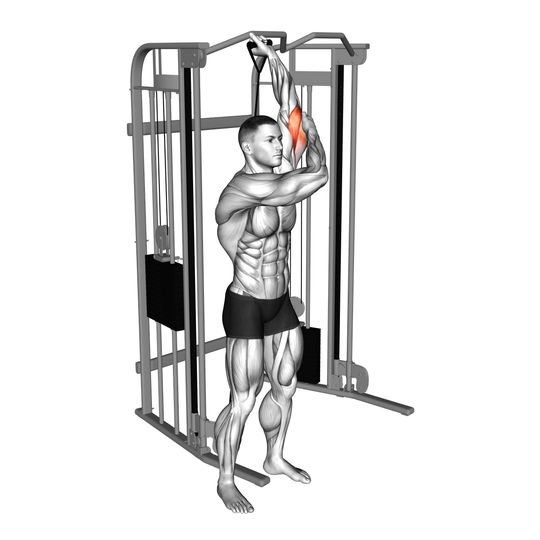
- Cable Triceps Extension Overhead with the arms raised, which stretches and loads the long head instead.
Straight bar vs rope triceps pushdown#
The straight bar fixes the hands in a pronated grip. That stability lets you push heavier weight with a consistent path, which makes it the better choice for progressive overload. Its weakness is the wrist: some lifters cannot fully extend without the wrists bending, and heavy sets can irritate the elbows or forearms over time.
The rope lets the hands separate at the bottom so the elbow can lock out completely, and it is usually more comfortable on the joints. It gives a stronger squeeze at the cost of a bit less load. A sensible approach is the straight bar for heavier sets of 8-10 and the rope for higher-rep finishing work, or alternating between them across training blocks.
Common questions#
What muscles does the straight bar triceps pushdown work?
All three heads of the triceps, with the lateral and medial heads doing the most because the upper arm stays by the side. The wrist extensors hold the pronated grip, the anconeus assists at lockout, and the lats and abs keep the elbows and torso still.
Rope vs straight bar tricep pushdown: which is better?
The straight bar is better for lifting heavier and progressing load, the rope is better for a full contraction and comfortable wrists. Most lifters benefit from using both, the bar for lower-rep sets and the rope for higher-rep finishers.
How wide should my grip be on a straight bar pushdown?
About shoulder width, so the forearms stay roughly vertical at the bottom. A narrower grip slightly increases the lateral head involvement but stresses the wrists; a wider grip is more comfortable but lets the elbows flare. Shoulder width is the sensible default.
Should I lean forward during a triceps pushdown?
A small lean of five to ten degrees from the hips is fine and helps the cable clear the body. A large lean that changes as the set goes on is the torso helping push the bar down, which takes work from the triceps. Set the lean before the set and keep it fixed.
How much weight should I use on a straight bar pushdown?
Enough that 8-12 reps with a full lockout is difficult, which for most lifters is 20-45 kg on a standard stack. The elbows should not move forward at the top and the bar should touch the thighs at the bottom on every rep. If either fails, drop a plate.