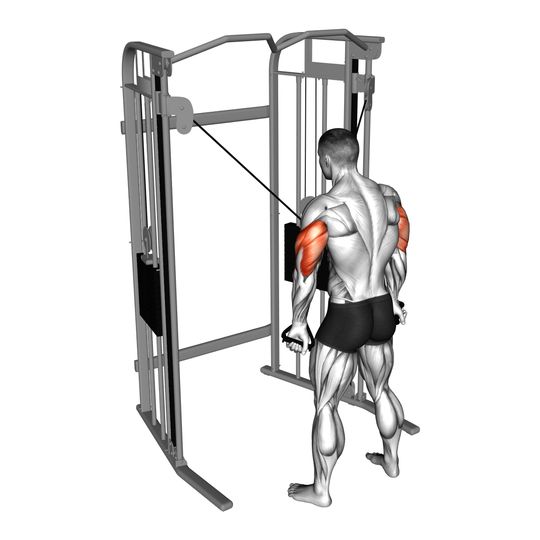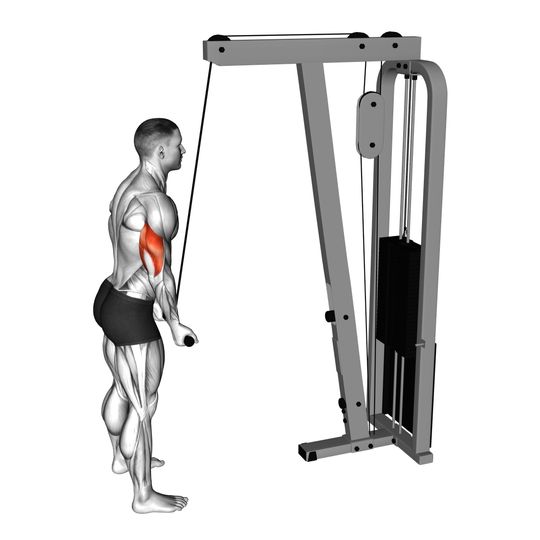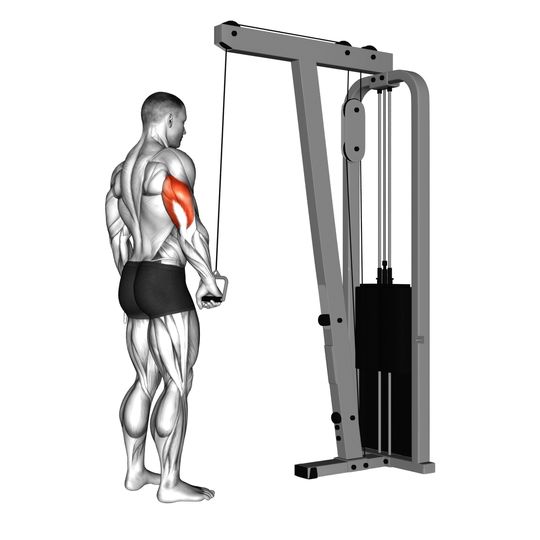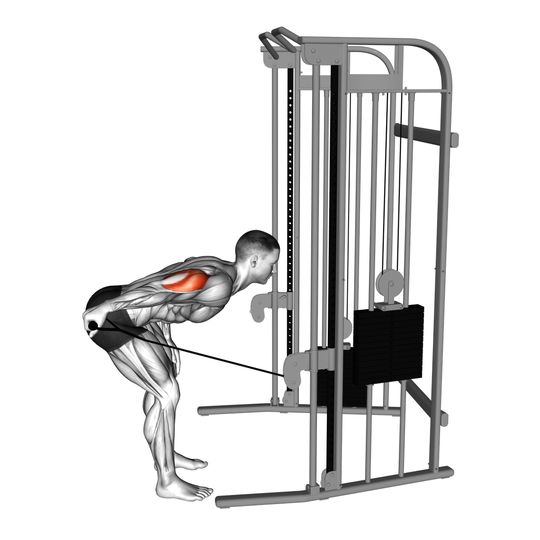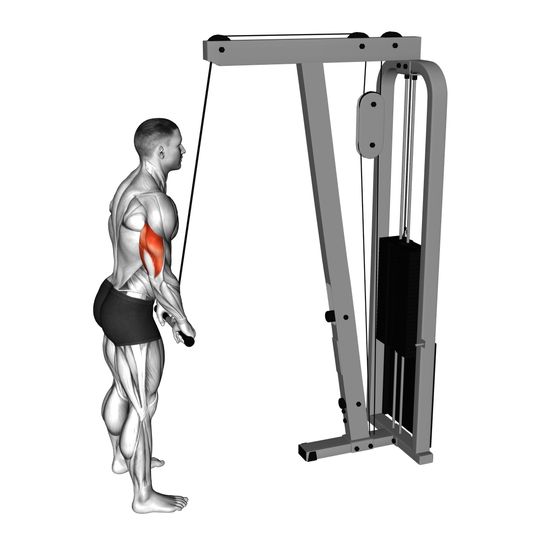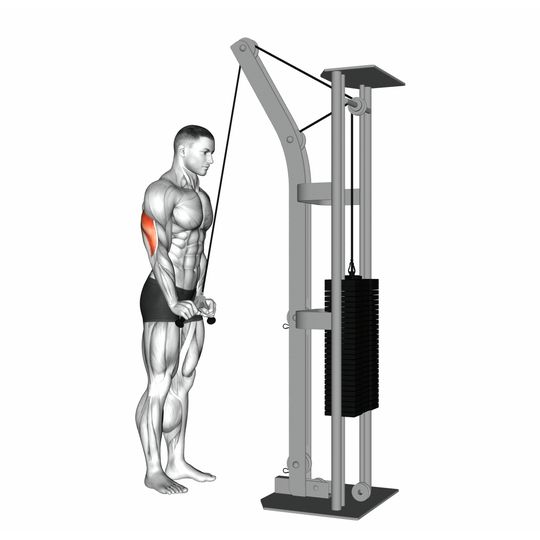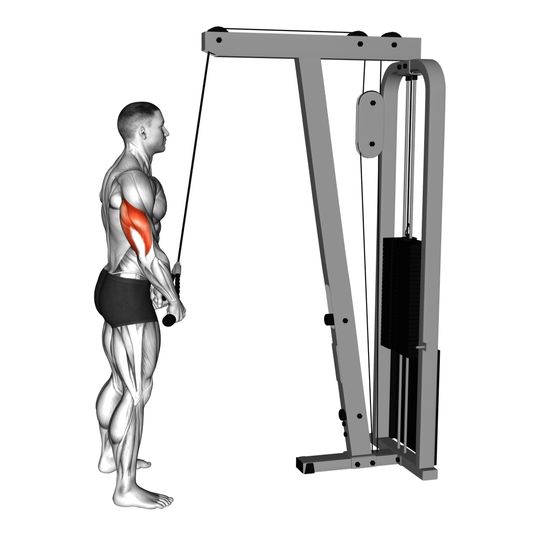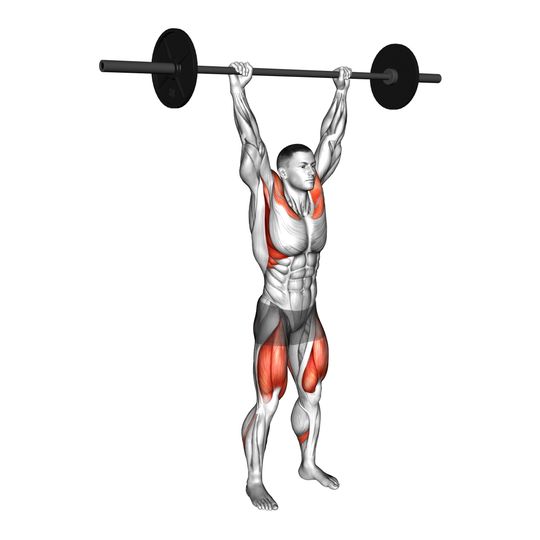


An overhead cable triceps extension that isolates the triceps by extending the elbows while the upper arms stay steady.
How to do the Cable Triceps Extension#
- Secure a rope to the low pulley and grasp it with both hands in a neutral grip.
- Step forward and lift your hands so your forearms point upward and your elbows sit close to your temples.
- Keep your upper arms stationary and bend only at the elbows to lower the rope toward the back of your neck until you feel a triceps stretch.
- Straighten the elbows by contracting the triceps to return your forearms to the starting vertical position.
- Perform each rep with control and avoid using momentum or moving your torso.
Muscles worked#
The overhead cable triceps extension trains all three heads of the triceps, but it is the long head that makes it worth doing. The long head crosses the shoulder joint, so it is only fully stretched when the arm is overhead; pushdowns and kickbacks, with the arm by the side, never load it in that position. Extending the elbow from behind the head takes the long head from its longest length to a hard contraction, which is the range that builds it.
The lateral and medial heads work on every rep, as they do on any elbow extension. The shoulders, upper back and core hold the upper arms still and keep the ribs from flaring as the cable pulls back. Expect the burn along the back of the upper arm, deepest near the shoulder, and a stretch behind the arm at the bottom of each rep.
- Primary: Triceps (Triceps Brachii)
Common mistakes#
- Letting the elbows flare outward during the movement.
- Using body lean or momentum to push the weight up.
- Allowing the upper arms to move instead of isolating elbow motion.
- Choosing too much weight and losing the full stretch at the bottom.
Why it works#
It is the best-tolerated way to train the triceps in the stretched position. Skullcrushers and dumbbell overhead extensions do the same job, but the cable keeps tension constant through the whole rep, there is no weight hovering over your face, and the resistance angle can be tuned by stepping closer to or further from the stack. Lifters whose elbows complain on skullcrushers usually manage this fine.
Training the long head matters for more than looks. It is the largest of the three heads, so it drives most of the size on the back of the arm, and it assists the lats in pulling the arm down and back. Pair this extension with a pushdown and you have the whole muscle covered in two exercises.
Sets, reps and setup#
Three sets of 10-15 reps, once or twice a week, after pressing or alongside pushdowns on an arm day. Keep the loads moderate; the elbow is at its most vulnerable with the arm overhead, and heavy sets of five belong on the close-grip bench, not here.
- Setup
- Set the cable at a low or mid position with a rope or straight bar, face away from the stack and step forward into a split stance until the cable is taut behind your head. Elbows point forward and up, upper arms near the ears. Extend the arms until they are straight, squeeze, then let the hands travel back behind the head over two to three seconds until you feel a full stretch in the triceps. The elbows should not flare out or drift forward.
- Progression
- Add weight when every rep of every set reaches a full stretch at the bottom and a straight lockout at the top. When the stack starts pulling you off balance, brace against a bench or use a high cable position facing the stack and extend forward instead. A two-second pause in the stretched position on a lighter load is often more productive than another plate.
Variations#
- Triceps Rope Pushdown The arm-by-the-side partner that trains the lateral and medial heads in the shortened range.
- Triceps Pushdown (Cable - Straight Bar) A pushdown with a rigid bar, easier to load heavy and a good pair with the overhead extension.
- Triceps Extension (Dumbbell) The same overhead stretch with a dumbbell, with tension that falls off at the top instead of staying constant.
- Cross Body Triceps Extension (Cable) One arm at a time across the body, useful for fixing a weaker side.
- Skullcrusher (Barbell) The lying free-weight extension that loads the long head heavily, at the cost of more elbow stress.
Overhead cable extension vs triceps pushdown#
Both are cable exercises for the triceps and both are worth doing, because they train different parts of the range. The pushdown, with the arm by the side, keeps the long head slack at the shoulder and works the lateral and medial heads in the shortened range. The overhead extension stretches the long head fully and loads it where it grows most.
If you only do one, the overhead extension builds more total triceps size, and research comparing the two supports that. The pushdown is easier to load heavy, kinder to sore elbows and quicker to set up. Most lifters do best with one of each per week rather than choosing.
Common questions#
What muscles does the cable triceps extension work?
All three heads of the triceps, with the long head doing the most because the overhead arm position stretches it fully. The shoulders and core hold the arms in place but do not contribute to the movement.
What is the difference between a triceps extension and a pushdown?
Arm position. In an extension the upper arm points overhead or forward and the elbow straightens from behind the head; in a pushdown the upper arm stays by the side and the hand pushes down. Extensions stretch the long head, pushdowns do not, which is why they feel so different despite both being elbow extensions.
Rope or bar for overhead extensions?
The rope lets the hands separate at lockout and is easier on the wrists, so it is the default. A straight bar allows a little more load. Either works; pick the one that lets you reach a full stretch without the elbows flaring.
Why do I feel this in my shoulders?
Because the arms are drifting forward or the ribs are flaring as the cable pulls back. Brace the core, keep the elbows pointing forward rather than out, and use a load you can control in the stretched position. Stepping a little further from the stack also changes the angle so less of the pull lands on the shoulders.
How many sets of overhead extensions should I do?
Three sets of 10-15 reps once or twice a week is plenty, on top of your pressing. Combined with a pushdown for the other two heads, that is a complete triceps program for most lifters.